Blog · Front Lever · 7 min read
Front lever hips sagging: why it happens and how to fix it
A sag is your body shortening a lever it cannot hold yet. Film it from the side, find the cause, then train shorter holds that stay flat.
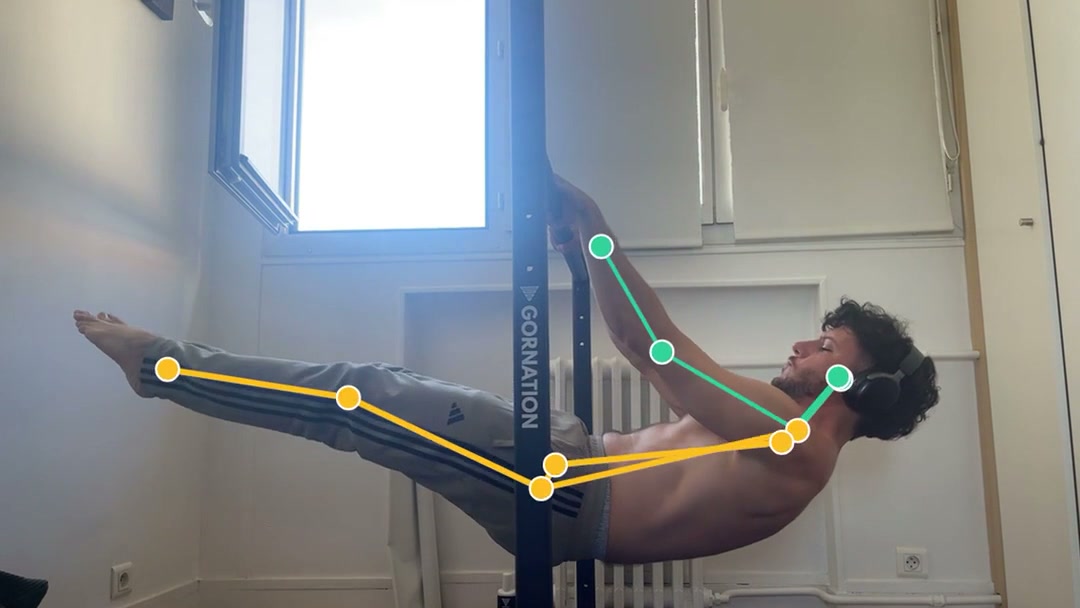
Your hips sag in the front lever because your lats can no longer hold the full length of the lever, so your body folds at the hips to shorten it. The usual reasons are a variation that is too hard, fatigue late in the hold, or a pelvis and glutes that do not lock the line.
On straight-leg levers, this is the fault to check first. Across the one leg, straddle and full front lever scans analyzed by CaliLens, more than two thirds showed sagging hips, and it was the most common main fault on those scans. It is also a common complaint on r/bodyweightfitness: in one thread, an athlete holding a full lever for about 6 seconds found the hips were the first thing to break. A reply advised scaling back to an easier progression and flattening the back, and the poster came back agreeing the full lever was too hard for them at that point.
What does hip sag look like in a front lever?
Hip sag means your hips sit below the straight line that runs from your shoulders to your ankles. From the side, the body looks like a shallow hammock: shoulders and feet high, hips hanging toward the floor. Because you face the ceiling in a front lever, a sagging hip is a small fold at the front of the hips, which is why many people describe the same fault as a front lever pike.
Three other faults look similar on a quick glance. Telling them apart matters, because each one has a different fix.
| What you see from the side | Fault | What it usually means |
|---|---|---|
| Hips below the shoulder-to-ankle line | Hip sag | The pull is maxed out and the body shortens the lever |
| Hips pushed above that line, lower back arched | Hiked hips | The lower back takes over from the lats, often with ribs flared and shoulders pinched back |
| Straight line, whole body tilted down toward the feet | Low lever | Pulling strength is not yet level with this variation |
| Straight line, whole body tilted up toward the feet | High lever | The hold is easier than the variation it claims to be |
Why do my hips drop in the front lever?
Your hips drop when the load on your shoulders exceeds what your pulling muscles can hold at that body length. Five causes come up again and again, and they often stack.
- Your lats and shoulder depression let go. A front lever is held by pressing straight arms down toward your hips while keeping the shoulders pulled away from your ears. It behaves more like a horizontal row than a pull-up. When those muscles fade, the body shortens the lever by folding at the hips.
- The variation is too hard. Each step from advanced tuck to one leg, straddle and full moves your legs farther from the bar. If you can only hold it with the hips down, the seconds you log belong to an easier shape.
- Your pelvis tips the wrong way. With the pelvis tipped forward (anterior tilt), the lower back arches and the hips lose their anchor. A slight backward tilt (posterior tilt) locks them to the trunk, and squeezing the glutes and the abs together, as in a hollow body hold, is the usual way to get there. Overdoing it and curling hard can also fold you at the hips, so aim for a flat back, not a rounded one.
- Your trunk is not locked. The abs and glutes fix the pelvis to the ribs so the body moves as one piece, and when they relax, the weight of the legs closes the hip angle. Squeezing them helps, but weak glutes alone rarely explain a sag: in the Reddit thread above, the poster blamed their glutes, and a reply pointed to the abs, the lats and pecs, or the shoulder blade muscles instead.
- You are past fatigue. Many holds start flat and sag in the last two or three seconds. Those seconds still count as practice, so they teach the sag.
How do I check my hip position on video?
Film from the side, because a sag is almost invisible from the front or from below. A phone and two minutes are enough.
- Set the phone level, at about the height your hips will be during the hold, 3 to 4 meters (10 to 13 feet) from the bar. Use landscape so the bar, your hands and your feet all stay in frame.
- Film one full hold, from the moment you are still until you come down.
- Pause at the first second, the middle and the last second. On each frame, picture a straight line from the shoulder joint to the ankle bone.
- Find the hip joint, the bony point on the side of your hip. On the line: clean. Clearly below it: sag. Above it: hiked hips.
- Count only the seconds where the hips stay on the line. That is your real hold time.
How is hip sag measured from a video?
CaliLens draws the same shoulder-to-ankle line on every frame and measures how far below it your hips sit, as a share of your shoulder-to-ankle length. On a full front lever it starts flagging a sag at about 5 percent of that length, only a few centimeters on most adults, and rates it as severe around 20 percent. One leg and straddle get a little more room, with flagging starting around 10 and 12 percent. The first and last moments of the hold are left out, and a dip that lasts an instant is ignored: the sag has to persist through a real part of the hold to count. Tuck and advanced tuck are not judged on this at all, since folded legs leave no straight shoulder-to-ankle line.
How do I fix sagging hips in the front lever?
Fix the pull first, then the line. In practice that means holding an easier variation flat, building rowing strength, and rehearsing the full-length shape with raises and negatives.
- Cue
- Drive the bar down toward your hips, then squeeze glutes and abs so the hips ride up into line.
- Why
- Low hips usually mean the lats stopped pulling. The front lever is a back move, so the lasting fix is straight-arm pulling strength, with the core holding the line in place.
- Drill
- Weighted inverted rows, 3 x 8, pulling the elbows toward your hips.
Rows earn their place for a measurable reason: in an electromyography study of 16 men, an isometric inverted row activated the inner part of the latissimus dorsi more than a body-lifting shoulder depression exercise or a trunk extension (Park and colleagues, 2015).
For the holds themselves, Steven Low, author of Overcoming Gravity, programs isometric sets at about 60 to 70 percent of your max hold. If your best flat hold is 10 seconds, sets of 6 to 7 seconds leave room to finish every one of them with the hips up. A typical week, two or three sessions, looks like this:
| Drill | Dose | What to watch |
|---|---|---|
| Flat holds, one variation easier than your goal | 5 to 6 sets at 60 to 70 percent of your flat max | End the set at the first hip drop |
| Weighted inverted rows | 3 x 8 | Body stays one plank, elbows toward the hips |
| Front lever raises | 3 x 5 | From an inverted hang, lower to horizontal and back up with straight arms |
| Front lever negatives | 3 x 3, 5 seconds each | Lower slowly enough to pass horizontal with a flat line |
| Hollow body hold | 3 x 20 seconds | Ribs down, pelvis tucked, lower back pressed to the floor |
Raises and negatives let you practice the full-length shape at a strength level you cannot hold yet, which is exactly where the sag appears. Do them in the variation you are working toward, or one step easier if your hips drop halfway. If straight-arm work hurts your elbows or shoulders, stop the painful variation and see a physiotherapist if the pain persists.
When can I move on to the next variation?
Move on when you can hold the current variation for 3 sets of 8 seconds with the hips on the line in every set, checked on video. Eight clean seconds is the bar used across this blog for static skills, and it is a stricter test than your longest hold with a sag.
Read your video honestly. If the sag only shows in the last second or two, you are close: keep the variation and trim the holds. If it shows from the first second, go back one step and rebuild. The tuck to advanced tuck guide covers the early part of the progression, where most athletes first meet a longer lever, and when to progress in calisthenics explains the same rule for every skill.
Frequently asked
Is the front lever a core exercise or a back exercise?
Mostly a back exercise. The lats press your straight arms toward your hips and hold the body up, while the abs and glutes keep the line rigid. A strong core with a weak straight-arm pull still ends in sagging hips.
Should I squeeze my glutes in a front lever?
Yes. Squeezing the glutes together with the abs tilts the pelvis slightly backward and locks the hips to the trunk. It is a finishing cue rather than the cure, since weak glutes alone rarely cause a sag. If squeezing makes you curl or fold at the hips, ease off until the line is straight.
Why do my hips drop at the end of my hold?
Fatigue. The lats fade first and the body folds at the hips to shorten the lever. End each set at the first drop and count only the flat seconds, even if that makes your holds shorter for a few weeks.
Is it okay to let my hips pike to hold the front lever longer?
It buys seconds, but they belong to an easier shape. A folded lever is shorter, so the strength you build does not carry over to a flat one. Regress one variation and hold that one flat instead.
Do resistance bands help with hip sag?
They can. A light band under the hips or feet takes off enough load to let you practice a flat line at full length. Use the thinnest band that keeps you flat, and pair it with unassisted holds of an easier variation.