Blog · Progression · 6 min read
When to progress in calisthenics: reps and holds
Move up when the current variation is clean for every set, not when you manage one good rep. Here are the numbers, what clean means, and how to bridge a gap that feels too big.
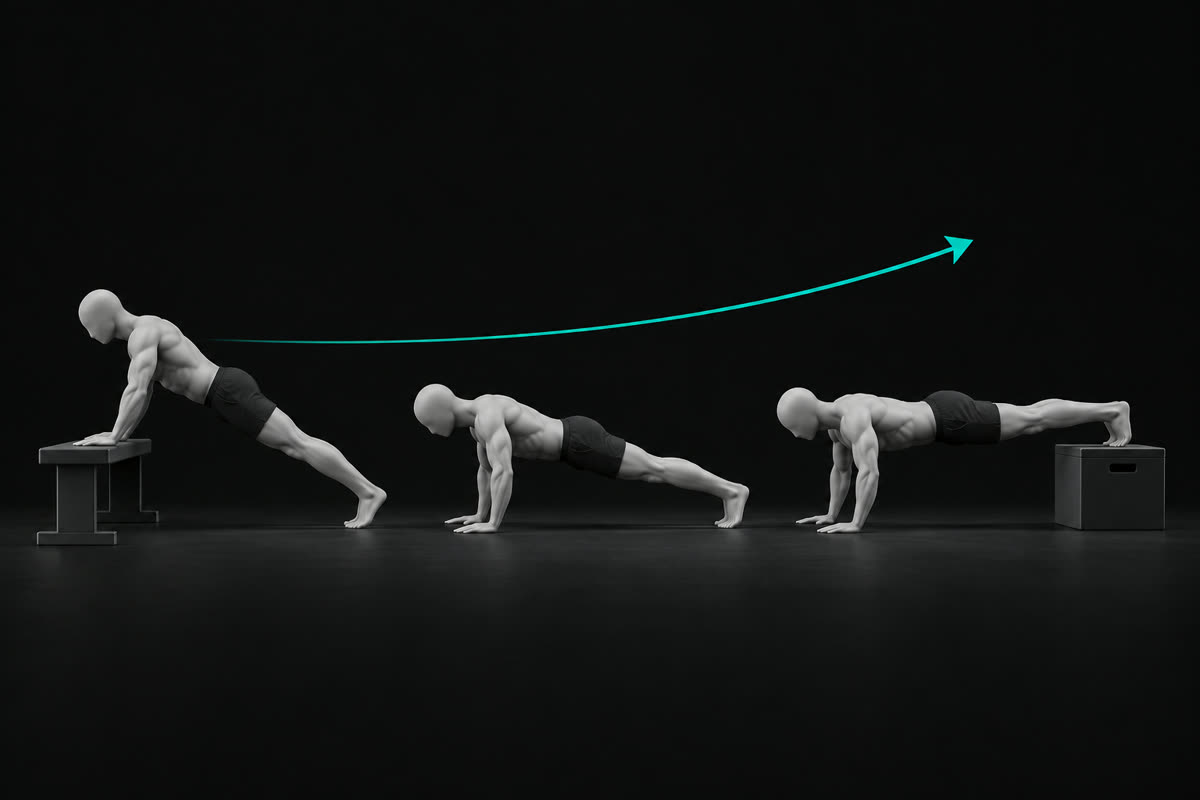
Progress to a harder calisthenics variation when every set of the current one is clean: 3 sets of 8 reps for most strength exercises, more than 20 push-ups or 15 to 20 dips for high-rep basics, and 3 holds of 8 seconds for lever skills. Clean means full range, controlled tempo and no compensation, including on the last rep.
How many reps before a harder variation?
For most dynamic exercises, 3 sets of 8 clean reps is the gate. That is the rule of the r/bodyweightfitness Recommended Routine: work the hardest variation you can do for 3 sets of 5 to 8, and when you hit 3 sets of 8 with good form, move on and restart at 3 sets of 5.
The range fits what strength coaches recommend. Steven Low, author of Overcoming Gravity, puts the useful range at about 5 to 12 reps for strength and muscle, and notes that adding reps beyond a certain point mostly builds endurance. The American College of Sports Medicine position stand uses the same logic with weights: once you can do one or two reps over your target, increase the load by 2 to 10 percent. In bodyweight training, a harder variation is how you add load.
Some basics get a higher bar, because you also use them for volume and the next step is a big jump. In practice, that means more than 20 clean push-ups before a harder push-up variation, and 15 to 20 clean dips before adding weight.
How many seconds should you hold before progressing a static skill?
For lever skills, a clean 8-second hold repeated for 3 sets is the benchmark used on this blog. For a handstand, the gate is a still 10-second hold.
Holds are programmed as a share of your best hold. Steven Low's isometric method trains at about 60 to 70 percent of your max: with a 10-second max tuck front lever, you would do sets of 7-second holds. By that logic, 3 clean holds of 8 seconds mean your max is comfortably above 8 seconds, and the next lever variation is worth testing.
The Recommended Routine asks for more on its static holds, the support hold and even the tuck front lever in its row progression: sets of 10 to 30 seconds, moving on at 3 sets of 30 seconds. If you follow that routine, keep its rule. The 8-second bar used here is a lower gate for testing the next lever, and it only counts if the line stays straight for every second.
What does a clean rep actually mean?
A clean rep uses the full range of the exercise, a controlled tempo and no compensation from the rest of the body. If any of the three changes on the last reps of a set, those reps don't count toward the gate.
- Full range. Chest near the floor and elbows locked on push-ups. Straight arms at the bottom and chin clearly over the bar on pull-ups. Shoulders down to elbow level on dips.
- Controlled tempo. For heavy strength work, the ACSM recommends a moderate speed of about 1 to 2 seconds up and 1 to 2 seconds down. No dropping into the bottom, no bouncing out of it.
- No compensation. No hip sag or pike on push-ups, no kick or swing on pull-ups and muscle-ups, no bent arms on straight-arm skills, no shrugged shoulders.
The gap between counted reps and clean reps is real. Across the push-up scans scored by CaliLens, the median scan counted 8 reps, while the median number of reps that met the strict standard for depth, lockout and body line was 6.
Why progress only when your form holds?
A harder variation magnifies whatever compensation you already have. Moving up with a slight hip sag or a short range turns a small flaw into the main thing you train.
Levers show it clearly. Across the CaliLens scans of one-leg, straddle and full front levers, more than two thirds showed the hips sagging below the shoulder-to-ankle line. If that sounds like you, read why your hips sag in the front lever before you extend the legs further, and why the jump from tuck to advanced tuck stalls if you are earlier in the chain.
When to move to the next progression, exercise by exercise
Use the table as a checklist: meet the criterion on every set, then move to the next step. The ranges are coaching benchmarks.
| Exercise | Type | Move on when | Next step |
|---|---|---|---|
| Push-up | Dynamic | More than 20 clean reps | A harder push-up variation |
| Pull-up | Dynamic | Easy for high reps (a common coaching range: 3 sets of 8 strict reps or more) | Added weight or a harder variation |
| Dips | Dynamic | 15 to 20 clean reps | Added weight |
| Muscle-up | Dynamic | 3 to 5 clean strict reps | Rings or added weight |
| Front lever | Static | A clean 8-second hold, 3 sets | The next lever in the chain: tuck, advanced tuck, one leg, straddle, full |
| Handstand | Static balance | A still 10-second hold | Longer freestanding holds |
For the details of each standard, see how to tell if your push-ups are clean, how deep to go on dips, why a muscle-up tips over one arm and how to fix a banana handstand. Still working on your first rep? Start with why you can't do a pull-up yet.
What if the next variation is too hard?
If you meet the criterion but the next step gives you zero or one rep, bridge the gap instead of waiting. Three tools do most of the work.
The situation is a common complaint on r/bodyweightfitness: 3 sets of 8 on incline rows, then a struggle to reach 3 sets of 5 on horizontal rows. The two options usually weighed, an easier angle or grinding out the harder rows, both have a place, and the tools below combine them.
- Mixed sets. Start each set with 1 to 3 reps of the harder variation, then finish with the easier one up to your usual rep count. Example: 2 archer push-ups, then 6 regular push-ups. Add one hard rep per set when all sets allow it.
- Eccentrics. Lower slowly through the harder version. Steven Low's eccentric guidelines start with 2 to 3 sets of 2 to 3 reps lasting 3 to 5 seconds, then build each rep toward 7 to 10 seconds.
- Isometrics. Hold the hardest position of the new variation: the top of a pull-up, the bottom of a dip, the advanced tuck lever. Use about 60 to 70 percent of your best hold, for several sets (Low's example is 6 sets of 7 seconds).
Keep the old variation in your session for volume until the new one reaches 3 sets of 5. Bands and a higher or lower bar also make the step smaller. If a new variation hurts a joint, stop it and see a physiotherapist if the pain persists.
- Cue
- Judge the last rep of the set, not the first.
- Why
- The first rep of a set is usually your cleanest. Fatigue is what reveals whether depth, lockout and line are really yours.
- Drill
- Film your final set from the side. If the last 2 reps or the last 3 seconds look like the first, count the set. If not, repeat the level next session.
How to test yourself before moving up
Test at the start of a session, rested, and film it. Place the phone side-on: at floor level for push-ups, at hip height for levers and dips, at chest height (side or three-quarter) for pull-ups, with your whole body in frame. Do your normal 3 sets, then compare the first and last rep of each set on video. If all three sets pass on the criterion from the table, move up next session and restart low.
Frequently asked
How many reps should I do before moving to a harder variation?
For most strength exercises, 3 sets of 8 clean reps is a solid gate, the rule used by the r/bodyweightfitness Recommended Routine. Basics you also use for volume get a higher bar: more than 20 clean push-ups, or 15 to 20 clean dips before adding weight.
How long should I hold a static skill before progressing?
For lever-type skills such as the front lever, a clean 8-second hold done for 3 sets is the benchmark used on this blog. For a handstand, aim for a still 10-second hold. The r/bodyweightfitness Recommended Routine is stricter, with 3 sets of 30 seconds for its static holds, including the tuck front lever.
What if I can only do 1 or 2 reps of the next variation?
Mix the two levels. Do your 1 or 2 hard reps first, then finish the set with the easier variation, and add slow eccentrics or holds in the hard position. Add a rep of the harder version when all sets allow it.
Should I keep adding reps instead of progressing?
Only up to a point. Steven Low notes that adding reps beyond a certain point mainly builds endurance, and places the useful range for strength and muscle at about 5 to 12 reps. Past that, a harder variation or added weight is the better stimulus.
Do I have to restart at low reps after progressing?
Yes, and that is expected. The Recommended Routine restarts each new progression at 3 sets of 5 reps, then builds back toward 3 sets of 8.