Blog · Dips · 7 min read
How deep should you go on dips? Depth and shoulder safety
The standard depth for a dip, what the research says about deep dips and your shoulders, and a plan to reach full depth without pain.
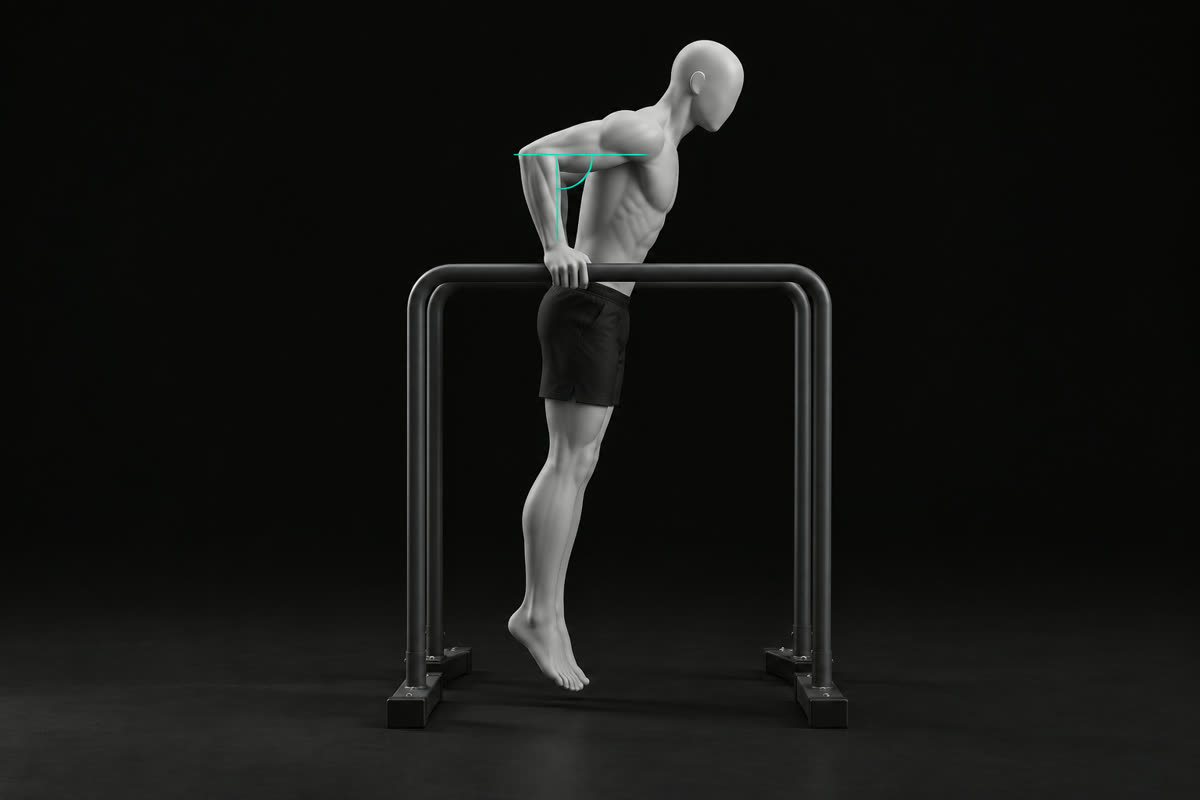
On a dip, lower yourself until your shoulders are level with your elbows or slightly below them, which puts the elbow at roughly 90 degrees or a little deeper. That depth trains the full press. Going much lower is optional and depends on your shoulder mobility, while stopping well above it turns every rep into a half dip.
How deep is a full dip?
In practice, most coaches count a dip as full once your upper arm is parallel to the floor, with your shoulder at the height of your elbow. Stricter coaches ask for a little more: they want you to break parallel, with the shoulders just below the elbows. Neither standard asks you to drop as low as you can for a bigger stretch, and the shoulder research below explains why.
Coaches read the bottom of the rep from where your shoulder sits relative to your elbow, which a side-on video shows clearly:
| Bottom position | How coaches usually read it |
|---|---|
| Shoulders clearly above the elbows | A half rep |
| Shoulders level with the elbows, upper arms parallel to the floor | The usual minimum for a full rep |
| Shoulders slightly below the elbows | The stricter standard some coaches ask for, if you reach it slowly and without pain |
| Shoulders far below the elbows | Not required: the bottom is where the shoulder is most exposed |
Whether you stop level with the elbows or slightly below depends on your shoulder mobility: go to the lower one only if you get there without pain and without rolling the shoulders forward. The elbow angle, roughly 90 degrees at that depth, is a looser guide, because arm length and forward lean change it.
Why do half dips hold back your progress?
Half dips skip the bottom of the press, which is the hardest part of the rep, so your rep count climbs while your strength in that position stays where it was. When you later add weight, or move on to skills that finish in a deep press like the muscle-up, the bottom is where the rep fails.
The research on range of motion points the same way. A 2021 meta-analysis of 16 studies in the Scandinavian Journal of Medicine and Science in Sports found that full range of motion training produced larger strength gains than partial range training. The evidence on upper-body muscle growth is thinner and conflicting, as a 2020 systematic review by Schoenfeld and Grgic points out, so treat full depth as the reliable default for strength rather than a promise of bigger triceps.
Half dips also make progress impossible to measure. If your depth changes from one session to the next, a jump from 10 to 14 reps may only mean you went less deep.
Are deep dips bad for your shoulders?
Deep dips are not dangerous by default. The bottom of the dip is the position that asks the most of the front of the shoulder, though, so your depth should match your mobility and your control, and it should grow gradually.
The clearest data comes from a 2022 motion-capture study by McKenzie and colleagues that compared bench, bar and ring dips in 13 experienced men. Before testing, each man measured how far his own shoulder could extend. On bar dips they used about 88% of that range on average, on bench dips about 101% and on ring dips about 69%. The bench dip, often treated as the easy version, took the shoulder the furthest.
The authors are careful about the injury question. They note that evidence of harm is limited, with only two published case reports of chest muscle (pectoralis major) ruptures caused by bar dips, and that the risk may rise when you add load, train into heavy fatigue or use a wide grip. The regressions they suggest (standing dips with the feet on the floor, machine-assisted dips and band-assisted dips) all reduce the load at the bottom, the position they identify as the most vulnerable.
The question comes up often. In a common complaint on r/bodyweightfitness, a lifter who dropped as low as possible, shoulders down to the level of the bars, started feeling shoulder pain after workouts and asked whether injury risk climbs past a certain depth. The most useful replies were practical: go shallower if you feel strain, and do not buy extra depth by letting the shoulders roll forward. If a dip hurts, stop that variation, and see a physiotherapist if the pain persists.
How do you find your useful depth?
Your useful depth is the lowest point you can reach slowly, without pain, with your shoulders held down, and press out of without bouncing. Find it with a short test, then build toward shoulder-to-elbow depth over a few weeks.
- Supported depth check. Stand between parallel bars or in a dip station with your feet on the floor. Lower yourself slowly as deep as feels comfortable, letting your legs take some of the weight, and hold the bottom for 3 seconds. The range test in the McKenzie study used a similar self-paced descent and 3 second hold.
- Film it. Place your phone side-on at hip height with your whole body in frame. Pause on the lowest frame and compare your shoulder height with your elbow height.
- Read the result. If you reach shoulder-to-elbow depth comfortably with your feet helping, strength is your limit: train assisted reps to full depth. If you cannot get there even with support, or the front of the shoulder pinches, train at the depth you own and extend it a little at a time.
A simple depth progression
Use this as a template (a typical coaching structure, not a fixed rule), two or three sessions a week:
- Weeks 1 and 2: slow negatives, 3 x 5, taking 3 to 5 seconds to lower to your current best depth, then step back up with your feet.
- Weeks 3 and 4: band-assisted dips to full depth, 3 x 8, with a one-second pause at the bottom.
- From week 5: full dips to shoulder-to-elbow depth, 3 sets of as many clean reps as you can, followed by one assisted set.
Go a few centimeters deeper at a time. If a new depth hurts, go back to the last pain-free one for another week.
What does a clean lockout look like on a dip?
At the top of every rep, your arms are fully straight and your body is tall and still before the next descent. Stopping short of straight arms skips the top of the range and leaves the rep unfinished.
Camera test. Pause on the highest frame of each rep: shoulder, elbow and wrist should line up vertically.
- Cue
- Press to straight, locked arms.
- Why
- A full lockout on every rep trains the whole press and keeps your count honest.
- Drill
- Support hold on the bars, 3 x 15 s with arms locked, then dips 3 x 6 with a one-second pause at the top.
Why do your shoulders shrug up to your ears?
Your shoulders ride up when the muscles that hold the shoulder blades down tire or switch off, and the upper traps take over the top of the press. At lockout it looks like a short neck, with the ears sinking toward the shoulders.
Fatigue makes it more likely. In a 2022 study of 15 men doing bar dips to failure, the peak joint angles did not change as the set went on, but the top position did, and the dips lost height. The authors suggest, without having measured it, that the shoulder blades were no longer held down as well. The usual coaching cue follows from that: keep your shoulders back and down, and do not shrug them.
Camera test. Compare the gap between your ear and your shoulder at the top of the first rep and of the last rep. If it has shrunk, you are shrugging.
- Cue
- Push your shoulders down, away from your ears.
- Why
- Packed shoulders keep the lockout on the chest and triceps instead of the traps.
- Drill
- Scapular dips on the bars (arms straight, shoulders sink and then push down), 3 x 8, then a packed support hold, 3 x 20 s.
Should your legs swing during dips?
No. Your lower body stays quiet while your arms do the pressing. Bending the knees and crossing the feet to clear the floor is fine. The fault is throwing the knees or hips forward to bounce out of the bottom, which borrows momentum and hides how strong your press really is.
Camera test. Watch the angle between your torso and your thighs through each rep. A small, steady bend is normal. If your knees kick forward as you leave the bottom, rep after rep, you are kipping. It usually starts in the last reps of a set.
- Cue
- Keep your lower body quiet and press with your arms.
- Why
- A still lower body makes every rep an honest measure of your strength.
- Drill
- Tempo dips, 3 x 5, 3 seconds down, feet held still for the whole set.
When should you add weight to dips?
Add weight once you can do 15 to 20 clean reps: full depth, full lockout, shoulders down and legs quiet. Past that point, extra reps mostly build endurance, so a dip belt or a loaded backpack is the better next step. Start with a light load, a few kilograms, and rebuild to sets of 5 to 8 clean reps.
Count reps the way you would for clean push-ups: a rep that stops short, shrugs or swings does not count. The same move-on logic applies to every calisthenics progression.
Frequently asked
Should you go below 90 degrees on dips?
Slightly, if your shoulders allow it. Shoulders level with the elbows, roughly 90 degrees at the elbow, is the usual coaching minimum for a full rep, and stricter coaches ask for the shoulders just below the elbows. Go lower only if it is pain-free and you can control the bottom without bouncing.
Are dips bad for your shoulders?
Not by default. Motion-capture research shows the bottom of a bar dip uses most of a trained lifter's shoulder extension range, so depth, added load and fatigue deserve respect. Build depth gradually, stop any variation that hurts, and see a physiotherapist if the pain persists.
How many dips should you do before adding weight?
Add weight once you can do 15 to 20 clean reps with full depth, full lockout, shoulders down and quiet legs. Start with a light load and rebuild to sets of 5 to 8 clean reps.
Are bench dips easier on the shoulders than bar dips?
Not necessarily. In a 2022 motion-capture study of experienced men, bench dips used slightly more than the lifters' own maximum shoulder extension range, more than bar or ring dips. They are lighter, but they take the shoulder further back.
Why do my shoulders shrug up during dips?
Usually because the muscles that hold your shoulder blades down are tired or switched off, so the upper traps finish the press. Cue pushing your shoulders away from your ears at the top, and train scapular dips and packed support holds.