Blog · Push-up · 7 min read
Proper push-up form: how to know if your reps are clean
Six checks you can run with your phone on the floor, with what each fault looks like, why it matters and the drill that fixes it.
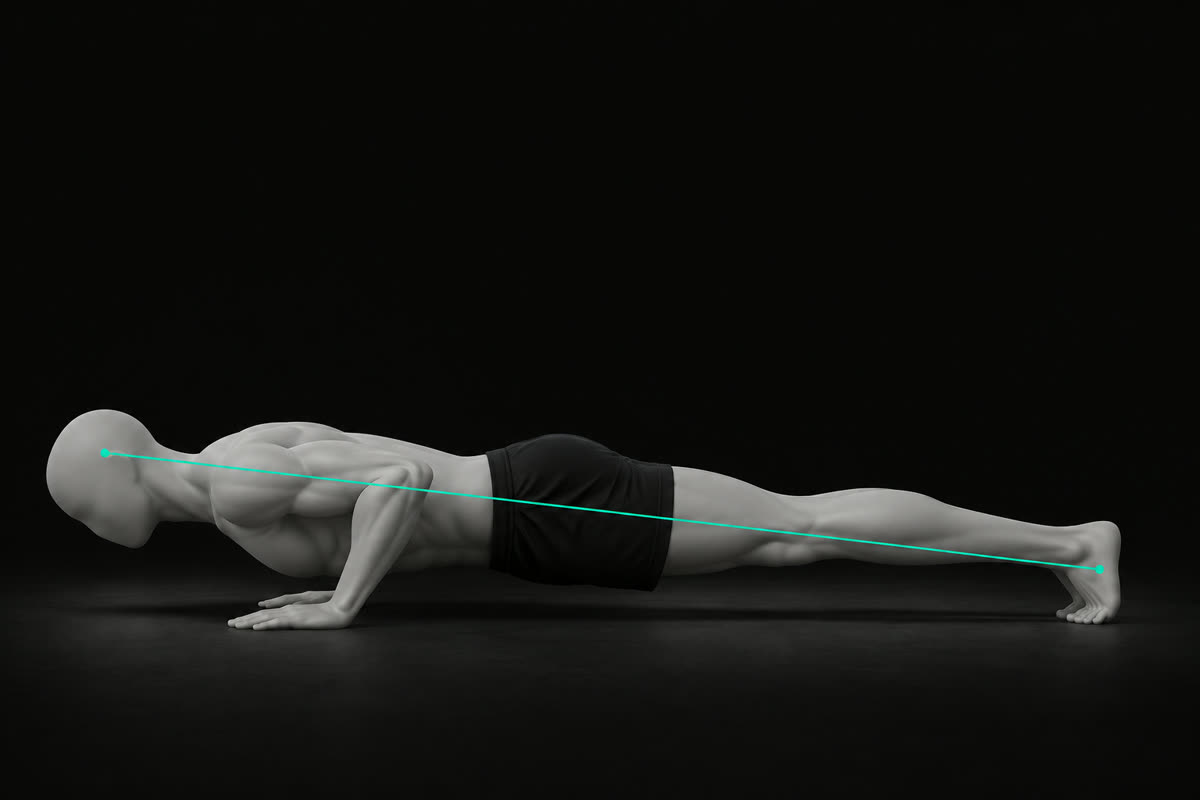
Your push-ups are clean when every rep passes six checks: hips that neither sag nor pike, elbows bent to about 90 degrees or deeper, arms locked at the top, a neutral head, and chest and hips rising together. Film one set from the side with your phone on the floor and check each rep.
Most sets fail at least one. Across the push-up scans analyzed by CaliLens (standard and knee variants), 72.7% showed at least one form fault. The median scan counted 8 reps, and the median number of strict reps (full depth, full lockout, hips in line) was 6.
The six-point push-up form check
| Check | What a fail looks like | Pass when |
|---|---|---|
| 1. Hips sagging | Belt line drops, lower back arches | Hips stay on the shoulder-to-ankle line at the bottom |
| 2. Hips piked | Butt rises, body forms a shallow upside-down V | Hips stay on the line from top to bottom |
| 3. Depth | Elbows stop well short of 90 degrees | Shoulder drops to elbow height or lower |
| 4. Lockout | Elbows stay bent at the top | Arms fully straight on every rep |
| 5. Head | Chin juts toward the floor or the head hangs | Ear on the shoulder-to-hip line at the top |
| 6. Worming | Chest rises first, hips follow a beat later | Chest and hips leave the bottom together |
How do you film a push-up form check?
Put your phone on the floor, side-on, far enough away that your whole body stays in frame from head to heels. This is also the angle CaliLens asks for, because it is the only view where the elbow angle and the hip line can both be read.
- Floor level. A camera looking down at you hides a sag.
- Feet in the shot. Without the ankles, there is no line to judge the hips against.
- Never from the head or the feet. Filmed along the body, the elbow angle and the hip line become unreadable.
- A real working set. Most faults appear in the last reps, when you are tired.
Then pause on the lowest and the highest frame of each rep. Most checks below are judged on those two frames.
1. Do your hips sag during push-ups?
Your hips sag when they drop below the straight line from your shoulders to your ankles, usually at the bottom of the rep and late in the set. The belt line dips, the lower back arches, and in bad cases the thighs touch the floor before the chest.
Why it matters. A push-up is a moving plank. A 2012 review of push-up biomechanics in the Strength and Conditioning Journal describes it as a general stiffening of the knees, hips, pelvis and spine that keeps the body straight from head to feet. When the hips drop, the lower back takes over from the trunk muscles.
Camera test. On the bottom frame, picture a ruler from shoulder to ankle. A practical threshold: a hip more than about a tenth of that distance below the ruler is a sag.
- Cue
- Squeeze your glutes and hold one straight line.
- Why
- Bracing the glutes and abs keeps the work in the chest and arms instead of the lower back.
- Drill
- Plank holds, 3 x 30 s, then push-up sets that end the moment the line breaks.
2. Are your hips piked too high?
Your hips are piked when your butt rises above the shoulder-to-ankle line and the body forms a shallow upside-down V. It often shows at the top of the rep, when the chest comes up and the hips stay high.
Why it matters. Piking turns the rep into a partial pike press and shortens the distance your chest travels.
Camera test. Use the same ruler over the whole rep. A hip clearly above it (about the same tenth of your body length) on most frames means a piked rep.
- Cue
- Drop your hips into a straight line.
- Why
- A flat line from head to heels keeps the load on the chest and arms through the full range.
- Drill
- 3 x 10 push-ups next to a mirror, checking the hip line on every rep.
3. How low should you go on a push-up?
Go down until your elbows reach about 90 degrees or deeper. From the side, your shoulder drops to the height of your elbow, and your chest ends up around a fist's height from the floor or lower. A rep whose elbows never bend past roughly 95 to 100 degrees is a short rep.
Short reps are common: in the same scans, about one in four contained at least one rep that stopped too high.
Why it matters. A shallow push-up trains only the easy top half and inflates your count. The bottom is the hardest position, and the one that dips and harder push-up variations will demand.
Camera test. On the lowest frame, your upper arm should be level with the floor, or your shoulder slightly below your elbow. Chest to floor is fine if the body line holds.
- Cue
- Lower your chest close to the floor.
- Why
- Full depth builds strength where the rep is hardest and keeps your count honest.
- Drill
- 3 x 10 push-ups to a fist-height target under your chest, such as a rolled towel. If you cannot reach it for 5 reps, use an easier variation (see below).
4. Do you lock out at the top of each rep?
Straighten your arms fully at the top of every rep, without forcing the elbows past straight. A rep that turns around with the elbows still visibly bent (more than about 20 degrees short of straight) skips the top of the range.
In the same scans, 18.2% had at least one rep that stopped short of lockout, usually in the last reps, when you start rushing.
Camera test. On the highest frame, shoulder, elbow and wrist should form one straight line.
- Cue
- Push all the way to locked elbows.
- Why
- A full lockout trains the complete range and makes every rep count honestly.
- Drill
- 3 x 10 push-ups with a one-second pause at full lockout.
5. Where should your head be during a push-up?
Keep your head neutral, in line with your spine, eyes on the floor slightly ahead of your hands. Tuck the chin in slightly rather than dropping it, and watch for the chin jutting forward as you lower, which is where it tends to drift.
This is the most frequent fault in the sample: in the same scans, 51.5% showed the head out of line at the top of the reps.
Why it matters. A dropped head breaks the line and can hide a shallow rep, because the chin reaches the floor while the chest is still high.
Camera test. Judge the head at the top, where your ear should sit on the line from shoulder to hip. Ignore the bottom: almost everyone lifts the chin a little there to keep the face off the floor.
- Cue
- Keep your head in line with your spine.
- Why
- A neutral head keeps the whole body in one line through the range.
- Drill
- 3 x 10 push-ups with your eyes on a spot slightly ahead of your hands, neck relaxed.
6. Does your body rise in one piece?
Your chest and hips should leave the bottom together. Worming is when the chest comes up first and the hips follow a beat later, so the body ripples upward while still looking straight at the bottom and at the top.
Why it matters. It means your trunk gave out mid-rep. The arms still finish the push, but the rep stops training the rigid body line.
Camera test. Watch each ascent at quarter speed and follow the hips through the middle of the rise. One wobble can be a filming glitch; call it worming when the lag repeats on two reps or more, usually at the end of the set.
Fatigue tends to break several checks at once. A common complaint on r/bodyweightfitness: eight to ten reps in, the hips sag, the shoulders flare and each rep feels more like surviving than training.
- Cue
- Push the floor away with your chest and hips as one block.
- Why
- Glutes and abs braced for the whole ascent keep the rep a moving plank.
- Drill
- Hard-style plank, 5 x 10 s at maximum tension, then 3 x 5 slow push-ups (3 seconds down) with glutes and abs braced.
Should your elbows flare or tuck in a push-up?
Tuck them, angled back toward your hips. Many coaches use roughly 45 degrees between the upper arm and the torso as a default and cue the elbows close to your sides rather than flared out. Research has not settled on one ideal angle: the 2012 review notes that studies of hand width do not make clear whether elbows were flared or tucked. A side camera cannot see flare well, so film one extra set from the front if you want to check it.
When are your push-ups clean enough to move on?
Move to a harder push-up variation once you can do more than 20 reps in a row that pass all six checks. Count only clean reps: if rep 14 sags, your set was 13.
If you cannot do 5 clean reps, switch to an easier version where your form holds. Knee push-ups and incline push-ups both work, with different tradeoffs. The depth test from check 3 carries over to dips, where shoulder level with the elbow is also the reference.
In between, a typical coaching setup is 3 sets of 8 to 15 clean reps, 2 or 3 times a week, ending each set a rep or two before form breaks. Film one set a week and rerun the checks. The same rule drives every calisthenics progression.
Frequently asked
How do I know if I'm doing push-ups correctly?
Film one set from the side with your phone on the floor and check every rep. Your hips should stay on the line from shoulders to ankles, your elbows should reach about 90 degrees, your arms should lock out at the top, your head should stay in line with your spine, and your chest and hips should rise together. If every rep passes, your form is correct.
How low should you go on a push-up?
Lower yourself until your elbows reach about 90 degrees, which from the side means your shoulder is level with your elbow or lower. Your chest ends up around a fist's height from the floor or closer. Touching the floor is fine as long as your body stays in one straight line.
Should your elbows be tucked or flared during push-ups?
Tucked, angled back toward your hips instead of straight out to the sides. Many coaches use roughly 45 degrees between the upper arm and the torso as a comfortable default. Research has not settled on one ideal angle, so adjust within that range if your shoulders complain, and see a physiotherapist if the pain persists.
Why do my hips sag when I do push-ups?
Usually because your trunk tires before your arms do, so the lower back gives way late in the set. Squeeze your glutes and abs, build plank endurance with 3 x 30 second holds, and end each set when the line breaks instead of grinding out more reps.
How many push-ups should I be able to do before moving to a harder variation?
Move on once you can do more than 20 clean reps in a row. If you cannot do 5 clean reps yet, use knee push-ups or incline push-ups until you can.