Blog · Push-up · 6 min read
Knee push-ups vs incline push-ups: which should you do?
What force-plate studies say about the load of each variation, which one carries over better, and a progression with a clear point to move on.
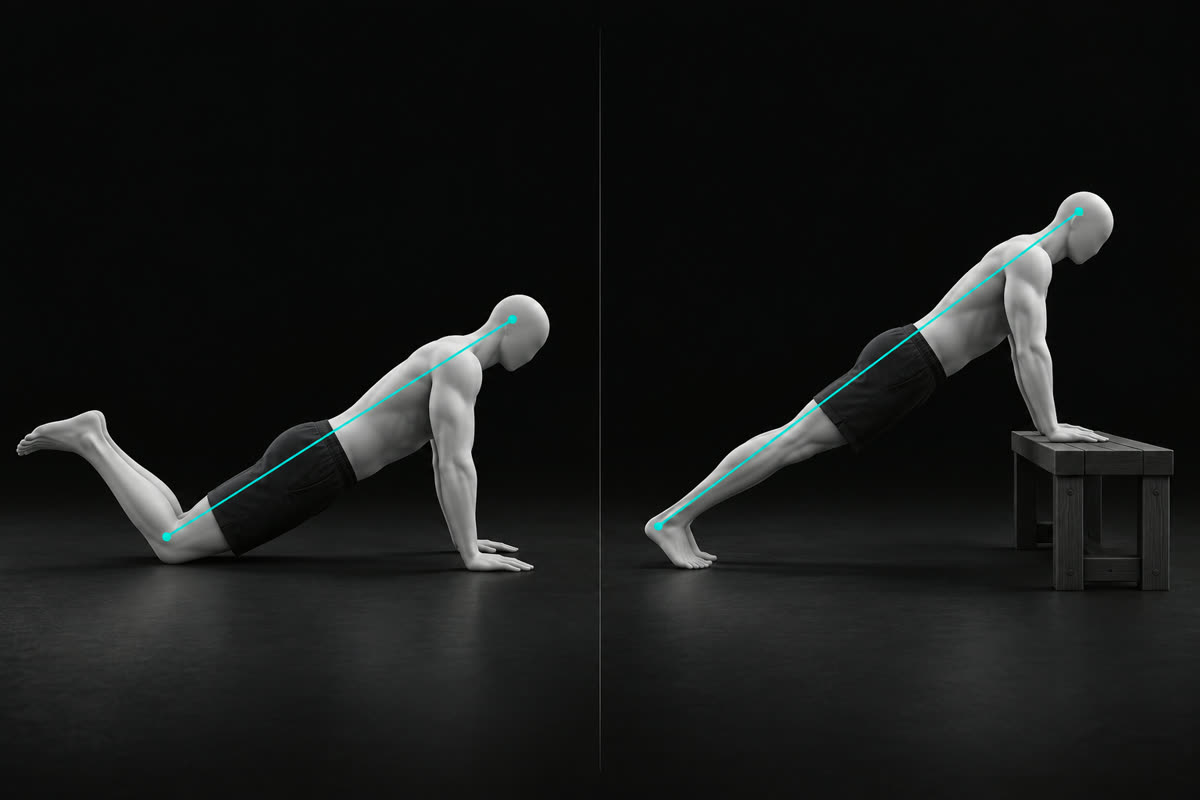
Both build toward a full push-up, and incline push-ups are the better default for most beginners: they keep the full plank from head to heels and let you adjust the difficulty step by step. Knee push-ups are lighter than a low incline and handy when all you have is a floor, which makes them a good source of extra volume.
How much of your body weight do you push in each variation?
A knee push-up moves roughly half your body weight, a standard push-up about two thirds, and an incline anything in between, depending on its height. Ebben and colleagues measured this with a force plate under the hands of 23 recreationally fit adults (Journal of Strength and Conditioning Research, 2011; the conference version with the full table is free to read). Peak force under the hands, as a share of body weight:
| Variation | Peak load (% of body weight) |
|---|---|
| Hands on a 24-inch (61 cm) box | 41% |
| Knee push-up | 49% |
| Hands on a 12-inch (30 cm) box | 55% |
| Standard push-up | 64% |
| Feet on a 12-inch (30 cm) box | 70% |
| Feet on a 24-inch (61 cm) box | 74% |
Two points stand out. A high incline is lighter than a knee push-up, and a low incline is heavier. A wall or a kitchen counter is higher still and so lighter again, although the study did not measure those. The incline therefore covers a much wider band of difficulty, ending about 9 percentage points short of the full push-up, while the knee push-up sits 15 percentage points short.
The load also changes within the rep. In a separate study of 28 strength-trained men, Suprak and colleagues (2011) measured static top and bottom positions: according to the figures summarized in a 2012 review of push-up biomechanics, the knee push-up went from about 54% of body weight at the top to 62% at the bottom. Whatever variation you choose, the bottom of the rep is the hardest part.
Knee vs incline push-ups: side by side
| Knee push-up | Incline push-up | |
|---|---|---|
| Load | About 49% of body weight | About 55% (12-inch box) down to 41% (24-inch box), lighter on higher surfaces |
| Body line | Shoulders to knees | Shoulders to ankles, same as the full push-up |
| Trunk demand | Lower: shorter lever, knees on the floor | Same position as the full push-up |
| Adjusting difficulty | One setting, plus tempo and pauses | Any height: wall, counter, table, bench, step |
| Depth practice | Chest travels to the floor, as in the full version | Chest travels to the edge of the surface |
| Equipment | A floor, and a pad under the knees | A stable surface that will not slide |
| Best use | Extra volume, floor-only sessions, finishing sets | Main progression toward the full push-up |
Which one carries over better to a full push-up?
Incline push-ups usually carry over better, because the position is the same as the full push-up: on your toes, knees locked, glutes and abs holding one line. Only the angle changes. With the knees down, the lever is shorter and the trunk works less; the 2012 review cited above notes that the knee push-up substantially reduces the demand on both the prime movers and the core muscles.
Knee push-ups still earn their place. Your hands stay on the floor, so the chest travels the same path to the ground as in the full push-up, and you need no equipment. Some coaches start there on purpose. They accept that the core works less, because a beginner who has to fix too many things at once tends to get frustrated. If floor knee push-ups are still too hard, put your hands on a stool or a chair.
One limit applies to both camps. The force-plate studies measure load in a single session, so they cannot say which variation gets you to your first full push-up faster over months. The carry-over argument is coaching logic, and it is the reason many coaches make the incline the main road.
Progress here is often slow, and that is normal. A common complaint on r/bodyweightfitness: five months of work, from table push-ups to chairs, negatives and knee push-ups, and still no clean full push-up. The most useful replies suggested dropping the mix of variations for the single hardest one (knee push-ups, in that case), adding 3 x 30 s planks for the body line, and checking food and sleep. Another thread shows a slow path that worked: someone whose back bent before the chest could get low, even on the knees, went from wall push-ups to elevated push-ups to full push-ups from the toes in six months.
Which should you pick? A quick decision guide
| Your situation | Start with |
|---|---|
| Fewer than 5 clean knee push-ups | Incline at counter or table height |
| Hips sag or pike even on your knees | High incline, plus plank holds of 3 x 20 to 30 s |
| Only a floor available | Knee push-ups, lowering over 3 seconds |
| A stable bench, box or staircase available | Incline push-ups, lowering the height over time |
| 10 or more clean knee push-ups, no full push-up yet | Both: low incline sets, a knee push-up finisher and full push-up negatives |
| Knees uncomfortable on the floor | Incline push-ups |
What is the best push-up progression for beginners?
Lower the incline step by step, and use knee push-ups as extra volume near the floor. Train 2 or 3 times a week, 3 sets per exercise, and end each set a rep or two before your form breaks. Move to the next step once you can do 20 clean reps in a row at the current one.
- Wall push-ups, standing about an arm's length away, 3 x 10 to 15.
- Counter or table incline, around waist height, 3 x 8 to 15.
- Chair or bench incline, braced against a wall so it cannot slide, 3 x 8 to 15.
- Low incline on a step or a box around 30 cm high, 3 x 8 to 15, followed by 1 set of knee push-ups to full depth.
- Full push-up negatives, 3 x 3 to 5, lowering over 3 seconds from the top, then dropping to your knees to press back up. Add them once you reach about 12 clean reps on the low incline.
- Full push-ups: 3 sets of whatever you can do cleanly, even 2 or 3 reps, plus one low incline set for volume.
The sets and rep ranges are typical coaching ranges, not measured thresholds. The move-on rule is the fixed part: 20 clean reps at one step before you go to the next. If knee push-ups are your main variation, the rule is the same, 20 clean knee push-ups in a row and then full push-ups. The general version of this rule, across skills, is in how many reps or seconds before moving on.
How do you know a rep is clean enough to count?
A rep counts when it reaches full depth (shoulder at elbow height or lower), locks out at the top, and keeps the head and the body line straight. Counting that way usually lowers the number. Across the push-up scans analyzed by CaliLens (standard and knee variants), the median scan counted 8 reps, while the median number of strict reps (full depth, full lockout, body in line) was 6.
If you film your knee push-ups, CaliLens scores them as their own variant, checking depth, lockout and head position. It has no incline variant, so inclines are for your own video review. The full checklist, with a camera test for each fault, is in how to know if your push-ups are clean.
Frequently asked
Are knee push-ups a waste of time?
No. At about 49% of body weight they are a real training load, and they let you practice full depth with your hands on the floor. Their weak point is the shorter body line, so pair them with planks or with incline push-ups that keep you on your toes.
How high should an incline push-up be for beginners?
High enough that you can do 8 to 15 clean reps, which for most beginners means a counter or a table. In a force-plate study, hands on a 24-inch box meant about 41% of body weight and a 12-inch box about 55%, so lower the surface in steps as you get stronger.
How many knee push-ups should you do before a full push-up?
A good benchmark is 20 clean knee push-ups in a row, with full depth and a straight line from shoulders to knees. In practice, many people can start slow full push-up negatives earlier, once they reach about 10 clean knee reps.
Do incline push-ups work the same muscles as regular push-ups?
Yes. They train the same pushing muscles and keep the same straight body line as a full push-up, only with less load. The higher your hands, the lighter the rep.
Can you combine knee and incline push-ups?
Yes. A practical split is to do your main sets on an incline, then finish with one set of knee push-ups to full depth. The incline trains the full body line and the knee set adds volume close to the floor.