Blog · Pull-up · 6 min read
Why can't I do a pull-up? 4 tests and a plan
Your first pull-up is a strength-to-weight problem with a few specific gaps. Test which one you have, then train that gap three times a week.
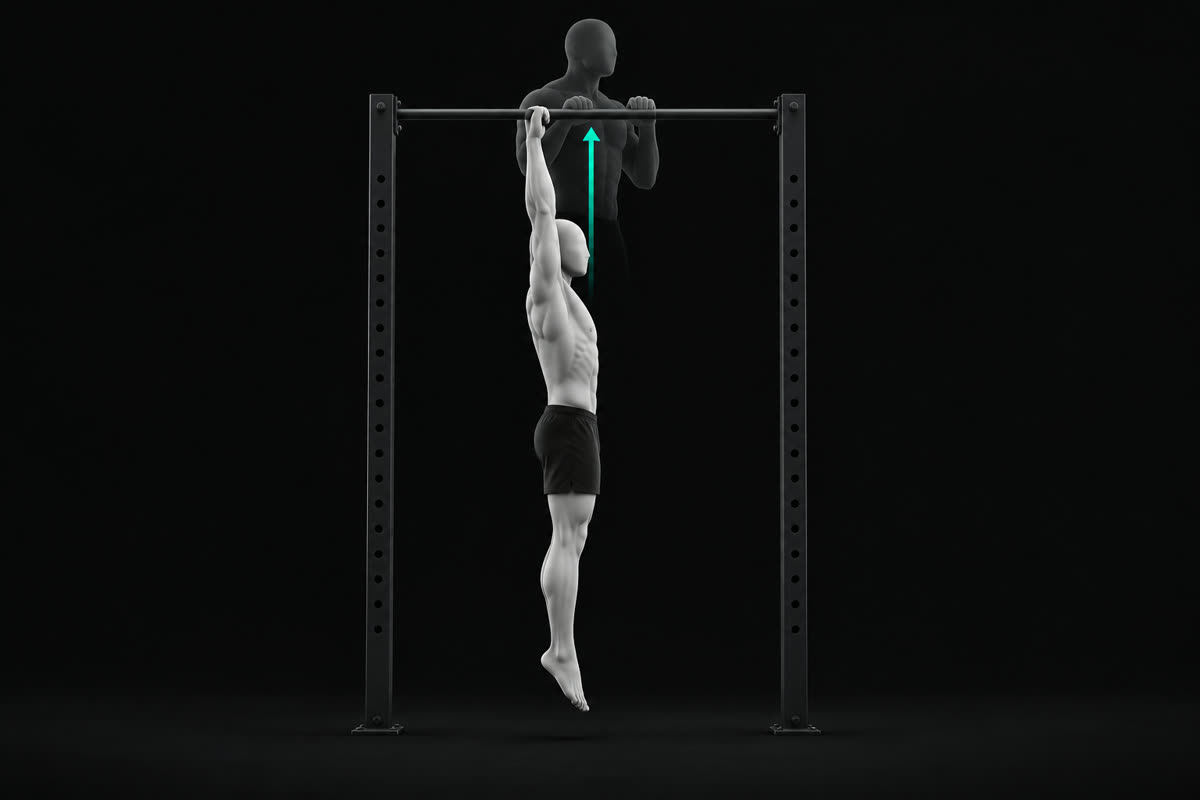
You can't do a pull-up yet because your pulling strength is still short of your body weight, and one link is usually missing: passive shoulder blades in the dead hang, an untrained top range, a grip that fails first, or practice that is too rare. Four quick tests show which one, and a five-step progression closes it.
Why can't I do a single pull-up?
Most people who can't do a single pull-up are missing strength relative to their body weight, plus one or two specific gaps in the movement. Weight matters, and so do the gaps below, which are all trainable.
- Relative strength. In a study of 25 trained men, max pull-ups correlated with lat pulldown reps at a load equal to body mass (r = 0.62), but not with the heaviest single pulldown (r = 0.09), and fell as body mass rose (r = -0.55). A training study in college-age women found the same pattern: those who reached a pull-up had a higher strength-to-mass ratio.
- Passive shoulders in the dead hang. The pull starts with the shoulder blades moving down and back. If they stay up by your ears, your arms have to start the rep on their own.
- No eccentric work. You can lower yourself slowly long before you can pull yourself up: Steven Low notes that eccentrics can handle loads near 140 to 150 percent of a one-rep max. Skipping that phase means training only the part you can't do yet.
- Grip. If your hands open after 15 seconds of hanging, the back never gets a real stimulus.
- Programming. One max attempt a week, or sets so hard every rep is a grind, builds little. Frequent, repeatable sets build more.
Stalling for months is a common complaint on r/bodyweightfitness, even after months of rows, dips and negatives. In another thread, a lifter who wondered whether they were genetically unable to do a pull-up had been pausing negatives at three fixed points instead of lowering continuously, which leaves the range between those points untrained.
Where exactly do you get stuck? Four tests
Run these four tests in one session, rested, in this order. Rows stay in your plan whatever you score; the first test you fail tells you where to start in the progression below, and passing all four means it is time to test a full rep. The pass marks are typical coaching targets, not lab norms.
| Test | How to do it | Typical pass | If you fail it |
|---|---|---|---|
| Dead hang | Hang from the bar, arms straight, legs together | 30 seconds | Grip is the limit: add hangs to every session |
| Scapular pulls | From the hang, arms straight, pull the shoulders down and hold 1 second | 8 controlled reps | The pull has no base: start at step 2 |
| Timed negative | Jump or step to chin over bar, lower as slowly as you can | 5 seconds, even speed to straight arms | Start at step 3 |
| Flexed arm hang | Chin above the bar, hold | 10 seconds | The top range is weak: add step 5 |
Film the negative with your phone at chest height, from the side or at a three-quarter angle, with your feet in frame. Play it back and note the height where the descent suddenly speeds up. That height is your sticking point, and it tells you where to aim holds and partial reps.
What is the best pull-up progression for beginners?
The best pull-up progression moves from rows to scapular pulls, negatives, band-assisted reps and top-range partials, three times a week. Rows are the real first step, since your feet take part of your weight, and a common coaching target is 3 sets of 8 horizontal rows.
- Rows. Inverted rows under a low bar or rings, body straight, chest to the bar. 3 sets of 5 to 8. Lower the bar or raise your feet as you get stronger, until you own 3 sets of 8 horizontal rows.
- Scapular pulls. From a dead hang, pull the shoulders down and slightly back with straight arms, hold 1 to 2 seconds. 3 sets of 8. This builds the start of every rep.
- Negatives. Start at the top, chin over the bar, and lower to straight arms. Steven Low's eccentric guidelines start at 2 to 3 sets of 2 to 3 reps lasting 3 to 5 seconds each, then build each rep toward 7 to 10 seconds.
- Band-assisted pull-ups. A band around the bar and under a foot or knee. 3 sets of 5 to 8 full-range reps, then switch to a lighter band.
- Top-range partials and holds. Flexed arm hangs of 3 sets of 10 seconds, or half reps from the top down to 90 degrees at the elbow and back. These target the top of the pull, where a band helps least.
What does a first pull-up week look like?
Train three non-consecutive days a week, for example Monday, Wednesday and Friday, and keep one or two reps in reserve on most sets. Start at the step your tests pointed to and leave out anything below it.
| Exercise | Sets and reps | Rest | Add it when |
|---|---|---|---|
| Dead hang | 3 x 20 to 30 seconds | 60 seconds | From day one, if the hang test failed |
| Rows | 3 x 5 to 8 | 90 seconds | From day one |
| Scapular pulls | 3 x 8, 1 to 2 second hold | 60 seconds | From day one |
| Negatives | 2 to 3 x 2 to 3, 3 to 5 seconds each | 2 to 3 minutes | Once scapular pulls pass |
| Band reps or top holds | 3 x 5 to 8, or 3 x 10 seconds | 2 minutes | Once negatives reach 5 seconds |
Every week, add a little: a rep, a second of lowering, or a lower bar for rows. If your body weight is high, losing some fat raises your strength-to-mass ratio without any new strength, but the plan above works either way. If a step causes elbow or shoulder pain, stop that variation and see a physiotherapist if the pain persists.
- Cue
- Shoulders down first, then drive your elbows to your ribs.
- Why
- Starting with the shoulder blades puts the back in charge before the arms bend, which is exactly the part a passive dead hang skips.
- Drill
- 3 sets of 3 negatives of 5 seconds, each finished with one scapular pull at the bottom before you let go.
What counts as a real pull-up?
A real pull-up starts from straight arms, ends with the chin clearly above the bar, and returns to straight arms, with no kick or swing. Anything less still works as a drill. Count it separately.
- Bottom: elbows fully straight in a dead hang before each rep.
- Top: chin clearly over the bar, not just level with it, and not reached by tipping the head back.
- Body: legs straight and together, no knee drive, no hip kick, no pendulum swing.
- Tempo: a controlled descent, not a drop.
CaliLens scores a filmed pull-up against this same standard: it checks that the chin clears the bar and the arms fully extend, and flags kipping, body swing, bent knees and legs drifting apart.
When are you ready for the next step?
Move to the next step once the current one is clean for all its sets. For negatives, that means 2 to 3 sets lowering for 7 to 10 seconds with no drop at the bottom. At that point, test one full rep at the start of a fresh session, before anything else tires you.
Once your first pull-up arrives, build reps with the same care. Move on to added weight or a harder variation once pull-ups feel easy for high reps. A common coaching range is 3 sets of 8 clean reps, the rule the Recommended Routine uses for its strength exercises. Our guide to when to progress in calisthenics applies it across exercises.
Pull-ups that feel easy for high reps also set up the muscle-up, where pulling height matters most. If your first attempts tip over one arm, read why a muscle-up goes over one arm first.
Frequently asked
Why can't I do a pull-up even though I can lift weights?
A pull-up depends on strength relative to your body weight, not on absolute strength. In a study of trained men, pull-up reps tracked lat pulldown reps at a load equal to body mass, while the heaviest single pulldown did not predict them. A strong but heavy lifter can still stall at zero.
Are negative pull-ups enough to get your first pull-up?
Negatives are one of the most useful tools, because you can lower more than you can lift. They work best combined with rows and scapular pulls. When you can lower for 7 to 10 seconds under control over 2 to 3 sets, test a full rep at the start of a session.
How often should I train for my first pull-up?
Three sessions a week with a rest day in between is the structure of the r/bodyweightfitness Recommended Routine, and it suits most beginners. Rare max attempts build little. Frequent, submaximal practice of rows, scapular pulls and negatives builds more.
Does a pull-up count if my chin barely reaches the bar?
Not by a strict standard. A clean rep starts from straight arms, ends with the chin clearly above the bar, and uses no kick or swing. Half reps are useful as a drill, but count them separately.
Should I use a resistance band for pull-ups?
Yes, as one step among others. A band gives the most help at the bottom, where it is stretched most, and the least near the top, so pair band work with negatives and top-position holds.