Blog · Muscle-up · 6 min read
Chicken wing muscle-up: why one arm goes first
A chicken wing muscle-up is usually a height and timing problem before it is a strength problem. Find which one you have, then rebuild the turnover so both elbows arrive together.
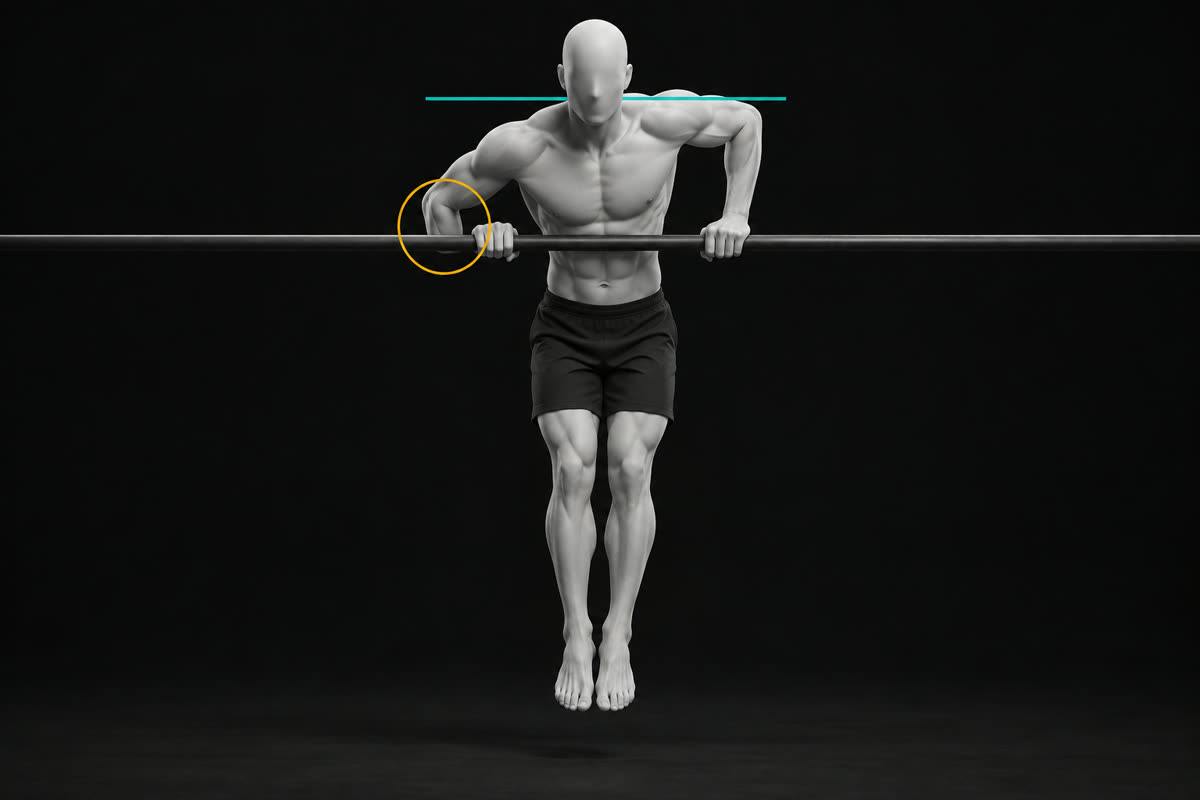
A muscle-up goes over one arm first (the chicken wing) when you reach the bar too low to turn both wrists over together, so the stronger or more mobile side hooks over and drags the other up. The fix is a higher pull, a false grip, less swing and slow transition work until both elbows clear the bar together.
What is a chicken wing muscle-up?
A chicken wing muscle-up is a rep where one elbow gets over the bar while the other arm is still below it, so you finish the transition lopsided and press out from an uneven support. It usually looks like one elbow flaring high and wide while the other side catches up.
It is a common complaint on r/bodyweightfitness, even from an athlete who can do 13 pull-ups, pull to the lower chest and string banded muscle-ups, yet still gets only one arm over once the band comes off. In another thread, the original post describes it as the usual next step after 10 pull-ups in Russia, Ukraine and Belarus, while most replies treat it as bad form and warn about the stress it puts on one arm. It gets you over the bar, but it hides a gap you will need to close before rings or added weight.
Why does one arm go over the bar first?
One arm leads because the transition happens too low or too unevenly for both wrists to rotate at once. Five causes explain most cases, and often more than one applies.
- Pull height is too low. If the bar only reaches your upper chest, there is no room to bring both elbows over. Aim the pull at your stomach and build speed from the very start of it.
- A low transition. Even with enough height, turning over while the shoulders are still under the bar forces one arm to hook over and lever the body up.
- Strength or mobility asymmetry. A stronger side, or a wrist or shoulder that moves less freely on one side, reaches the support position first. When it is always the same arm, suspect this.
- No false grip. With a regular pull-up grip, each hand has to shift over the bar during the transition. A false grip sits between a pull-up grip and a dip grip, which removes that grip switch.
- An uncontrolled kip. A swing that rotates the hips or throws the legs off-center sends one shoulder to the bar before the other.
What does a clean muscle-up look like?
A clean bar muscle-up is one continuous movement from a still dead hang to locked arms above the bar, with both arms doing the same thing at the same time. Use this checklist when you watch your clips.
- Start: a still hang with straight arms, both hands in the same false grip.
- Pull: the bar travels to your lower chest or stomach, and your body moves slightly around the bar rather than straight into it.
- Turnover: both wrists rotate over the bar together, elbows moving back at the same height.
- Press: chest leaning over the bar, then a press to fully locked elbows.
- Body: legs together, no knee drive or hip throw for a strict rep.
- Return: a controlled descent back to a full hang before the next rep.
Treat the rep as one fluid movement around the bar, not a pull-up, then a transition, then a dip.
Is a chicken wing muscle-up bad for your shoulders?
An occasional, pain-free chicken wing while you learn is common. A chicken wing that repeats on every rep, always on the same side, with rings or added weight, or that brings pain, is a sign to rebuild the transition before loading it.
In a lopsided turnover, one shoulder and one elbow carry more of the transition than the other side. Watch for these signs:
- The same arm leads on nearly every rep, for weeks.
- The leading elbow flares far out to the side.
- You feel pain at the front of the shoulder or around the elbow during or after sets.
- The asymmetry grows when you add reps, rings or weight.
If a muscle-up variation hurts, stop that variation and see a physiotherapist if the pain persists.
How can you tell which arm leads?
Film yourself from the front with the phone at bar height and your whole body in frame, then play the reps back in slow motion. For each rep, note which elbow clears the bar first.
| What you see | What it usually means | Where to start |
|---|---|---|
| The same arm leads on every rep | Strength or mobility asymmetry | Slow negatives, extra work for the lagging side |
| The leading arm changes from rep to rep | Pull height or timing | Chest-to-bar pulls, banded transitions |
| It only appears on the last reps | Fatigue | Fewer reps per set, more sets |
| The hips twist before the turnover | Uncontrolled kip | Strict reps from a still hang |
A second clip from the side, camera at bar height, shows pull height: where the bar meets your body as you turn over. That side view is also the one to film if you want a muscle-up scored by CaliLens. Only the front clip shows which arm leads.
How do you fix a chicken wing muscle-up?
Fix a chicken wing by building a higher pull, owning the top position and training the transition slowly with both arms in sync. Run these drills two to three times a week, before your muscle-up attempts or in place of them.
- Explosive chest-to-bar pull-ups. 4 to 5 sets of 2 to 3 reps, aiming for the bar at the lower chest or stomach. If you can't reach that height yet, use a band for the same stomach-to-bar pulls.
- Straight bar dips. 3 sets of 5 to 8, leaning over the bar, both elbows tracking back evenly, full lockout on every rep. These build the support position you land in.
- Banded transitions. A band on a low bar, or feet on a box, 3 sets of 5. Move through the turnover in one continuous arc and rotate both wrists at the same moment.
- Slow negatives. Start in support above the bar and lower through the transition, keeping both arms even. 3 sets of 3. Steven Low's eccentric guidelines begin with reps of 3 to 5 seconds and build toward 7 to 10 seconds.
- False grip hangs. 3 sets of 10 to 20 seconds, both wrists set identically, to make the grip automatic.
If the same arm always leads, add 2 sets of 6 to 8 single-arm rows or archer pull-ups for the lagging side. For the pulling base itself, start with why you can't do a pull-up yet: its tests and progression apply to anyone short of a strong, strict pull.
- Cue
- Pull both arms over the bar together.
- Why
- A chicken wing lets one arm cross the bar before the other, which hides a strength gap and does not carry over to a clean muscle-up. Turning over together trains both sides evenly.
- Drill
- Slow negative muscle-ups, 3 sets of 3, both arms even.
When is your muscle-up clean enough to move on?
Move on to rings or added weight once you can string 3 to 5 clean strict muscle-ups, each with both arms turning over together and a press to locked elbows. Until then, keep the reps strict and the sets short.
Rings are a real step up. In a study comparing ring and bar muscle-ups in ten active men, the ring version demanded more upper trapezius, biceps and forearm activity during the pull, and more triceps and biceps activity during the push. The authors suggest the bar muscle-up may be the better one to learn first because it is less difficult. Rings also move independently, so fix the asymmetry on the bar first. For how that gate compares with other exercises, see when to progress in calisthenics.
Frequently asked
Is a chicken wing muscle-up bad?
An occasional pain-free chicken wing while you learn the movement is common. It becomes a problem when it happens on every rep, always on the same side, under added load or rings, or with pain at the front of the shoulder or elbow. In that case, stop the variation and see a physiotherapist if the pain persists.
Does a chicken wing muscle-up count?
By a strict standard, no. A clean muscle-up has both arms turning over together, then a press to locked elbows. A chicken wing rep shows you can get over the bar, but it is not yet the skill you want to load.
How high do I need to pull for a muscle-up?
Higher than a regular pull-up: aim for the bar to reach your lower chest or stomach, not your chin. That extra height is what gives both wrists room to turn over at the same time.
Does the false grip help with the chicken wing?
It helps many athletes. A false grip already places the wrist partly over the bar, so you don't have to switch grip in the transition, and an uneven grip switch is one way one arm ends up leading.
How many muscle-ups before moving to rings?
A sensible gate is 3 to 5 clean strict bar muscle-ups in a row, with both arms turning over together. Rings demand more from the arms and move independently, so fix the asymmetry on the bar first.