Blog · Handstand · 6 min read
Banana handstand fix: how to straighten an arched back
Two different causes produce the same curved line. Test which one is yours before you spend months stretching or bracing.
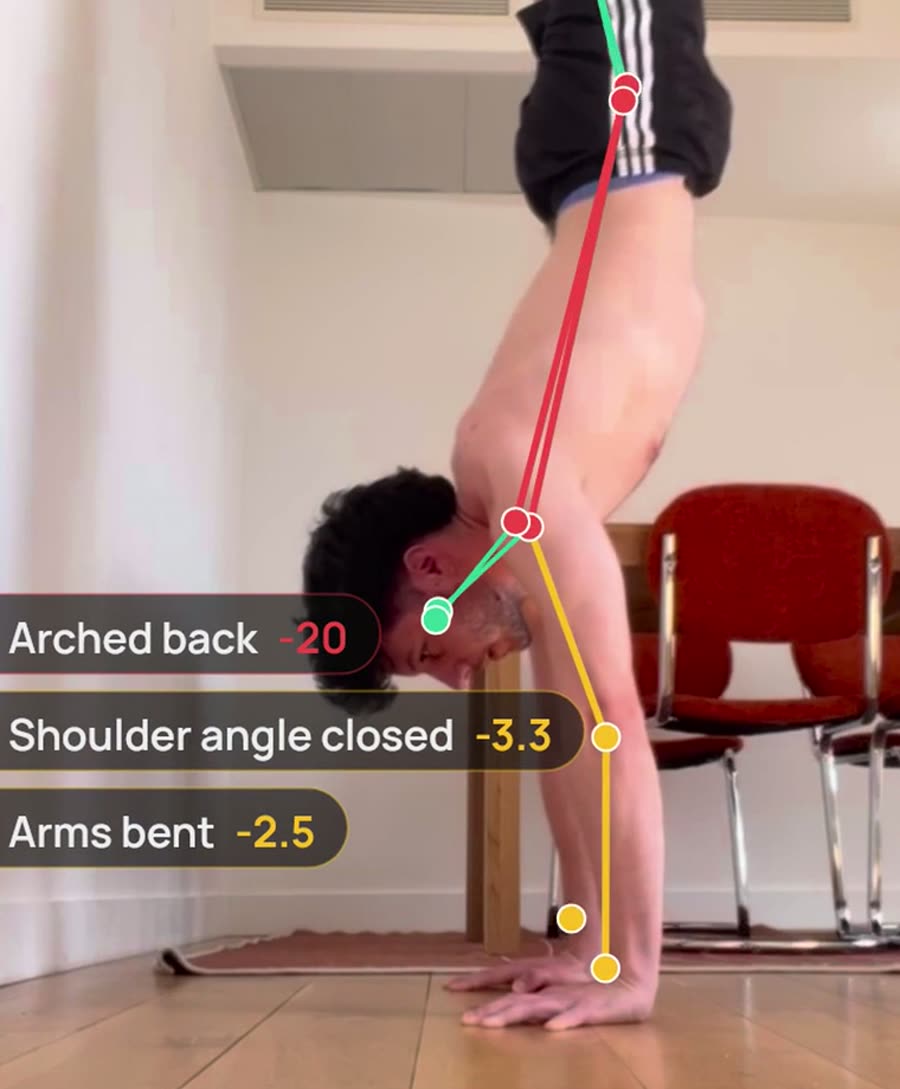
A banana handstand usually has one of two causes: shoulders that do not open fully overhead, so your lower back arches to bring your feet over your hands, or an arch you learned to use for balance, with ribs flared and glutes relaxed. A floor test and a wall test tell you which one to fix first.
Across the handstand scans analyzed by CaliLens, 46 percent showed a banana back. Closed shoulders were even more frequent, in 55 percent of them, and the head was out of line in 21 percent. It is also a common complaint on r/bodyweightfitness, often from athletes whose shoulders are not the issue: one keeps kicking up into a banana handstand despite a comfortable chest-to-wall position, another still arches after testing their shoulder mobility as fine.
What is a banana handstand?
A banana handstand is a handstand where the body curves instead of stacking in a straight line over the hands. From the side, the lower back arches, the ribs flare, the hips drift toward the belly side and the feet hang out over the back.
The curve often feels easier to balance at first, which is exactly why it sticks. It is a hard habit to break, and the longer you practice it, the more automatic it gets.
Why does my handstand arch?
Two root causes, shoulder range and trunk control, account for most banana handstands, and four habits make either one worse.
Cause 1: your shoulders do not open all the way
A straight handstand needs your arms in line with your trunk, overhead. If your shoulders stop short of that, the only way to get your feet above your hands is to bend somewhere else, and the lower back is the easiest place to bend. In that case, the arch is a compensation, and bracing harder will not remove it.
Cause 2: your trunk and pelvis let the arch happen
With enough shoulder range, the arch can still appear if the ribs flare and the pelvis tips forward. The glutes switch off, the lower back extends, and the hips slide toward the belly side. Here the fix is trunk control: ribs down, glutes squeezed, a light hollow shape.
Four habits that feed the arch
- Using the arch to balance. In a force plate study of handstand balance, the better balances relied mainly on the wrists and shoulders with little input from the hips, while hip torques played a growing role in the less successful ones (Kerwin and Trewartha, 2001, a small sample of six handstands). Catching your balance by bending at the hips and lower back matches the less successful pattern.
- Kicking up too hard. The legs overshoot vertical and you save the handstand by arching, then you hold whatever shape you landed in.
- Craning the head. Looking far past your hands tends to pull the upper back into an arch. A neutral head, eyes on the floor near your hands, makes a straight line easier.
- Passive fingers. When you tip toward your back, pressing into the fingers pulls you back. Balance comes from pressing through the fingers and the heels of your hands. If the fingers stay quiet, the body bends to compensate.
Is my banana handstand a mobility problem or a habit?
Test both, in this order: shoulder flexion on the floor, then the same handstand facing the wall and with your back to it. Together they tell you where to spend your time.
Test 1, on the floor. Lie on your back, knees bent, feet flat. Press your lower back into the floor and keep the ribs down. With straight elbows and thumbs together, raise your arms overhead toward the floor behind you. You pass if the backs of your arms rest on the floor beside your ears while the lower back stays flat. You fail if the arms stop above the floor, or only reach it once the lower back lifts or the elbows bend.
Test 2, at the wall. Film both holds from the side, phone at about waist height, whole body in frame.
- Chest to wall: face the wall, walk your feet up and your hands in until they are about a hand's width from it. Push tall and hold 20 to 30 seconds.
- Back to wall: kick up with your back to the wall, hands a short distance from it, and hold 20 to 30 seconds.
| Floor test | Chest to wall | Back to wall | Most likely cause |
|---|---|---|---|
| Pass | Straight | Arched | Habit and balance strategy |
| Pass | Arched | Arched | Trunk control: ribs, pelvis, glutes |
| Fail | Arched, shoulders closed | Arched | Shoulder mobility |
| Fail | Straight only when you push very hard | Arched | Both, train them in the same session |
Testing inside the handstand shape matters. A 2023 preprint on 111 novice college athletes found no link between standard shoulder stability and mobility field tests and handstand quality, and its authors note that those tests load the shoulder differently from a handstand.
How do I fix a banana handstand caused by tight shoulders?
Open the shoulders first, then practice using that range upside down, in the same session.
- Cue
- Push tall and open your shoulders fully.
- Why
- When the arms cannot reach overhead in line with the trunk, the lower back arches to bring the feet over the hands. More shoulder range removes the reason to bend.
- Drill
- Chest-to-wall holds, 3 x 30 seconds, pushing tall through the shoulders.
- Bench shoulder stretch. Kneel, elbows on a bench, hands together, and sink the chest toward the floor with the ribs tucked. 3 x 30 to 45 seconds.
- Lying overhead reach. The floor test as a drill: 3 x 10 slow reps, pausing 2 to 3 seconds at your end range with the lower back flat.
- Shrug holds at the wall. Chest to wall, actively shrug the shoulders toward the ears to open the angle. 3 x 20 to 30 seconds.
How do I fix a banana handstand that is a habit?
Teach your trunk to hold a straight shape, then remove the reasons you bend: the hard kick, the craned head and the quiet fingers.
- Cue
- Ribs down, glutes tight, push the floor away.
- Why
- With flared ribs and a forward-tipped pelvis, the lower back arches even when the shoulders have enough range. A light hollow shape holds the line.
- Drill
- Hollow body holds, 3 x 20 to 30 seconds, followed by chest-to-wall holds with the glutes squeezed.
- Chest-to-wall holds. Hands close to the wall, glutes squeezed, toes pointed. 3 x 30 seconds.
- Back-to-wall walk-ins. Walk the hands toward the wall until only your heels touch it, and find vertical with the ribs down. 3 x 20 seconds.
- Soft kick-ups. 5 to 10 per session, aiming to arrive stacked rather than to reach the wall. Practice bailing out with a cartwheel first.
- Finger balance. From a chest-to-wall hold, lift the toes off the wall and balance with finger pressure, or hold freestanding. 5 x 10 seconds.
How is a banana back measured from a video?
From a side-view video, CaliLens draws a straight line from your wrists to your ankles and measures how far your hips drift off it, as a share of that length, along with the angle at your hips. It flags a banana back when the hips sit more than about 5 percent of that length off the line, or the hip angle bends more than about 15 degrees from straight, and the bend goes the banana way rather than the pike way. It checks your shoulder angle and head position separately. One honest limit: a curve that stays inside the lower back while the hips remain on the line can pass unflagged, so keep looking at your own video too.
When is your handstand straight enough to move on?
When you can hold a still, straight handstand for 10 seconds, checked from the side. Straight means wrists, shoulders, hips and ankles close to one line, with no arch returning in the last seconds.
That bar is higher than it sounds: the median hold in the scans quoted above was 7.5 seconds, before counting form. If the arch comes back as you tire, end the set there and count only the straight seconds. The same rule applies to every skill, as explained in when to progress in calisthenics, and the same straight-line check applies to hip sag in the front lever. If your lower back or wrists hurt during handstands, stop the painful variation and see a physiotherapist if it persists.
Frequently asked
Is a banana handstand bad?
It is a common stage, but many coaches warn that a habitual banana shape can be hard on the lower back. The curve also makes balance harder to refine, and presses and handstand push-ups are easier from a stacked line. Keep practicing balance while you work toward a straighter shape.
Should I practice chest to wall or back to wall to fix a banana handstand?
Chest to wall first. Facing the wall with your hands close to it makes a straight line much easier to find and hold. Back to wall is useful for kick-ups and balance practice, but it invites the arch, so use it once you can hold the line facing the wall.
Where should I look during a handstand?
At the floor near your hands, with the head neutral and the ears roughly between the arms. Craning the neck to look far ahead tends to pull the upper back into an arch. Small adjustments are fine as long as the ribs stay down.
How long does it take to fix a banana handstand?
It depends on the cause. As a rough estimate, a habit can change within a few weeks of frequent wall work, while a shoulder mobility limit often takes a few months. Film yourself every week or two to see which way the line is moving.
Can I fix a banana back just by squeezing my glutes?
Only if the arch comes from trunk control. If your shoulders cannot reach overhead in line with your body, squeezing harder usually moves the bend somewhere else, such as closed shoulders or bent hips. Run the floor test first.