Blog · Human flag · 9 min read
Human flag progression: how to learn it step by step
The flag is a push-pull problem more than a core problem. Lock the bottom arm, line up your hands, and build the lever one step at a time from the top down.
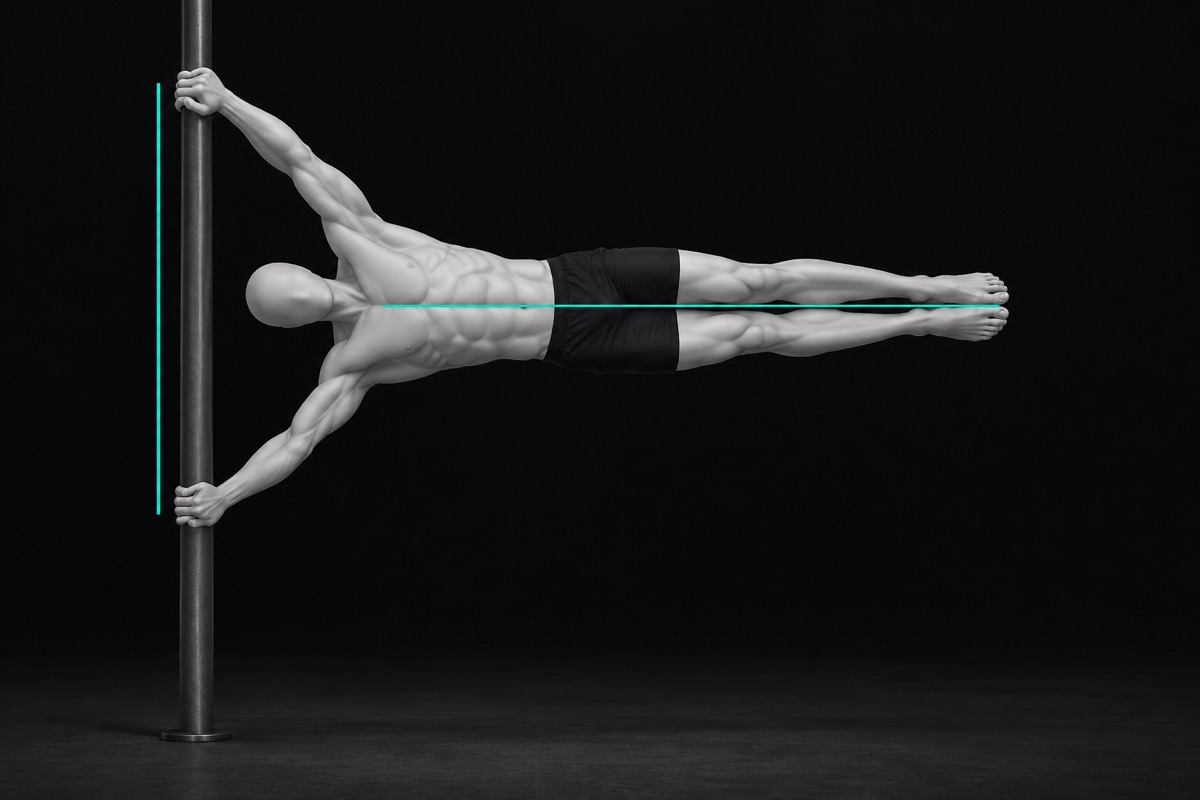
To learn the human flag, grip the pole with both hands on one vertical line, push hard through a locked bottom arm, pull with the top arm, and build the lever in steps: vertical flag, tuck flag, slow negatives, one leg or straddle, then full. Move to the next step after a clean 8-second hold.
Most people treat the flag as a core exercise and spend months on side planks. The core matters, but the flag usually fails at the arms first. On r/bodyweightfitness, one athlete who got the full flag after 6 months credited a base of overhead pushing and pulling first: wall handstands, dips and pull-ups in several grips, on a push, pull and core split.
What does a human flag really take?
The flag is two arms working in opposite directions while your trunk holds a straight line between them.
- The bottom arm pushes. It stays locked straight and drives into the pole. It is the pillar of the whole shape.
- The top arm pulls. Your lats and the shoulder hold you in and keep the body from sliding down.
- The side of your trunk holds the line. Obliques, lats and the rest of the lateral core keep your hips level with your shoulders.
- Leverage. Every step of the progression moves your legs farther from your hands, and that is where the difficulty comes from.
Steven Low explains in The Fundamentals of Bodyweight Strength Training that extending the body shifts the center of mass "further away from the fulcrum", which "increases the torque". In the flag, your hands are the fulcrum. A tuck keeps the legs close, a full flag puts them a whole body length away.
A good entry point is about 10 strict pull-ups plus solid push-ups and dips. In a thread on how long the flag takes, replies named grip, shoulders and obliques as the three things to build, and one suggested 10 to 15 pull-ups and dips before starting progressions. Keep building overhead pushing next to the flag: handstand holds and the steps in from pike push-ups to handstand push-ups train the same bottom-arm push.
How do you grip the pole for a human flag?
Put both hands on the same vertical line, with a medium spread between them. If your wrists sit on different lines, the push and the pull stop facing each other and your body rotates instead of staying flat.
- Stand side-on to the pole. Grab it overhead with your top hand wrapped around it.
- Place your bottom hand lower, at roughly shoulder width or a little more below the top hand, turned so the thumb points down and the heel of the hand can push.
- Keep the spread medium. Too narrow and the lever is hard to control, too wide and the wrists lose their strong, aligned position.
- Try both sides. Most people have a clearly stronger one. Start there, then add the other side once the easy steps feel solid.
You do not need a pole to start. Stall bars, a secured ladder or a rack upright give a better grip and stop the spinning, which makes them easier. A round pole comes later.
Why does my bottom arm bend in the human flag?
Your bottom elbow bends when the push fades and the arm stops acting as a pillar. The whole shape then collapses onto the shoulder, and your hips drop with it. On video, any bend you can see at the bottom elbow counts as a bent arm.
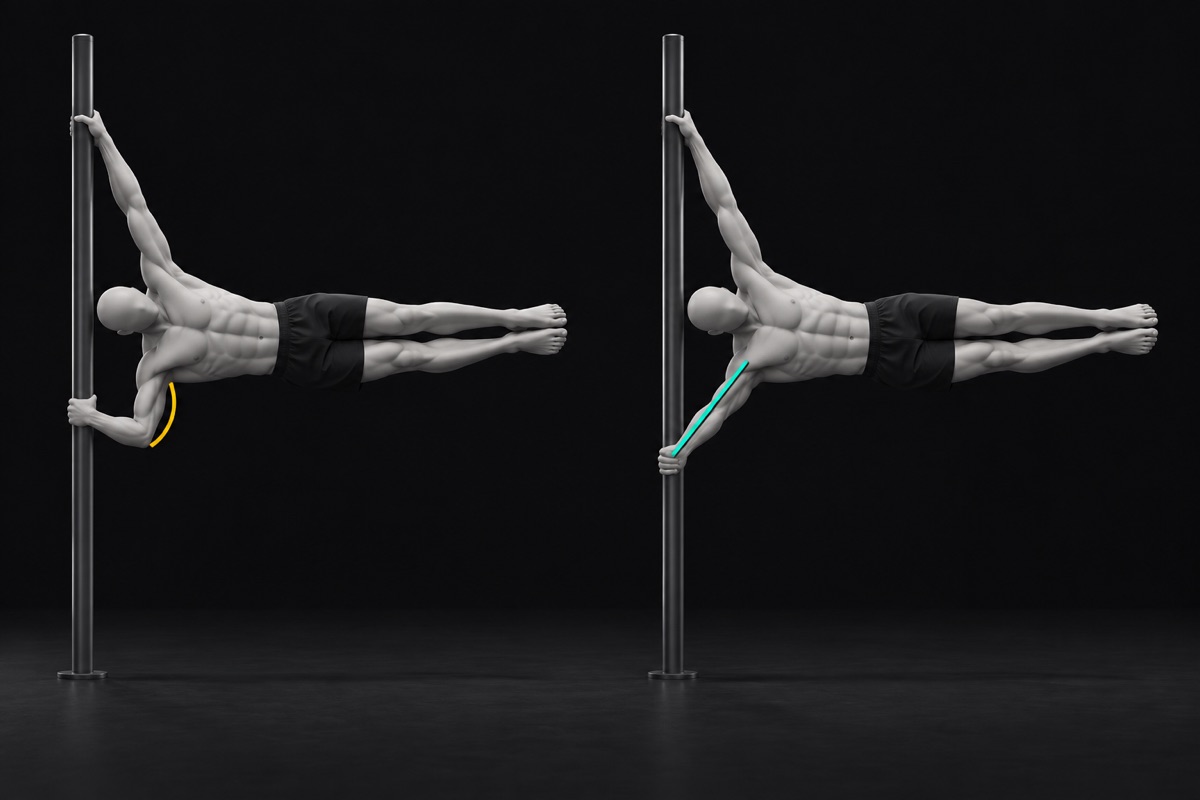
- Cue
- Lock your bottom arm straight and push the pole away.
- Why
- The bottom arm carries most of the load. Once it is fully locked, the top arm and your trunk have something solid to hold against.
- Drill
- Vertical flag holds, 3 x 10 seconds, with the bottom arm locked hard.
Your head changes the bottom shoulder too. In a tips thread, one athlete shared advice from a circus performer: looking down closes the bottom shoulder, while a neutral head and a chest turned slightly to the sky make that shoulder easier to hold.
What is the best human flag progression for beginners?
Start with the body high over your hands and bring it down toward horizontal step by step. Each step lengthens the lever a little.
- Flag grip hang: hands in the flag grip, feet just off the floor, bottom arm locked, 3 x 10 to 15 seconds.
- Vertical flag: kick up until your body stands straight above the hands, legs to the sky, 3 x 10 seconds. This is where you learn the kick-up.
- Diagonal flag: from the vertical flag, lower the straight body until it sits well above horizontal, 3 x 10 to 15 seconds.
- Tuck flag: knees pulled in, back level with the shoulders, 3 x 8 seconds. Keep the knees in the same plane as your body, not twisted toward or away from the camera.
- Negatives: from the vertical flag, lower slowly toward horizontal, 3 x 5 seconds on the way down. Stop the rep when the hips drop under the shoulder line.
- One leg or straddle flag: one leg tucked and the other straight, or both legs wide. Switch the straight leg each set.
- Full flag: legs straight and together.
Work the negatives before you chase the full static hold. A reply in a form check thread gave the same order: start from the top in a tuck and lower to parallel, then one leg at a time, then full negatives, then full negatives with a pause at parallel. For eccentrics, Steven Low starts with 2 to 3 sets of 2 to 3 reps of 3 to 5 second negatives, with long rests.
Why won't my body reach horizontal?
A body that hangs below horizontal is a partial flag. It feels like a flag, but the lever is shorter than the one you think you are holding, so the strength does not carry over. Feet even a few degrees below the shoulder line count as low.
- Cue
- Drive the hips up to the shoulder line.
- Why
- Height comes from the push of the bottom arm more than from the core. A harder push lifts the whole line.
- Drill
- Flag negatives, 3 x 5 seconds from the top, filmed from the front. Stop the rep the moment the hips drop under the shoulder line.
The opposite drift is feet held well above the shoulders. It shifts the load back toward a vertical hang, which is why it feels easier. A few degrees up is fine, but aim for a level line with the ankles at shoulder height.
The hips can also break the line on their own. Sagging hips dip below the line from shoulders to ankles and leak tension: press hard through both arms and drop to an easier variation where you can hold them level. Piked hips fold the body and shorten the lever: lengthen the line from hands to feet, and hold a flat tuck flag for 3 x 8 seconds until the shape is automatic.
Why do my legs split or my knees bend?
Both shorten the lever, so your body does them without asking when the hold gets hard. Legs that drift apart turn a full flag into a straddle, and bent knees bring the weight closer to your hands.
- Cue
- Glue your ankles together and squeeze straight legs.
- Why
- A straddle or a soft knee is an easier shape. Logging it as a full flag makes the progression look further along than it is.
- Drill
- Full flag attempts, 3 x 5 seconds, ankles touching, or a light object squeezed between the ankles.
The straddle is a real step. Just call it a straddle, and count a full flag only when the legs stay together and straight.
How do you film and judge your human flag?
Film from the front, with your chest facing the camera. That view shows the bottom elbow, both hands on the pole and the line from shoulders to feet in one frame.
- Set the phone level with your hands, 3 to 4 meters (10 to 13 feet) away, in landscape, with the pole and your feet in frame.
- Start counting once your body is still at the height you are training.
- Check the bottom elbow (locked), the hands (one vertical line), the hips (on the line from shoulders to ankles) and the legs (together, knees straight).
- Stop counting when the hips dip, the elbow bends or the body starts to drift or turn.
A pole that turns you is a common complaint. In one thread, an athlete who held 8 seconds on stall bars started rotating after 2 seconds on a pole, and a reply suggested an extra clip filmed with the feet pointing at the camera to see the twist. For light and framing, see how to film yourself for a form check. If you want a second opinion on the elbow and the line, CaliLens scores a human flag filmed from the front.
How often should you train the human flag, and how long does it take?
Train the flag itself 1 to 3 times a week, early in the session while you are fresh, and put the builders into your normal push and pull days. The flag needs recovery, and more attempts on tired arms mostly teach a bent elbow.
- Holds: sets at about 60 to 70 percent of your best clean hold, the range Steven Low uses for isometrics. If your best is 10 seconds, hold 6 to 7.
- Shoulders: handstand holds and shifted handstands for the bottom-arm push.
- Scapula and lats: scap pulls, shrugs in several directions and wide-grip pull-ups for the top arm.
- Lateral core: side plank holds on a bench for the obliques.
How long it takes depends on your base and your size. The athlete above needed about 6 months. In the how-long thread, one reply guessed that height matters a lot: tall athletes carry longer legs, so a longer lever.
Move on when you hold your current step for a clean 8 seconds: bottom arm locked, hips level, legs as the step requires, no drift. Judge it on the last set, on video. The same rule for every skill is in when to progress in calisthenics.
How do you keep your shoulders and wrists safe?
The flag loads the shoulder at full width and the bottom wrist at an unusual angle, so earn the position instead of forcing it.
- Warm up the shoulders and wrists before every session: arm circles, scap pulls, light hangs and wrist circles.
- Do not jump hard into a hold you cannot keep. In the 6-month thread, one commenter wrote that a friend tore a biceps jumping into the flag, and another prefers to jump to the top and lower down, so the load builds gradually.
- Stop the set when the bottom elbow starts to bend. That is where the shoulder takes the load.
- Train both sides over time, so one shoulder does not do all the pushing.
If a shoulder, elbow or wrist hurts during the flag, stop that variation and go back to a step that feels fine. See a physiotherapist if the pain persists.
Frequently asked
How many pull-ups do I need before training the human flag?
Around 10 strict pull-ups plus solid push-ups and dips is a sensible entry point. You can start the easy holds earlier, but below that base most of your attempts end in failed kicks instead of useful training time.
Which hand goes on top in a human flag?
Either can. Try both sides and start with the one that feels clearly stronger, then add the weaker side once you can hold the easy steps. Training only one side leaves one shoulder doing all the pushing.
Can I learn the human flag without a pole?
Yes. Stall bars, a secured ladder or a sturdy rack upright work, and many people find them easier because the rungs stop the body from spinning. Move to a round pole later, since it asks for a cleaner alignment.
Why do I rotate when I flag on a pole?
A round pole gives your hands little leverage against twisting, so any push and pull that are not in one line turn you. Check that your wrists are stacked vertically, keep your chest facing the camera, and fix it in the tuck before lengthening the legs.
Is the human flag bad for your shoulders?
Not when you build up to it. The risk comes from kicking hard into a position you cannot hold yet. Warm up the shoulders and wrists, lower into the flag from the top, and see a physiotherapist if pain lasts after you stop the painful variation.