Blog · Handstand push-up · 6 min read
How to progress from pike push-ups to handstand push-ups
In a pike push-up, your feet still carry part of your body weight. In a handstand push-up, your hands carry close to all of it. These steps close that gap without turning your reps into kicks and half presses.
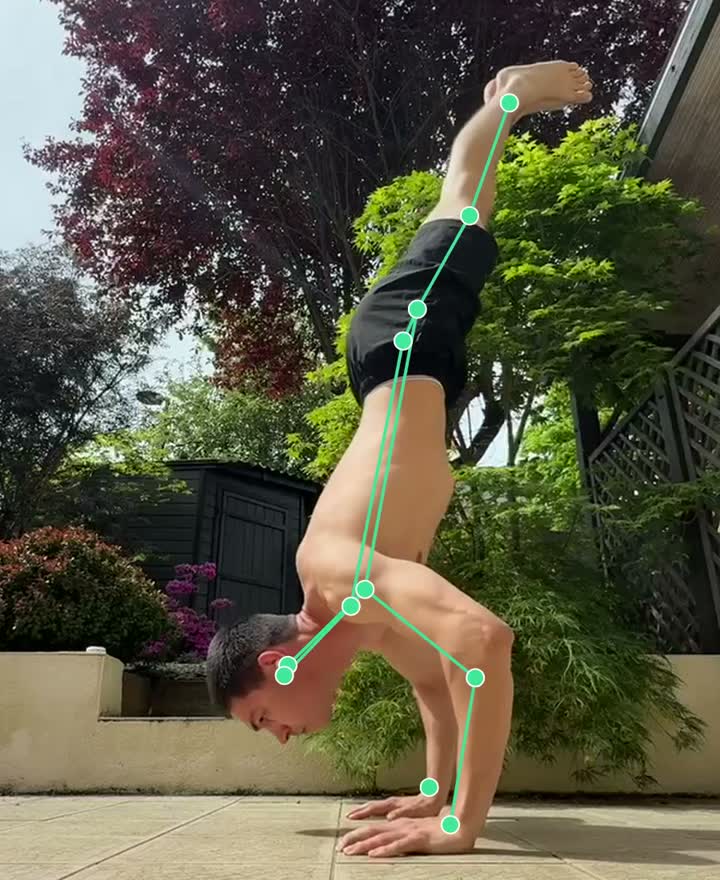
To get from pike push-ups to a handstand push-up, add load in small steps: floor pike push-ups, then feet-elevated pike push-ups at rising heights, then slow wall negatives, then wall handstand push-ups to a raised target that you lower over the weeks until your head reaches the floor. Move up a step only when every set is clean.
The gap between the two exercises is bigger than it looks: at the wall, your hands carry close to all of your weight instead of sharing it with your feet on the floor, which is why jumping straight from floor pikes to wall reps so often fails. How many pike push-ups you need before moving to the wall is a common question on r/bodyweightfitness, and one reply there shows why the count alone misleads: an athlete who found 20 pike push-ups easy struggled with 3 sets of 6 once the head and shoulders moved further forward.
What makes a good pike push-up?
Hips high and stacked over the shoulders, elbows kept in, and the crown of the head lowered all the way to the floor. A pike push-up done with the hips drifting back is a different, easier exercise.
Treat it as the first pressing step toward the handstand push-up, with the same technique rules as the full move:
- Hips over shoulders. Walk your feet in until the hips are mostly stacked above the shoulders. The more upright your torso, the closer the rep is to a handstand push-up.
- Elbows in. About 45 degrees from the body, like a kettlebell military press, and never flared out to the sides.
- Crown of the head to the floor. Neck neutral, eyes looking forward rather than down between your hands.
- Full range, full lockout. Head to the floor at the bottom, straight arms at the top.
Pike push-ups also assume solid regular push-ups. If yours still sag or stop short, fix them first with the six push-up checks.
Pike push-up too hard?
Shorten the range instead of changing the position. Put a yoga block or a stack of books under your head, press from there, and remove height over the weeks. Letting the hips drift back until the shoulders sit behind the hands does make it easier, but it also takes the shoulders out of the overhead position you are trying to train.
What is the progression from pike push-ups to handstand push-ups?
Six steps, each one putting a little more of your weight on your hands. Stay on a step until all your working sets are clean.
- Pike push-up on the floor. 3 sets of 5 to 8. Move on at 3 x 8 clean reps.
- Feet-elevated pike push-up. Feet on a step, then a low box, a bench and finally desk height. 3 to 5 sets of 5. Raise the height once every set is clean.
- Wall negatives. Kick or walk up to the wall, lower over 3 to 5 seconds until your head touches a pad, then come down. 3 sets of 3. Move on when every negative stays slow to the bottom.
- Partial wall handstand push-ups. Lower to a folded mat or a yoga block under your head and press back up. Remove a layer every week or two. 3 to 5 sets of 2 to 5.
- Full wall handstand push-ups. The head lightly touches the floor, the arms lock at the top. Start with singles spread through the session, then build sets.
- Beyond the wall. Deficit reps with the hands on parallettes, or freestanding reps once your handstand balance is solid.
The feet-elevated step works for a measurable reason. In a force-plate study of push-up variations, raising the feet on a box produced a higher peak force through the hands than a regular push-up and every other variation tested (Ebben and colleagues, 2011).
Keep the previous step in your session for volume until the new one reaches 3 sets of 5, the restart rule explained in when to progress in calisthenics.
Chest to wall or back to wall handstand push-ups?
Back to wall is easier to enter and fine for your first negatives and reps. Chest to wall is stricter and carries over better to freestanding work.
- Back to wall. You kick up with your back to the wall. The entry is simple and the heels rest on the wall, which lets the head travel in front of the hands. The cost is a tendency to arch the lower back and to lean part of your weight into the wall.
- Chest to wall. You walk your feet up the wall while facing it. The body stays straighter and the path is closer to vertical, so each rep is harder and closer to a freestanding press. Getting in and out takes practice.
Whichever you choose, keep the same setup and hand distance for a whole training block, so that your rep counts stay comparable. Do not rush wall reps either: done too fast, the body tends to compensate by arching the lower back.
How many pike push-ups do you need for a handstand push-up?
There is no fixed number, and a high count of floor pike push-ups can mislead, since the reps get much harder once the head and shoulders move forward. Use the progression as your gate instead: once feet-elevated pike push-ups at desk height are clean for every set, start wall negatives.
Even then, strength from feet-elevated sets does not always carry straight into a clean wall rep, which is why negatives and partial reps sit between the two exercises. Pressing the same move almost every day also tends to wear you down, so 2 or 3 sessions a week is the safer plan.
How long does it take to learn a handstand push-up?
Longer than most people expect. A typical coaching range is several months from your first clean pike push-ups to a strict wall rep, and longer for a freestanding one. Your body weight, your pressing background and how consistently you train all change that number, so track your step and your reps rather than the calendar.
What counts as a strict handstand push-up rep?
Head to the floor, arms locked at the top, legs still and the body stacked over the hands. A rep that misses any of these is a partial or a kip, useful as a drill but not as a count.
- Depth. The head touches the floor, or your deficit target, on every rep.
- Lockout. The elbows straighten fully before the next rep starts.
- No kip. The knees do not bend and snap to drive the press.
- Body line. Hips over the shoulders, no banana back, legs together, no swing.
- Cue
- Press up without kicking your legs.
- Why
- A leg kick borrows momentum to fake the rep, and it does not build the pressing strength that a harder progression needs.
- Drill
- Back-to-wall strict presses, 3 x 5, legs still. Use a raised target under the head if full depth is not there yet.
Check your reps on video from a strict side view, phone at floor level, whole body in frame. A three-quarter angle distorts the elbow angle, so a full-depth rep can look shallow. Placement details are in how to film a calisthenics form check. CaliLens scores handstand push-ups from that side view as one standard variant: it counts your reps and checks depth, lockout, kipping, piked hips, banana back, legs apart, body swing and a body off vertical. At the wall, the lean the setup itself creates can be flagged as a body off vertical or a banana back even when the press is clean, so treat those two flags on wall reps with caution.
When are you ready to move past the wall?
When you can do 3 to 8 strict reps at full range. From there, add a deficit with the hands on parallettes, or start freestanding work once you can hold a still 10 second handstand, as covered in how to balance a handstand without the wall.
Lower with control so the head only touches the floor lightly. If your shoulders, wrists or neck hurt during these presses, stop the painful variation and see a physiotherapist if the pain persists.
Frequently asked
Are wall handstand push-ups an advanced exercise?
For most people, yes. They put close to your full body weight on your hands through a long overhead range, far more than a pike push-up. Build up through feet-elevated pike push-ups, slow negatives and partial reps before you expect full ones.
Should I do chest to wall or back to wall handstand push-ups?
Back to wall is easier to enter and a good place for your first negatives and reps. Chest to wall keeps the body straighter and makes each rep stricter, so it carries over better to freestanding work. Pick one setup and keep it for a training block, so your numbers stay comparable.
Do I need a freestanding handstand to do handstand push-ups?
Not for wall reps, and not for the steps before them: pike push-ups, feet-elevated pike push-ups and wall work all happen without one. For freestanding reps, a still 10 second handstand is the minimum to aim for first.
Why are pike push-ups so hard?
They are your first push with the arms overhead, and they already put a large share of your body weight on your hands. If you cannot do full reps, lower your head to a raised target, such as a yoga block, and remove height over the weeks, rather than letting your hips drift back.
How many sets and reps should I do for handstand push-up progressions?
A common structure is 3 to 5 sets of 3 to 8 slow reps, 2 or 3 times a week. Stay at one feet-elevated height until every set is clean before you raise it.