Blog · Muscle-up · 7 min read
Muscle-up transition: how to get over the bar
Most people who can't get over the bar have enough strength but not enough height, or the wrong path. Build a higher pull, choose your grip, then train the turnover on its own.
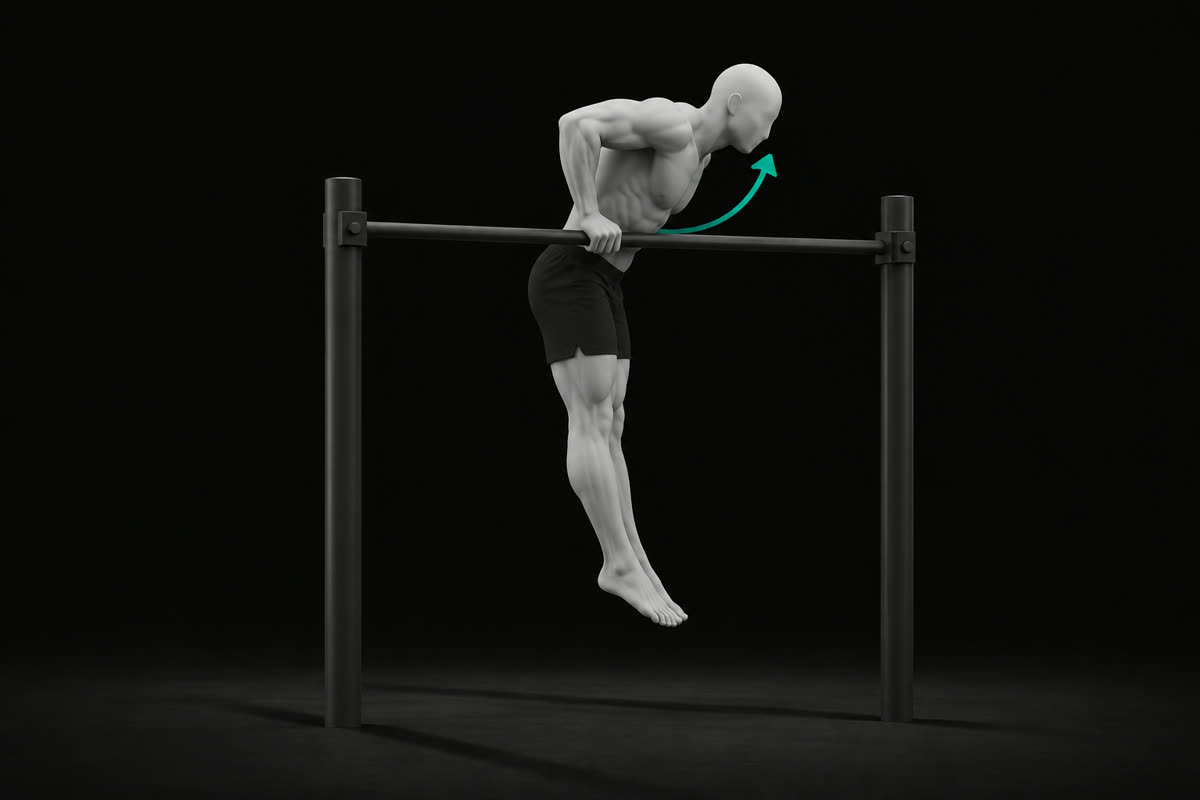
To get over the bar on a muscle-up, pull higher and faster than on a pull-up, bar toward your lower chest or stomach, with your body moving slightly around the bar rather than straight into it. As the bar reaches your chest, lean your chest over it, turn both wrists and elbows over together, then press to straight arms.
Why can't I get over the bar on a muscle-up?
Most failed transitions come from a pull that is too low, too slow or aimed straight into the bar, not from a lack of raw strength. Plenty of athletes pull and dip well, even weighted, and still can't do a muscle-up, because the transition is where most people struggle.
It is a common complaint on r/bodyweightfitness. In one thread, an athlete doing sets of 17 pull-ups with 10 kg had tried for four months without a single muscle-up, and mentioned still not being able to bring the chest to the bar with that weight. The replies agreed that the strength was there and the technique was missing. Check these causes in order:
- The pull stops at chin height. A regular pull-up ends too low to leave room for the turnover.
- The pull is slow. Speed from the very start of the pull lets the momentum carry you partway through the transition.
- The path goes straight into the bar. Your chest meets the bar before your shoulders can rise above it.
- The grip turns over late. A regular grip has to rotate further at the top than a false or half false grip.
- The support position is weak. This is less common, but if you can't press out of a deep straight bar dip, the rep stalls once you are over.
What do you need before training the muscle-up transition?
You need strict pull-ups that travel well past the chin and straight bar dips with a full lockout. As a rough guide, a base of around 12 to 15 strict pull-ups gives enough power, and if you can't press up from the bottom of a dip, fix that first. The targets below, like that base, are coaching estimates:
- Chest-to-bar pull-ups: 3 to 5 strict reps in a row where the bar touches your chest below the collarbones.
- Straight bar dips: 8 to 10 clean reps, chest close to the bar at the bottom and elbows locked at the top.
- Pain-free wrists and elbows: false grip work and transitions load both. If either hurts, stop that variation and see a physiotherapist if the pain persists.
If your pull-up count is stuck well short of that base, start with why your pull-ups are not improving and come back once the reps climb.
Should you use a false grip on the bar?
A false grip helps on a bar but is not required. It trades wrist comfort for an easier turnover, and a half version sits in between.
- Full false grip. Wrists flexed, knuckles above the bar. It sits between a pull-up grip and a dip grip, which removes the grip switch in the transition. Many athletes find it harder on a bar than on rings, because the hand is anchored and the wrist needs more mobility. It suits slow, controlled transitions and prepares you for rings.
- Half false grip. More of the hand on top of the bar than in a normal grip. It reduces how far the hands have to rotate, but expect your pull-up reps to drop with it at first.
- Regular grip. In practice, many bar athletes use it for fast muscle-ups. It works when the pull is high and fast enough for the wrists to roll over the top of the bar.
Whichever grip you choose, use it in your regular pull-up sets too, so the transition always starts from a familiar hand position.
What is the right pull path for a muscle-up?
Pull around the bar, not straight up into it. A circular path that keeps some space between your body and the bar makes the muscle-up easier, starting with the body slightly rocked forward, though not so much that it becomes a kip. The limit runs the other way too: a body that drifts far from the bar makes it harder to get over.
- Set: a still hang, legs together, arms straight, grip set.
- Pull: drive the bar toward your stomach, fast from the first inch, elbows close to your body.
- Turn over: as the bar reaches your lower chest, bring your chest and head forward over it while your elbows move from under the bar to behind it, both wrists at the same time.
- Press: lean over the bar and press to fully locked elbows.
To see where you stall, film one attempt from the side with the camera at bar height and your whole body in frame, then pause at the moment you try to turn over. If the bar is at your chin or collarbones, height is the limit. If it is at your lower chest or stomach and you still stall, the turnover is the limit. That side view is also how CaliLens scores a muscle-up: it checks that each rep starts from a full hang and gets over the bar, and flags kipping, body swing and legs drifting apart. It does not grade the finer points of your turnover.
Which drills teach the muscle-up transition?
Train pull height and the turnover separately, then join them. Do your full attempts early in the session, right after the warm-up, and the drills after. Sets and reps are coaching estimates.
- Banded high pulls. Raise the target in steps, from chest to bar, to lower ribs, to navel, with a thin band to bridge each new height. 4 sets of 3.
- Low bar transitions. On a bar at about stomach height, feet on the floor, start with the bar at your chest and elbows pointing down, then lean over and turn your elbows back into support, both wrists together. 3 sets of 5. A harder version starts in a deep dip on the bar and switches to the top of a pull-up and back.
- Jumping muscle-ups. Feet on a box, jump to help you through the transition, land balanced over the bar and press out. Lower the box as it gets easier. 3 sets of 3.
- Banded muscle-ups. A band under your feet does the same job, and a thicker band gives more help. Move to a thinner band once you get 3 clean reps.
- Negatives. Start in support, lower your stomach to the bar, then move slowly around the bar to the top of a pull-up and down to a hang. 3 sets of 2, slowest through the transition.
In practice, two or three sessions a week are enough. Keep your elbows close to your body on every drill. Once your form is solid, weighted strict pull-ups in sets of 3 to 5 reps add pulling power.
- Cue
- Pull the bar to your stomach, then bring your chest over it.
- Why
- A pull that stops at the chin leaves no room for the wrists and elbows to turn over. The extra height, with a path slightly around the bar, is what makes the transition possible.
- Drill
- Low bar transitions, 3 sets of 5, then 3 sets of 3 banded pull-ups to the lower ribs.
Is kipping fine on a muscle-up?
Kipping is fine when your goal is to get over the bar at all. Strict is the goal when you plan rings, added weight or a strict standard. A kipping rep takes part of its height from a hip and leg swing, while a strict rep gets all of it from the pull.
If you only want to get over the bar, a common approach is a small kip early on, then kipping less and less until the rep is strict. A kip gives valuable height and can bridge the gap after band work. Two cases call for strict work right away:
- The kip hides a low pull. If you only get over with a big swing, pull height is still your limit, and the swing will not build it.
- One arm gets over first. A swing often makes the turnover uneven. Read why a muscle-up goes over one arm first before adding more reps.
A muscle-up without momentum needs even more pulling height, so start each strict attempt from a still hang with your legs squeezed together. If you film your reps for CaliLens, kipping and body swing are flagged, which shows whether an attempt leaned on momentum.
When is your muscle-up ready for rings or weight?
Move on once you can string 3 to 5 clean strict muscle-ups: a full hang before each rep, no kip, both arms turning over together and locked elbows at the top. Our guide to when to progress in calisthenics uses the same gate. Until then, keep sets short, around 1 to 3 reps in practice, and end the set when your pull height starts to drop.
Frequently asked
How many pull-ups do you need for a muscle-up?
There is no fixed number, but as a rough coaching estimate, a base of around 12 to 15 strict pull-ups gives enough power. Height matters as much as the count: if your pull-ups stop at the chin, the muscle-up stays out of reach even with high reps. Work toward pulling the bar to your lower chest or stomach.
Do you need a false grip for a bar muscle-up?
No, but it helps. A false grip removes the grip switch in the transition, while a regular grip needs a higher, faster pull so the wrists can roll over the bar. A half false grip is a common middle ground on the bar.
Can you do a muscle-up without kipping?
Yes. A strict muscle-up uses no leg swing, and it is the version to own before rings or added weight. It needs a higher, more powerful pull than a kipping rep, so many athletes learn the turnover with a small kip and then reduce it.
What is the hardest part of the muscle-up?
The transition, when your wrists and elbows move from under the bar to over it. Many people who pull and dip well still fail at that point, which is why it pays to train it on its own with low bar and dip-to-pull drills.
Are jumping muscle-ups worth doing?
Yes, as a transition drill. Jumping from a box lets you feel the turnover and land in support before you have the pulling power for a full rep. Lower the box over the weeks so your pull does more of the work.