Blog · Pull-up · 7 min read
Pull-ups not improving? Why you're stuck at a few reps
A pull-up plateau at a few reps is rarely about effort. It usually comes from the same hard sets repeated every session, reps that do not fully count, or a change in body weight or grip.
Pull-ups stop improving at a few reps for a short list of reasons: every session is a max-effort grind, the weekly volume never grows, some reps are partial or swung, your recovery or body weight has changed, or your grip gives out first. Find the one that applies, then add clean volume with ladders, frequent easy sets and slow negatives.
Why are my pull-ups not improving?
Pull-ups stall when the training stimulus stays the same for weeks, or when the reps you count are not full reps. Six causes explain most plateaus between 1 and 5 reps, and more than one often applies.
- Every set to failure. Each set ends in a grind, form breaks on the last reps, and the next session starts tired.
- Flat volume. The same sets and reps every session, with no extra reps anywhere in the week.
- Partial reps. Reps that start with bent arms or stop with the chin level with the bar inflate the count without training the full range.
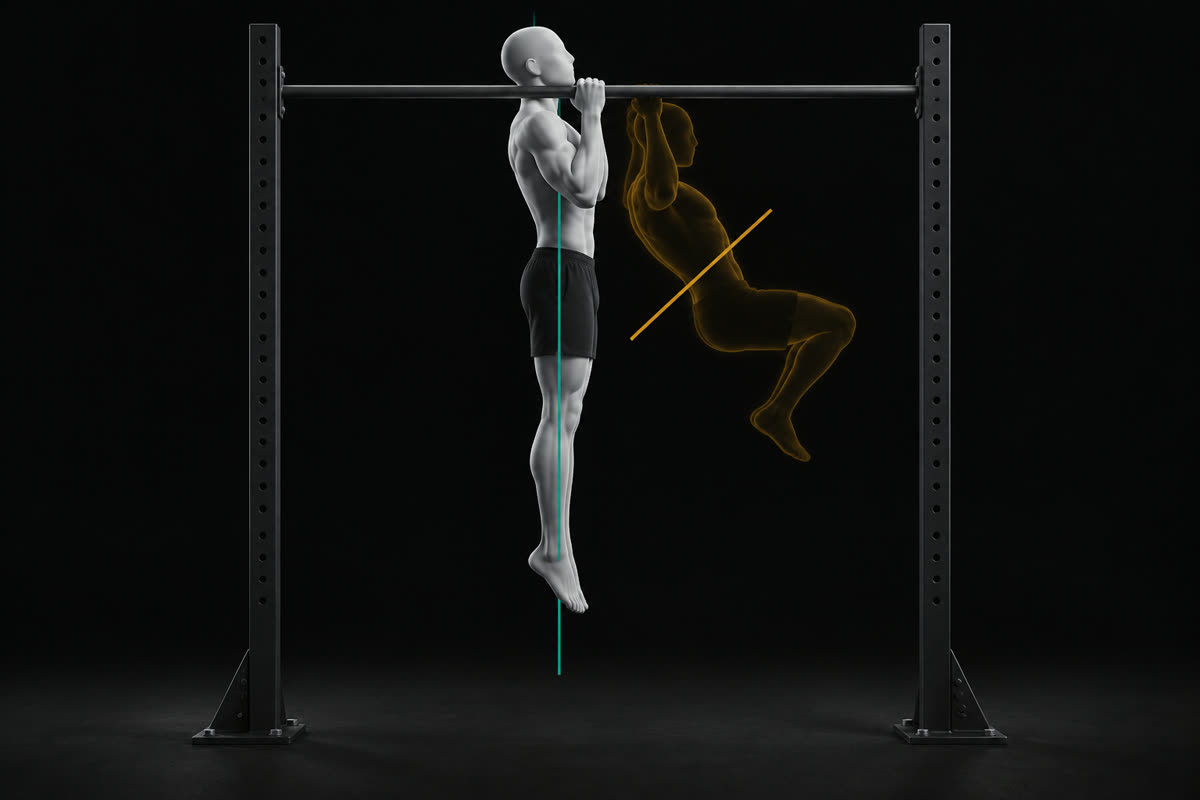
- Swinging. A kick or a pendulum shifts part of the work from your back and arms to your hips and legs.
- Recovery and body weight. Hard pulling on back-to-back days, or a few extra kilos to lift on every rep.
- Grip. Your hands open before your back is done.
Stalling like this is a common complaint on r/bodyweightfitness. In one thread, a lifter had spent a month trying to complete 5 sets of 4 pull-ups, three times a week, and kept ending the fourth and fifth sets with 2 or 3 bad-form reps. That single routine combines the first three causes.
Are you training to failure every session?
If every set ends in a grind, you are taking more sets to failure than you need. A 2022 meta-analysis of 15 studies found no significant difference in strength gains between training to failure and stopping short of it. In the studies where volume was not matched between groups, stopping short came out ahead for strength.
At 1 to 5 reps, the effect is easy to see. A max set of 4 leaves a few ugly reps for the sets that follow, and the session ends with maybe a dozen reps, several of them partial. Sets of 2, stopped with a rep or two left, let you do more sets with the same clean form, so the total climbs instead. Two changes fix this:
- Stop one or two reps before your form breaks. If your max is 4, most of your sets should be 2 or 3 reps.
- Grow the weekly total, not the single set. Add a set, a rep to one set, or a short extra session. In practice, the max follows the clean total a few weeks later.
Do all your reps count? Partial reps and swinging
A rep counts when it starts from straight arms, ends with the chin clearly over the bar, and uses no kick or swing. Reps that miss one of these still cost effort, but they train a shorter or easier movement, and they make it hard to tell whether you are progressing at all.
Swinging also changes which muscles do the work. In a study of 11 athletes comparing strict and kipping pull-ups, the kipping version showed much larger hip and knee movement, more activity in the abs and hip flexors, and lower biceps activity. The authors note that kipping may allow more reps by reducing upper-body fatigue, which is useful for a workout score and much less useful when the goal is a stronger strict pull.
Run this self-test on your next max set:
- Place your phone at chest height at a three-quarter angle, with your whole body and your feet in frame.
- Warm up, then do one max set as the first hard work of the session.
- Play it back slowly and check each rep: elbows fully straight at the bottom, chin clearly above the bar at the top, legs still.
- Write down two numbers: reps done, and reps that pass all three checks.
If the two numbers differ, your real max is the second one, and that is the number to build. To stop the swing, start every rep from a still dead hang with your legs straight and squeezed together, and pause for a second at the bottom. CaliLens counts the reps in a filmed set and flags partial range, a chin that stays under the bar, kipping and body swing, which makes that comparison quick.
Is it recovery, body weight or grip?
If your programming and your reps look right, check what changed outside the set. A pull-up lifts your whole body, so small changes on either side of the strength-to-weight ratio show up fast.
- Body weight. Gaining 2 kg at 70 kg adds about 3 percent to every rep. In another r/bodyweightfitness thread, a lifter stuck at 3 sets of 7 for two months mentioned that he had been bulking the whole time, and the replies pointed straight at the weight gain. A stall during a bulk is normal. Our guide to why you can't do a pull-up yet explains why relative strength matters so much.
- Recovery. Hard pull-ups on consecutive days, other heavy pulling such as climbing or rowing, or a max test at the end of a long session all hide your real level. Keep an easy day between hard pull-up sessions and test fresh.
- Grip. If your hands give out first, grip is the limit. In an 8-week study of 30 inactive young men, all three groups followed the same pull-up program, and the group that added forearm training made the largest gains in pull-up reps, grip strength and hang time. Finish your sessions with dead hangs.
How do you break a pull-up plateau?
You break a pull-up plateau by doing more clean reps across the week without grinding. Pick one of the two structures below, run it for four weeks, then test. Both keep most sets well below your max; they differ in how often you pull.
Option 1: daily ladders
A ladder is a series of short sets, each one rep lower than the last, such as 2, 1. The first set stays at least one rep below your max, so the whole ladder is submaximal, and repeating it on most days of the week adds up to far more clean reps than a few max sets. The numbers below are coaching estimates for a max of 3:
- Daily dose: two or three ladders of 2, 1, with a few minutes of rest between them.
- Progression: when every ladder feels easy, add one more, and start them at 3 once your max has grown.
- Rest: at least one full day off each week, and two or three easy days before you test.
Every rep in a ladder should pass the three checks from the self-test. It is a lot of weekly volume for the elbows, so pick the second option if they already ache.
Option 2: three sessions a week plus greasing the groove
If daily ladders do not fit your week, train pull-ups hard three times a week and add short, easy practice on the other days. The sets and reps below are coaching estimates for a max of 3 to 5 reps.
- Paused pull-ups: 5 sets of 2, with a one-second dead stop at the bottom and a one-second hold with the chin over the bar. Rest 2 minutes between sets.
- Slow negatives: 3 sets of 2, lowering over 5 seconds from chin over the bar to straight arms.
- Rows: 3 sets of 8 to 12 inverted rows, body straight, chest to the bar.
- Dead hangs: 2 sets of 30 to 45 seconds, legs together.
- Greasing the groove, on the other days: 1 or 2 clean reps, 4 to 6 times across the day, at least an hour apart, never close to failure.
Each week, add one rep to one paused set, or one practice set to a groove day. Keep added weight for later: until you own 3 sets of 8 at body weight, extra load mostly makes clean reps harder to come by. If your elbows or shoulders hurt during any of these, stop that variation and see a physiotherapist if the pain persists.
- Cue
- End every set with a rep still in the tank.
- Why
- A set taken to a grind turns the last reps into partial or swung reps and leaves you tired for the next session. Stopping early keeps every rep full and lets the weekly total grow.
- Drill
- Paused pull-ups, 5 sets of 2, with a one-second dead stop at the bottom of every rep.
When is the plateau broken, and what comes next?
Test every two to three weeks, as the first hard work of a session, and count only the reps that pass the three checks from the self-test. In practice, if your clean max has not moved after four weeks on one structure, switch to the other one.
Move on to added weight or a harder variation once pull-ups feel easy for high reps. A common coaching range is 3 sets of 8 strict reps, and our guide to when to progress in calisthenics applies the same logic to other exercises. If a muscle-up is the goal behind your pull-ups, pull height starts to matter as much as the count: see how to get over the bar on a muscle-up.
Frequently asked
Why am I stuck at 5 pull-ups?
Most often because every session repeats the same near-max sets, so the total never grows and fatigue builds. Partial or swung reps, weight gain and a weak grip are the other usual causes. Stop sets a rep or two short and add clean reps across more sets or more days.
Should I do pull-ups every day to improve?
Many people progress with frequent, submaximal practice, such as greasing the groove or short pull-up ladders on most days of the week. It only works if almost no set is a grind. If your elbows start to ache, drop back to three sessions a week.
How do I stop swinging on pull-ups?
Start every rep from a still dead hang with your legs straight and squeezed together, and pause for a second at the bottom. If you still swing, the sets are too long for now: do fewer reps per set and more sets.
Why don't I feel my lats during pull-ups?
Many people feel pull-ups mostly in the arms and grip, especially at low reps. Starting each rep by pulling your shoulders down, then driving your elbows toward your ribs, usually makes the back easier to feel. Judge progress by clean reps rather than by sensation.
When should I add weight to pull-ups?
Once bodyweight pull-ups feel easy for high reps. A common coaching range is 3 sets of 8 strict reps. Below that, your body weight is already a heavy load, and more clean reps will do more for you than a weight belt.