Blog · Lever vs planche · 6 min read
Front lever or planche first: which is harder?
Most people should start with the front lever. This guide explains why, when the planche is the better first pick, and how to train both without stalling either one.
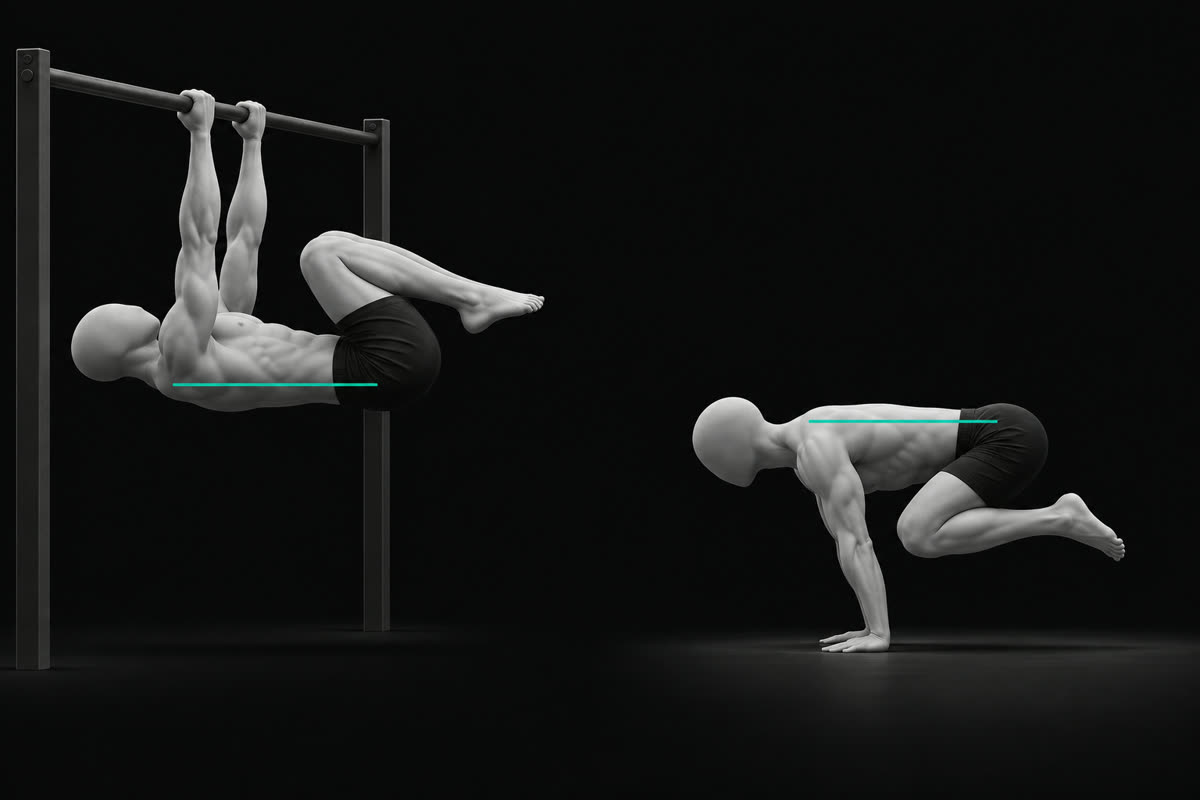
Learn the front lever first unless you already have a strong pushing base and wrists that tolerate your bodyweight. The planche is the harder skill: on the Overcoming Gravity charts it sits one level above the front lever at the tuck and three levels above it at the full version. The lever also spares your wrists.
The planche is still the more popular pick: more CaliLens users have scanned a planche than a front lever. How the two relate is a common question on r/bodyweightfitness. In one thread, an athlete about to start front lever training asked whether the similar body shape meant the strength would carry over to the planche. Replies agreed the two are opposites, a pull and a push, with little carry-over, and one added that this is what makes them a good pair to train together.
Which is harder, the front lever or the planche?
The planche is harder at every matching step, and the gap widens as the legs extend. The difference is small at the tuck and large at the full version.
The Overcoming Gravity progression charts, built mainly from the gymnastics Code of Points, rank each variation from level 1 to 16. The floor and parallette planche column against the front lever column reads:
- Tuck: front lever level 4, planche level 5.
- Advanced tuck: front lever level 5, planche level 6.
- Straddle: front lever level 6, planche level 8.
- One leg or half lay: front lever level 7, planche level 9.
- Full: front lever level 8, planche level 11.
The same charts put the ring front lever at level 8 and the full ring planche at level 14. In practice, the full front lever is an intermediate goal on these charts, and the full planche an advanced one.
Why is the planche harder than the front lever?
The planche pushes with straight arms while your shoulders lean far past your hands, and your wrists carry the whole load. The front lever pulls with the large back muscles that pull-ups and rows already train.
Steven Low, who wrote Overcoming Gravity, sums up the two in The Fundamentals of Bodyweight Strength Training: the front lever is one of the pulling statics, the planche one of the pushing statics, and "in the planche the primary shoulder muscle (anterior deltoid) is placed in an extended position." Three differences follow from that:
- The lean. A planche only balances when your shoulders travel well past your hands. Every step up moves more weight behind the shoulders and asks for more lean, so balance and strength progress together.
- The muscles. The front lever leans on the lats, which pull-ups and rows build from your first months of training. Straight-arm pushing at the front of the shoulder is rarely trained before the planche.
- The wrists. In a front lever you hang from a bar with neutral wrists. In a planche, your bent-back wrists take your full bodyweight, pushed forward.
What do CaliLens scans show for each skill?
Among CaliLens scans, neither skill comes out cleaner than the other. The median score is the same for both, and the median holds are close.
Across the planche and front lever scans analyzed by CaliLens, the median score was 85.4 out of 100 for both skills. The median hold was 6.7 seconds on the planche and 5.7 seconds on the front lever, both under the 8 seconds used on this blog as the bar to move on. The chart gap is about how much new strength each next step demands, not about one skill being cleaner at your current step. Both skills share the same traps, too: hips that sink below the line, which you can read about in why your hips are too low in the tuck planche and why your hips sag in the front lever.
How do you choose between the front lever and the planche?
Choose by your current base, your wrists, your equipment and the skill you actually want. When those point in different directions, the front lever is the safer first pick.
Pick the front lever first if:
- You already do strict pull-ups and rows. As a coaching estimate, 5 to 10 strict pull-ups make the tuck front lever realistic.
- You have a bar or rings.
- Your wrists complain on push-ups, handstands or planche leans.
- You want the quickest first milestone. The tuck front lever sits lower on the charts than the tuck planche.
Pick the planche first if:
- Your pushing base is strong: more than 20 clean push-ups and solid dips.
- You already practice handstands and your wrists handle your full bodyweight.
- You train at home with no bar. The planche needs only the floor, and parallettes help.
- The planche is the skill you actually care about. A skill you want will keep you training for the months it takes.
Train both if:
- You train three or more times a week and recover well between sessions.
- You are willing to make one the main skill and keep the other at a lower volume.
Your build matters for both skills, since a longer or heavier body means a longer, heavier lever. It changes how long each step takes more than which skill should come first.
What about your wrists?
If your wrists are sensitive, start with the front lever. The planche loads bent-back wrists with your whole bodyweight from the first lean.
Wrist pain is common in hand-balancing practice. In a 2025 survey of 321 adults who practice handstands, another skill that loads straight arms on bent-back wrists, 56.7% reported chronic wrist pain. Sore wrists are also a common obstacle in planche training, usually from too little preparation or from pushing planche leans too soon. Warm your wrists up before every session, use parallettes if the floor bothers you, and if either skill hurts your wrists or elbows, stop the painful variation and see a physiotherapist if the pain persists.
A quick self-test to pick your first skill
Test both on the same day, rested, and film each hold from the side with the phone at hip height. One session is enough.
- Tuck front lever. Hold as long as your arms stay locked and your hips stay level with your shoulders.
- Planche lean readiness. As a coaching estimate, a solid push-up plank held for 30 seconds, without sinking into your shoulders or shaking, means you are ready to start planche leans.
- Tuck planche attempt. Lean until your feet float, and hold as long as your arms stay locked and your hips level.
Then apply a simple rule. If your tuck front lever is the longer clean hold, start there. If your tuck planche matches or beats it and your wrists felt fine, the planche is a realistic first skill. If neither lasts 3 seconds, start with the front lever and build rows and planche leans on the side. CaliLens scores both skills, from the tuck to the full version, so you can scan each hold and compare a score and a hold time side by side.
How do you train both without stalling?
Give one skill the priority and keep the other at maintenance. Running both at full volume leaves little room to recover.
- Main skill first, while you are fresh: 5 to 6 sets at about 60 to 70 percent of your best clean hold, the range Steven Low uses for isometrics.
- Second skill after, 2 to 3 sets of the same kind.
- Strength work for each: rows and front lever raises for the lever, planche leans, dips and push-ups for the planche.
- Swap the priority every few weeks if you want both, and cut sets before you add them.
Keep an eye on recovery. In a 2021 survey of 93 street workout athletes, 62.4% reported an injury in the previous 12 months, the shoulder was the most often injured area, and overtraining was the cause injured athletes named most often.
When can you move to the next step in either skill?
Use the same bar for both: 3 sets of 8 clean seconds, arms locked, hips level, no swing or drift, checked on video. Only then does the next variation become your main hold.
The big early jump on the lever, from tuck to advanced tuck, is covered in tuck to advanced tuck front lever. The general rule for every skill is in when to progress in calisthenics.
Frequently asked
Is the planche harder than the front lever?
Yes. On the Overcoming Gravity progression charts, every planche step sits above the matching front lever step, and the gap grows: one level at the tuck, two at the straddle and three at the full version, level 8 for the full front lever against level 11 for the full planche.
Can I train the front lever and the planche at the same time?
Yes. One is a pull and the other a push, so they fit in the same week. Make one the main skill with most of the sets, keep the other at two or three sets, and cut volume first if your elbows, shoulders or wrists complain.
How many pull-ups do I need before the front lever?
There is no fixed number. As a coaching estimate, 5 to 10 strict pull-ups and solid rows make the tuck front lever a realistic goal. The lever needs straight-arm strength more than a high rep count, so start tuck holds early.
Do I need a handstand before learning the planche?
No, but time on your hands helps. Handstand practice gets your wrists used to carrying your bodyweight, which the planche asks for from the first lean. If your wrists already complain on push-ups, build that tolerance before you push planche leans hard.
I have no pull-up bar. Which skill should I start with?
The planche. It needs only the floor, and parallettes or two sturdy blocks make it easier on your wrists. Add the front lever once you have access to a bar or rings.