Blog · L-sit · 6 min read
Why is the L-sit so hard, and how do you fix it?
The L-sit asks your hip flexors to hold straight legs up at their shortest length while your arms press you off the floor. Find the part that fails first and train that part.
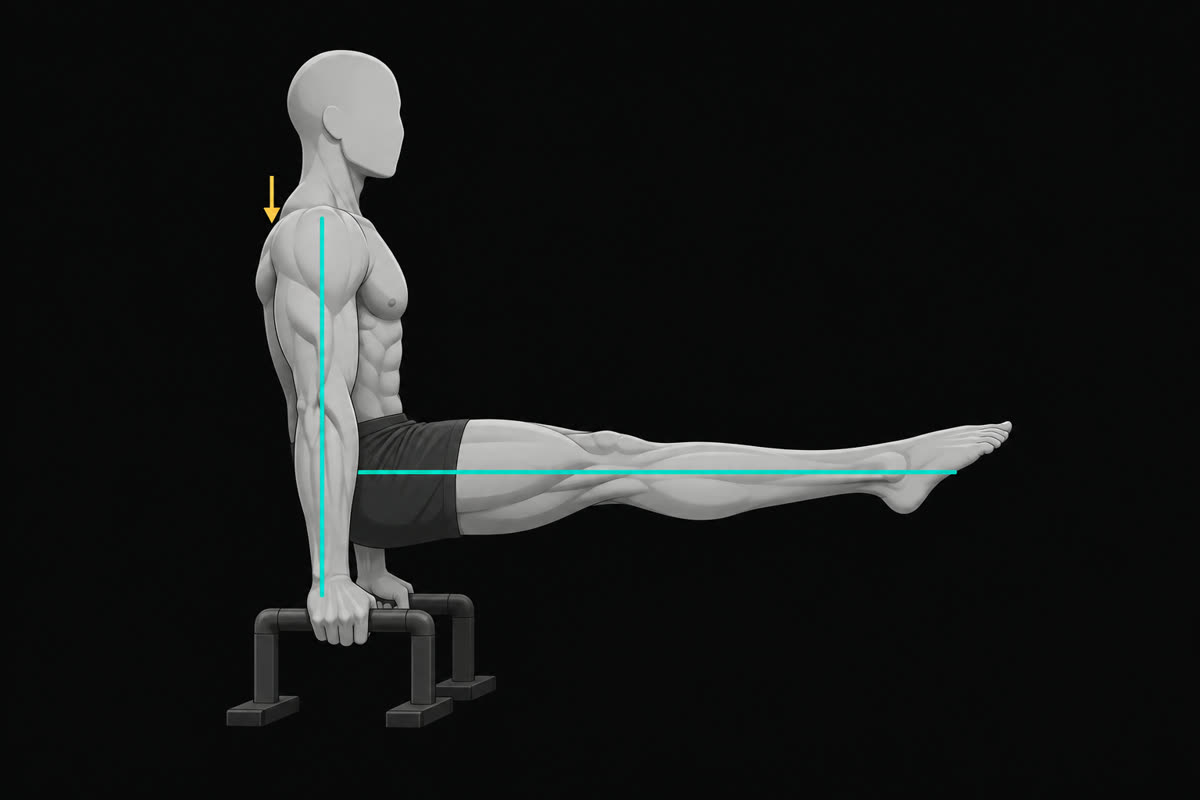
The L-sit is hard because it asks your hip flexors to hold straight legs up while they are almost fully shortened, a position daily life rarely trains, while your arms press your whole body off the floor. Most athletes fail on compression, on shoulder push or on hamstring length. Find which one fails first and train it directly.
It also looks easier than it is. The Overcoming Gravity progression charts place the L-sit at level 3 of 16, among the beginner skills, yet across the L-sit scans analyzed by CaliLens (all variations), the median hold was 6.7 seconds, short of the 10 clean seconds used on this blog.
Bent legs are a common complaint on r/bodyweightfitness. In one thread, an athlete two months into the Recommended Routine could not keep the legs straight in any kind of L-sit and asked whether the core or flexibility was to blame. Replies pointed to the hip flexors, to tight hamstrings and calves, or to both, and one summed it up: being flexible and lifting your legs actively are two different things.
Why is the L-sit so hard?
The L-sit stacks four demands in one position, and any one of them can end the hold.
- Active compression. Your hip flexors must lift your legs while your hips are already closed. Coaches call this compression strength: enough hip flexor drive to pull the legs up and keep them there. Touching your toes does not mean you can lift them.
- Pressing down. Straight arms and shoulders pushed away from your ears lift your hips high enough for your heels to clear the floor.
- Hamstring length. Straight knees pull on the back of the thighs, so tight hamstrings make the legs bend.
- Leverage. Straight legs put their weight far from the hip joint. The tuck keeps it close, which is why a tuck L-sit can feel easy while the full version feels impossible.
Why do my shoulders shrug in the L-sit?
Your shoulders creep toward your ears when they stop pushing down. It is a frequent fault: in CaliLens L-sit scans, 36.1% held the shoulders shrugged, more than one in three.
A shrugged L-sit hangs on the shoulder joint instead of pressing through it, and the hips sink with it. Steven Low writes in his article on scapular positioning that the shoulder blades "should be depressed and neutral during the L-sit", and notes that people tend to let them drift forward.
- Cue
- Push the floor down, shoulders away from your ears.
- Why
- Shrugged shoulders mean you are hanging on the joint instead of pressing through your arms. Pressing down is what lifts your hips and gives your legs room.
- Drill
- Scapular support holds, 3 x 15 seconds: arms locked, press tall, shoulders down.
Why won't my legs stay straight in an L-sit?
Your knees bend because your hamstrings are tight, because your hip flexors cannot hold the long lever, or both. Bending shortens the lever and eases the stretch, so the body does it without asking.
Tight hamstrings make straight legs harder, but they rarely make the L-sit impossible on their own. Two quick tests tell you which limit is yours:
- Pike test. Sit on the floor with your legs straight and together, toes pointed. If you cannot sit tall without rounding your lower back or bending your knees, hamstring length is part of the problem.
- Compression test. In the same seat, put your hands flat on the floor beside your knees and try to lift both heels a few centimeters for 5 seconds, knees locked, without leaning back. If the heels stay down, your hip flexors are the limit, and no amount of stretching fixes that alone.
Point your toes as well. It tightens the calves and helps lock the knees, and a flexed foot makes the line look shorter than it is.
Why do my legs drop, or climb too high?
Legs drop when the hip flexors fade. Legs climb when you keep folding at the hips past the L, which turns it into a V.
Across the L-sit scans analyzed by CaliLens, 19.4% had the legs dropping below horizontal. The fix is strength in the shortened position, not more stretching: seated leg raises and compression lifts train exactly that. Climbing legs are the opposite drift: a V is a different hold, so the seconds you log no longer count as an L-sit. CaliLens flags legs that sit about 20 degrees or more below horizontal for a sustained part of the hold, and legs that climb above horizontal. Aim for heels at hip height, legs parallel to the floor.
Leaning back is the real shortcut. It moves your hips behind your hands and eases the compression. The same share, 19.4% of those scans, had the torso leaning well off vertical. Bring your chest up over your hands.
How do I test my L-sit on video?
Film from the side with the camera at hip height. That view shows your arms, your shoulders and the angle of your legs in one frame.
- Set the phone level at the height of your hips, 2 to 3 meters (7 to 10 feet) away, in landscape, with your hands and feet in frame.
- Start counting once your heels are up and you are still.
- On the video, check your elbows (locked), the space between your ears and shoulders (visible), your torso (close to vertical), your legs (level with your hips, knees straight, toes pointed).
- Watch for shaking. Across the same scans, 30.6% were flagged as unstable.
- Count only the seconds where all of this holds. That is your real L-sit.
For lighting, distance and framing, see how to film yourself for a form check.
What is the best L-sit progression for beginners?
Build the position from the easiest lever up, and add compression work beside it. Each step shortens or lengthens the legs, so you can always find one you hold cleanly.
- Support hold on parallettes, dip bars or two chairs: 3 x 20 seconds, shoulders down.
- Foot-supported L-sit: heels on the floor, hips lifted, 3 x 15 seconds. Then lift one foot at a time.
- Tuck L-sit: knees pulled to the chest, 3 x 10 to 15 seconds. It is level 1 on the Overcoming Gravity charts.
- One-leg L-sit: one leg tucked, the other straight, switching sides each set. Level 2 on the same charts.
- Full L-sit: both legs straight, level 3.
Next to the holds, do seated leg raises (3 x 10, lifting the feet above hip level) and compression lifts (3 x 10, hands under the thighs, lifting the knees), plus a pike stretch if the pike test was hard. For the holds, Steven Low programs isometrics at about 60 to 70 percent of your max.
Can you do an L-sit without parallettes?
Yes. The floor is the hardest place to learn it, because your hands sit at hip height and your heels have less room to clear.
Anything that raises your hands helps: two sturdy chairs, yoga blocks, a stack of books or dip bars all work, so use what you have. Parallettes make the pressing feel easier to find. You can also hang from a pull-up bar. A hanging L-sit removes the press but keeps the compression, so it is a good way to train the legs if your wrists need a break. CaliLens scores the hanging version as well as the supported one. On the floor, if your wrists hurt, switch to parallettes or bars, stop the painful variation, and see a physiotherapist if the pain persists.
How long should you hold an L-sit before moving on?
Move on when you hold your current variation for a clean 10 seconds: arms locked, shoulders down, legs level, no shaking. Ten seconds is the L-sit bar used on this blog, a little higher than the 8 seconds used for levers.
Judge it on video, and on your last set, not your first. After the full L-sit, the charts continue with the straddle L-sit at level 4 and, later, the V-sit. The same move-on rule applies to every skill, as explained in when to progress in calisthenics.
Frequently asked
How long should I hold an L-sit?
A clean 10-second hold is a good bar before you try a harder variation. For training, hold several sets at about 60 to 70 percent of your best clean hold. Count only the seconds with straight arms, shoulders down and legs level.
Can I do an L-sit without parallettes?
Yes. On the floor your hands sit level with your hips, so you need more push and more compression to lift your heels. Two sturdy chairs, yoga blocks, dip bars or a pull-up bar for a hanging L-sit all work.
Do tight hamstrings stop you from doing an L-sit?
They make straight knees harder, but they rarely block the skill on their own. Keep training a tuck or one-leg L-sit while you work on your pike flexibility, and test whether your hip flexors can lift your legs at all.
Is the L-sit an ab exercise?
Partly. The abs hold your trunk, but the hip flexors lift the legs and the shoulders and triceps hold you up. Weak hip flexors in the shortened position are the usual limiter.
Why do my legs shake in an L-sit?
Shaking usually means you are close to your limit in that position. Pick a variation you can hold still, build seconds there, and move up once a still 10-second hold feels controlled.