Blog · Handstand · 8 min read
How to kick up into a handstand, even if you are scared
A kick-up feels like a leap of faith until you know two things: where your shoulders go and how you get out. Learn those first and the kick gets smaller, quieter and far less scary.
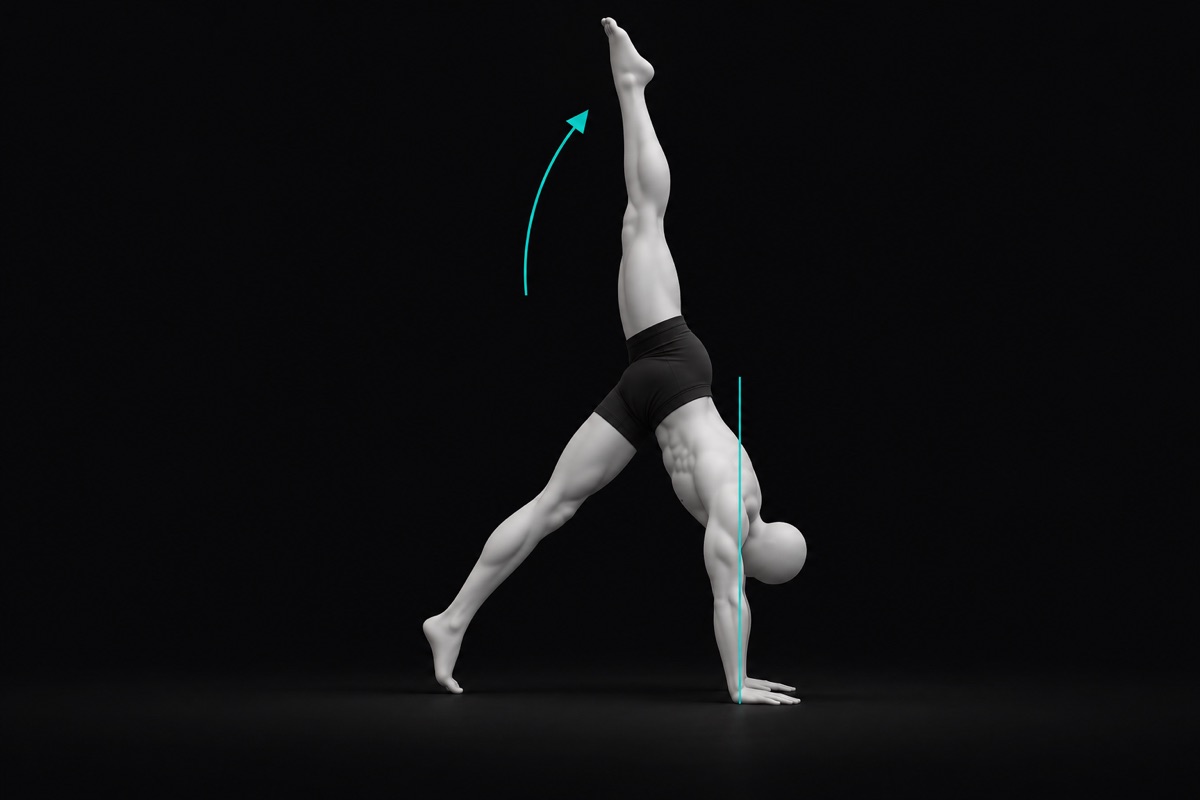
To kick up into a handstand, start in a long lunge with your arms by your ears, tip forward as one straight piece, and land your hands with your arms locked. The one thing that makes it consistent: get your shoulders over your hands before your legs arrive. Then swing the back leg up straight, using the smallest kick that brings your hips over your shoulders. If you are afraid, learn to cartwheel out first. That removes most of the fear.
Kick-up advice comes from coaches and practitioners, not lab data. A 2025 systematic review of handstand biomechanics did not cover the kick-up at all (MacDonald and colleagues).
Which leg should you kick with, and what is the scissor?
Most people lunge on their stronger leg and swing the other one. Try 5 easy kicks per side and keep the steadier one.
The scissor is the shape your legs make on the way up: the swing leg leads, the lunge leg follows, and they close only at the top. Steven Low, author of Overcoming Gravity, prefers the lunge kick-up because it keeps your arms and body in a straight line, so all that is left is finding the balance.
How do you kick up into a handstand, step by step?
- Stand tall, arms straight overhead, ears between your arms, ribs in.
- Step into a long lunge. Front knee bent, back leg straight, one line from back foot to fingertips.
- Tip forward as one piece. Low describes the lunge as a lever: the straight body goes upside down around it. Do not fold at the hips to reach for the floor.
- Land your hands shoulder width apart, fingers spread, about an arm's length ahead of your front foot.
- Lock your elbows and push the floor away, shoulders over hands, eyes on the floor just ahead of your fingers.
- Swing the back leg up, knee straight, while the front leg pushes. Push, do not jump.
- Bring your hips over your shoulders. The legs follow the hips, never ahead of them.
- Close the scissor at the top, or come back down one foot at a time.
Why do your shoulders have to arrive before your legs?
Because the legs cannot fix what the arms got wrong. In a thread on kick-up consistency, one reply explained it: start with your shoulders too far back, and by the time your legs are vertical they sit over your shoulders, but your shoulders are not over your hands. Another reply gave the fix: set them over the wrists before you kick, not behind them as in a downward dog.
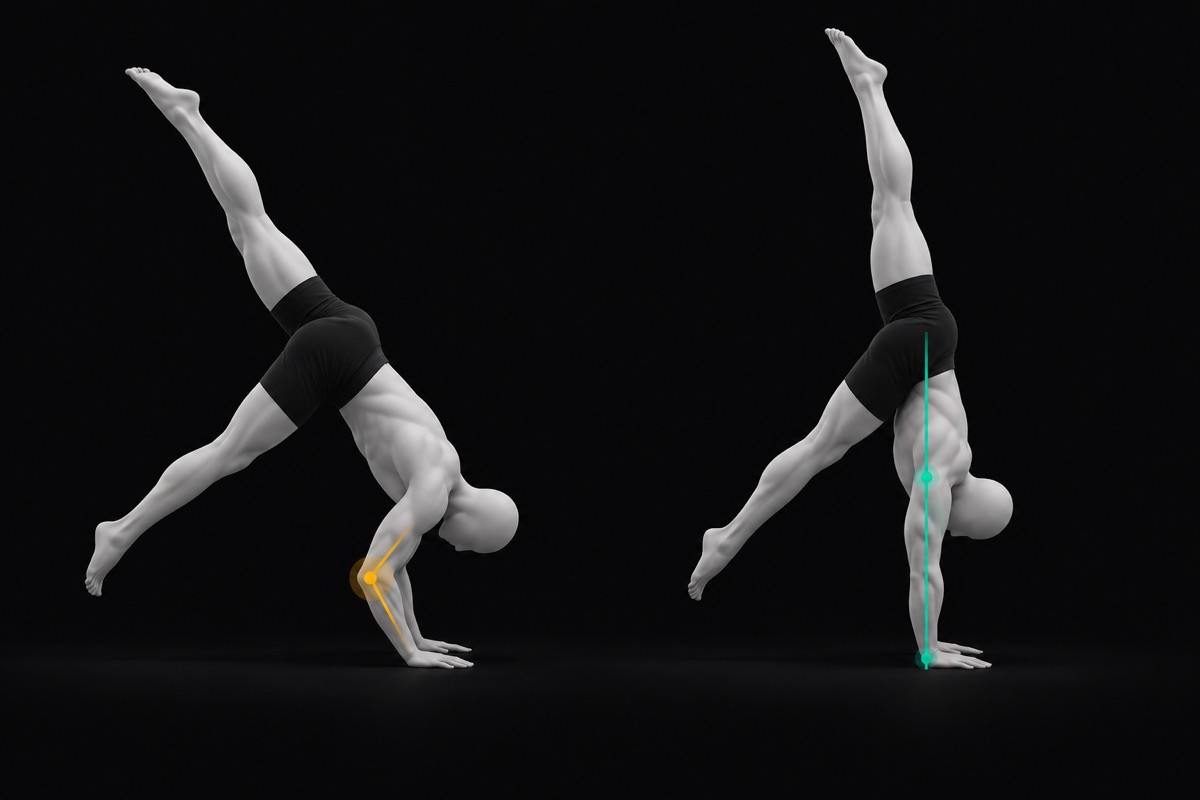
Over means over, not past: the same reply warns that pushing the shoulders well in front of the hands takes you away from the stack. Film from the side and pause where your back foot leaves the floor. A vertical line up from your wrist should pass through your shoulder.
How hard should you kick?
Only as hard as it takes to bring your hips over your shoulders. A reply in a thread from someone who kicked too hard and fell on their face made the point: a powerful kick leaves you fighting momentum instead of thinking about your shoulders. Another reply: kick up, not over.
- Too hard: your heels slam the wall, or you arch or tip toward your back. Kick softer.
- Too weak: your feet come down short of vertical. Check your shoulders first: being too far back feels just like being too weak. If they are in place, push a little more with the front leg.
- All over the place: Low usually blames the wall work, not the kick: the body wobbles on the way up.
Which drills make your kick-up consistent?
- Small hops. From the lunge, hands down, swap your feet in the air and land softly. 3 sets of 5 per leg. Start at knee height. Move on when your hips reach your shoulders with locked arms on every hop.
- Kick-ups to a wall. Back to the wall, hands about 15 to 30 cm (6 to 12 inches) from it. 3 sets of 5. Touch the wall with one foot, without a sound.
- The wall as a target. Same setup, but touch and leave at once, or stop just short of it. Arriving and staying a second without touching means your kick is close to right.
- Kicks in open space. Half height at first, on grass or a mat, ready to turn out. Stay on the wall too long and overkicking gets harder to fix, the same thread warns.
Low starts his clients' kick-up work once they hold 15 to 20 seconds chest to wall with the feet off, on the way to freestanding. Hops and soft wall kicks can start once you are comfortable in a chest-to-wall hold.
How do you bail out of a handstand safely?
Turn out to the side, like the end of a cartwheel. In a popular r/bodyweightfitness post, someone who had avoided open-room kick-ups for years spent a few gym sessions on the bail alone, and it came fast. In a thread from someone scared to kick up, the top reply said the fear comes from not knowing how to get out. Low agrees: learn the pirouette or the roll on the ground, then at the wall, then in a real handstand.
- Find soft ground, grass or a mat, with space all around. In one cautionary thread, someone who had never done a cartwheel tried the bail on marble and landed on their face.
- Baby cartwheels. Squat, hands down, hop your feet to the other side of your hands. 5 per side, higher each set.
- Low kick, then turn. Kick to half height, lift one hand, turn your hips and step down to the side. 5 per side. The dropping leg drives this, not a spin around the shoulder.
- Go higher each set, until you can turn out of a full handstand to both sides.
The pirouette is a tighter version: one hand steps around, you turn on the spot, your feet come down. The forward roll is the other exit, which an acro instructor in that post teaches first. Tuck your chin, bend your arms slowly and roll across your upper back, only on a soft surface.
What are the most common kick-up mistakes?
Bent arms. The elbows soften when the hands land or the legs swing.
- Cue
- Lock the elbows before the foot leaves the floor.
- Why
- The handstand review links elbow bending with a failed wrist strategy and big losses of balance.
- Drill
- Hops at knee height, 3 x 5 per leg. If the elbows bend on video, go lower.
Shoulders behind the hands. You start in a downward dog shape and your legs arrive over a slanted arm.
- Cue
- Lean in until your shoulders sit over your wrists, then kick.
- Why
- A slanted arm leaves your hips short of the stack.
- Drill
- In the lunge with your hands down, hold your shoulders over your wrists for 3 seconds, then kick. 3 x 3.
Looking too far. You crane your neck to look across the room, or tuck your chin to look at your belly.
- Cue
- Eyes on the floor just ahead of your fingers.
- Why
- Craning tends to pull the back into an arch. In the review, bending the neck forward made balance harder.
- Drill
- Put a coin a hand's length past your fingertips and look at it through 5 kicks.
Kicking with a bent leg. The swing leg whips up from the knee, like a donkey kick.
- Cue
- Long leg, pointed toes, start to finish.
- Why
- A bent leg shortens the lever, so you need a harder, less accurate kick.
- Drill
- One hand on a wall, swing the straight leg behind you 10 times per side. Then 3 x 5 hops, knee locked.
Overshooting. Your legs fly past vertical and you arch or bail.
- Cue
- Hips first, legs last. Stop at the top.
- Why
- An arch is how you save an overkick, and the habit sticks. See how to fix a banana handstand.
- Drill
- 5 silent wall touches, pressing your fingertips down as you arrive. The method is in how to balance a handstand.
How many kick-ups should you do per session?
Start with about 10 full attempts plus your hops, 2 to 4 times a week, resting 30 to 60 seconds between attempts. These are coaching estimates. Do them early: in a 2024 study of 14 male acrobatic gymnasts, fatigue increased side-to-side sway in the handstand (Sabido and colleagues).
- Stop for the day when 2 attempts in a row get worse, or your arms start to bend.
- Go by your wrists. If they ache the next morning, halve your attempts next time and take an extra day off.
- Add slowly, 2 or 3 attempts at a time, only if your wrists feel normal the next day.
Warm up first with the routine in wrist pain in push-ups and handstands.
When should wrist or shoulder pain stop you?
When it is joint pain, not muscle soreness. In a 2025 survey of 321 adults who practice handstands, 56.7% reported chronic wrist pain, with no clear link to how often they trained (Martonovich and colleagues).
See a physiotherapist or doctor if:
- pain lasts more than 2 weeks after you cut the load;
- a wrist hurts at one specific spot or swells, especially after a fall onto your hand;
- you feel numbness or tingling in your fingers or hand;
- you feel a pop or a sharp pain, or your shoulder feels unstable or catches.
Get urgent care after a blow to the head followed by a headache, confusion, dizziness or vomiting. Ask a doctor before going upside down if you have high blood pressure, an eye condition such as glaucoma, or a past neck injury. More in shoulder pain in calisthenics.
What comes after a consistent kick-up?
Move on when 8 of 10 kicks arrive softly, arms locked, hips over shoulders, and you can turn out to both sides. Next comes staying up: how to balance a handstand without the wall. Keep some wall work: Low never drops it entirely.
Film from the side, phone at hip height, 2 to 3 meters (7 to 10 feet) away, with room for your legs at the top. Once you can hold it, CaliLens can score your freestanding handstand from that view. It scores the hold, not the kick-up. For light and framing, see how to film a calisthenics form check.
Frequently asked
Can I learn to kick up without a wall?
Yes, on grass or a mat, once you can cartwheel out to the side. A wall makes the first weeks calmer because it stops you going over, so most people start with one. Leave it early enough that it does not become the only way you know how to stop.
Why can I only kick up with one leg?
That is normal, and your strong side is fine for your main practice. Give the other side a few easy hops each session so it does not feel foreign. You do not need both sides to hold a handstand, but you do want to bail to both sides.
Is it better to hop up with both feet?
It can work. The hop from a bent-over position takes more flexibility and more control to reach a straight line. For most beginners the lunge is simpler, because the body is already long when the hands land.
I am too scared to kick up even at a wall. What now?
Skip the kick for now. Start in a push-up position with your feet at the wall and walk up until you are comfortable, then walk down. Repeat over a few sessions while you practice cartwheels on the floor. The kick is easier once being upside down feels ordinary.
How long does it take to get a consistent kick-up?
There is no reliable number, and it varies a lot with your wall handstand and how often you practice. Track a simple measure instead: how many of your 10 kicks arrive with hips over shoulders and arms locked. When that climbs, you are on track.