Blog · Shoulder pain · 8 min read
Shoulder pain in calisthenics: causes, fixes and red flags
Most training shoulder pain builds over weeks of too much, too deep or too fast. Fix the position, shrink the dose, and learn the few signs that need an examination instead of a new drill.
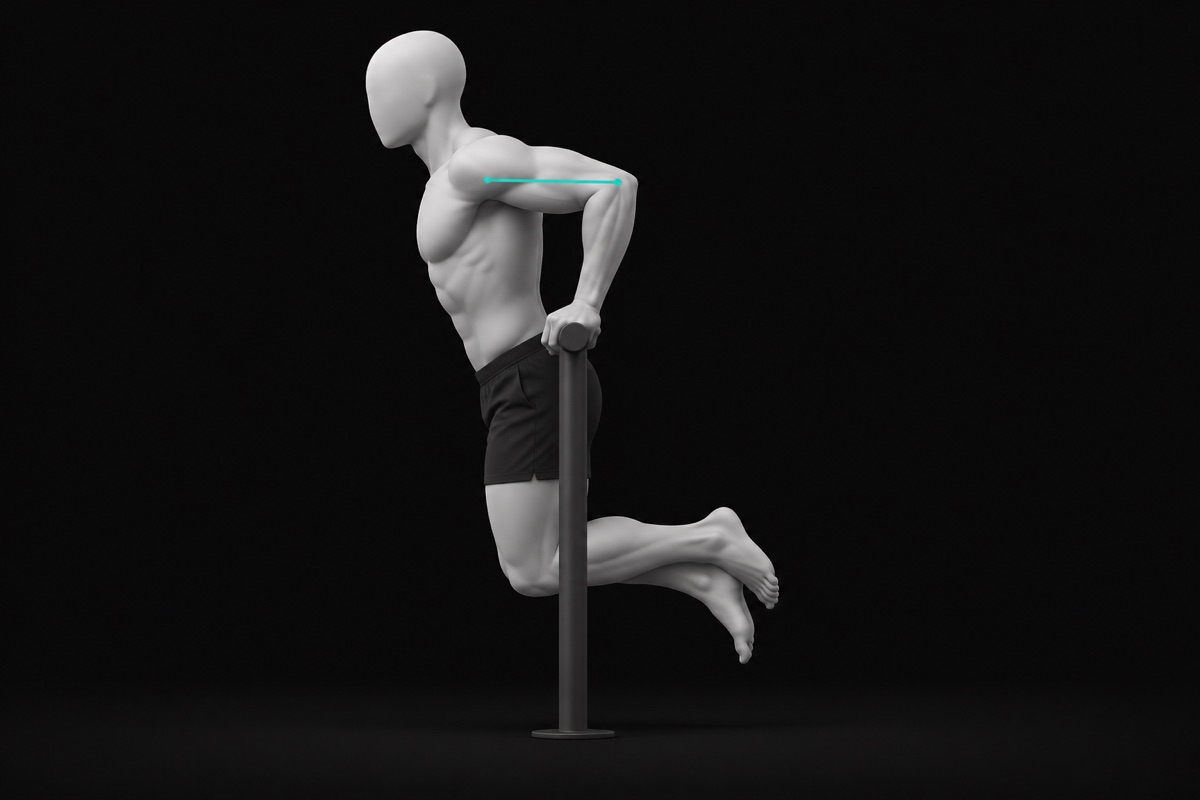
Shoulder pain in calisthenics usually shows up at the front of the shoulder in deep dips and push-ups, as a pinch overhead in handstands and pike push-ups, or after kipping pull-ups and muscle-ups. The usual causes are volume added too fast, depth forced too soon, flared elbows, shoulders that shrug or roll forward, and swinging into reps. Change the position, cut the dose of what hurts, and see a physiotherapist or doctor for pain after a fall, night pain, weakness, tingling down the arm or a shoulder that feels unstable.
This article is not a diagnosis: only an examination can tell shoulder problems apart. It covers what tends to help with common training pain, and the signs that need an appointment.
In a survey of 181 Dutch calisthenics athletes, 59% reported an injury in the previous 12 months, and the shoulders topped the list of injured body parts, at 32%.
Pain matters more than noise. In a popular r/bodyweightfitness thread warning about shoulder clicks during dips, a commenter who works in orthopedics said painless pops and clicks are not what clinicians worry about, and that the poster's shoulder tightness was the more telling sign. Another found the gym dip bars too wide for a narrow frame, and dips became comfortable on narrower bars.
When does your shoulder hurt?
- Front of the shoulder in deep dips and push-ups. An ache at the front as you lower, worse the deeper you go.
- Bottom of the dip. A sharp or pulling feeling at the deepest point, often when the shoulders roll forward to buy extra depth.
- Pinching overhead. A pinch at the top or side of the shoulder in handstands, pike push-ups or wall walks.
- Kipping pull-ups and muscle-ups. Pain at the bottom of a swing, or during the turnover of a muscle-up.
Tingling down the arm or pain that began with a fall do not fit these patterns: see the red flags at the end.
Why do dips, push-ups and pull-ups hurt your shoulders?
Because the dose outran what the shoulder was ready for, or the position put the load in the wrong place. Five habits come up again and again:
- Volume jumps. A new program, a push-up challenge, or a comeback at your old volume. In the Dutch survey, training several sessions a day was linked with more injuries. So was having trained for 6 months to 4 years.
- Range forced too deep, too soon. In a motion-capture study of bench, bar and ring dips, 13 experienced men used about 88% of their own shoulder extension range on bar dips, and slightly more than their measured maximum on bench dips. The authors warn that this end range may strain the front of the shoulder capsule.
- Flared elbows in push-ups. Elbows straight out to the sides, so the body makes a T shape from above.
- Shrugging or rolling forward at the bottom of dips. The shoulders creep up to the ears, or tip forward over the hands to find more depth.
- Kipping. A swing loads the shoulder suddenly at the end of its range.
Tendons also adapt slowly. A meta-analysis of tendon loading studies in healthy adults found tendons responding over programs of 8 weeks or more, with bigger changes past 12 weeks. A new program adds sets in days.
Where should your elbows point in a push-up?
Back toward your hips, about 45 degrees from your body. That is the default many coaches use, though research has not settled on one ideal angle.
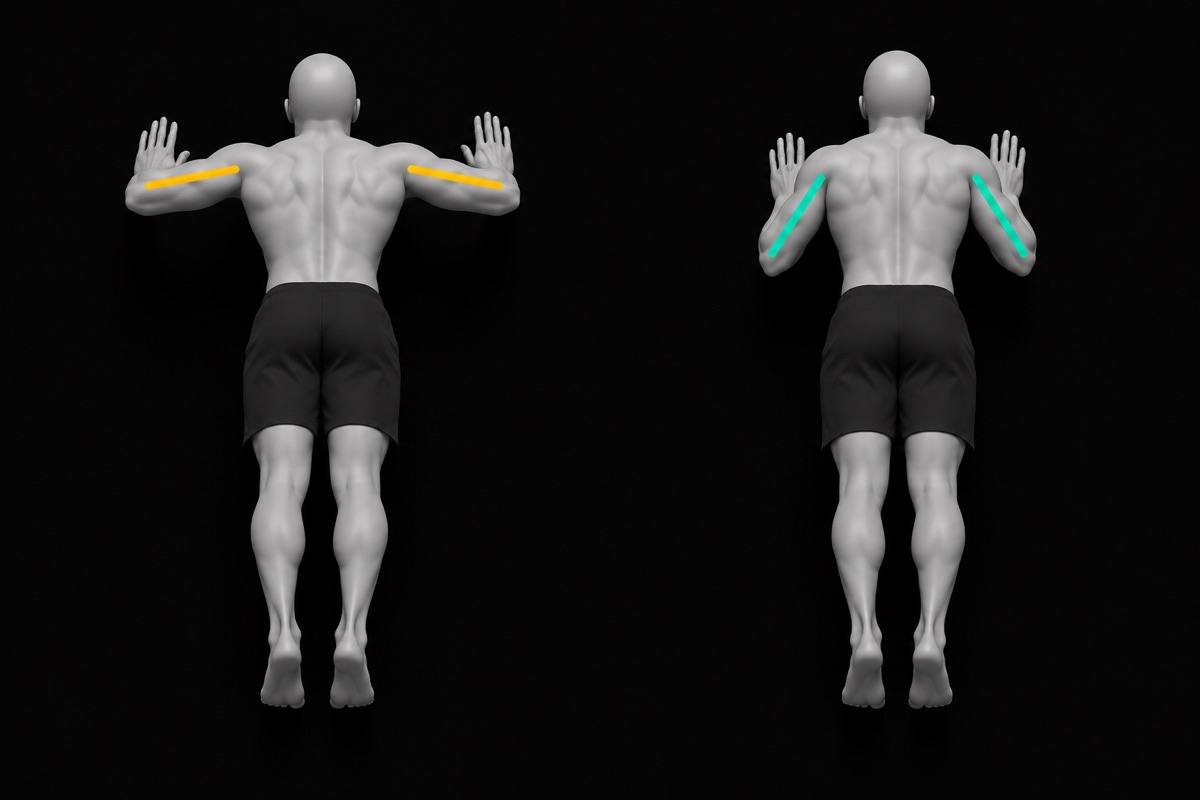
Flared elbows. Your elbows point out to the sides at the bottom of each rep.
- Cue
- Make an arrow, not a T.
- Why
- Flared, the upper arm sits straight out to the side under load at the bottom, a position many irritated shoulders dislike. Tucked elbows change how the front of the shoulder takes the weight.
- Drill
- Hands just outside shoulder width, index fingers forward. Do 3 x 8 slow incline push-ups on a bench, 3 seconds down, elbows brushing past your ribs. Film one set from the front to check. For the rest of the rep, see how to know if your push-ups are clean.
How deep should you dip with a sore shoulder?
Only as deep as you can control without pain.
Too deep, too soon. The front of the shoulder aches at the bottom of every rep.
- Cue
- Stop where you can still pause.
- Why
- The bottom takes the shoulder furthest back, the position the dip study above calls the most vulnerable. A depth you can hold is a depth you control.
- Drill
- Lower for 3 seconds to the deepest point you can hold for 1 second without pain, 3 x 5. Add a little depth every week or two, never through pain. Band-assisted dips, or feet on the floor, take load off the bottom while you build. How deep should you dip covers the full depth test.
Shoulders shrugging or rolling forward. At the bottom, your shoulders creep toward your ears or tip forward past your hands.
- Cue
- Chest proud, shoulders away from your ears.
- Why
- Rolling forward buys depth from the shoulder instead of the elbows. Shoulder blades down and back keep the bottom in a range you control.
- Drill
- Scapular dips on the bars, arms straight: let the shoulders sink a little, then push them down, 3 x 8. Then a straight-arm support hold, shoulders down, 3 x 20 seconds.
Why do your shoulders pinch in handstands and pike push-ups?
Often because the shoulders stay low while the arms go overhead, or because you force the arms past their current range. Steven Low notes in his article on scapular positioning that vertical pressing, like handstands and handstand push-ups, is the one place where the shoulder blades should rise.
Shoulders held down overhead. You feel a pinch at the top of the shoulder in a wall handstand.
- Cue
- Push the floor away, shoulders to your ears.
- Why
- Overhead, the shoulder blades should rotate up and rise with the arms. Cues borrowed from dips, like "shoulders down", do the opposite here.
- Drill
- Pike shrugs: in a pike position, arms straight, let your head sink between your arms, then push tall, 3 x 8. Then wall handstand shrugs, 3 x 5. If your arms cannot reach overhead without arching your lower back, do pike push-ups with your hands on a box for now. See pike push-ups to handstand push-ups.
Are kipping pull-ups and muscle-ups bad for your shoulders?
Not by themselves, but they add a sudden load at the end of the range. Steven Low explains in his article on relaxed hangs that hanging still is fine, while dynamic force at the bottom of a movement, combined with low strength and fatigue, can be dangerous to the shoulders. In a survey of 187 CrossFit athletes, 23.5% reported a shoulder injury over 6 months. Improper form and old injuries flaring up were the most cited causes, and the authors judged the rate similar to other recreational exercise.
Swinging into reps. Your pull-ups or muscle-ups start with a big kip, and your shoulder hurts at the bottom of the swing.
- Cue
- Start every rep from a still, active hang.
- Why
- A strict rep loads the shoulder at a speed you control. A kip asks it to catch your bodyweight at the end of its range, rep after rep.
- Drill
- Strict reps only while the shoulder is sore. Start with scapular pull-ups from a dead hang, 3 x 8: shoulders down, elbows straight. On muscle-ups, read the muscle-up transition before you add kipping back, since the turnover ends in the bottom of a dip.
What does the research say about exercise for shoulder pain?
Exercise is the usual first treatment for common shoulder pain, but the evidence is modest.
- Exercise helps. A meta-analysis of trials in adults with shoulder impingement found exercise reduced pain more than non-exercise controls, but rated the evidence very low quality.
- The best type is unclear. That same review found specific exercises ahead of generic ones. Another review of 6 trials found specific scapular exercises no clearly better than general strengthening. Scapular push-ups and pull-ups are useful tools, not a cure.
- Keep training what does not hurt. Steven Low advises in his article on training when injured to get it assessed, avoid what aggravates it, and keep training the rest.
How do you train around a sore shoulder?
Lower the dose, swap the painful moves, and add back slowly. If you can, run this plan past a physiotherapist.
- Find your baseline. Note which exercises hurt, at what depth, and how much on a 0 to 10 scale.
- Swap to pain-free variations. Incline push-ups instead of floor push-ups. Shallow or band-assisted dips instead of full dips, or none for a while. Strict pull-ups or rows, no kipping. Pike push-ups with hands on a box instead of handstand push-ups.
- Keep the pain mild. The rule used in the wrist pain and elbow pain articles works here too: pain stays at about 3 out of 10 or less, does not climb during the set, and is not worse the next morning.
- Add scapular control. Scapular push-ups, 3 x 10: in a plank, arms straight, let your chest sink between your shoulder blades, then push the floor away. Scapular pull-ups, 3 x 8. Start two or three sessions a week with them.
- Progress slowly. When a week passes without a flare, add one set back, or a little depth. Return to your old exercises at about half your old volume, and use the rules in when to progress in calisthenics.
When should you see a physiotherapist or doctor?
Book an appointment if any of these apply:
- Pain after a fall or a sudden pop, especially with bruising or a shoulder that looks different from the other.
- Night pain. Pain that wakes you, or aches at rest.
- Weakness. You cannot lift your arm out to the side or overhead, or you lost strength you had last week.
- Numbness or tingling down the arm, or pain running into the hand. It can come from the neck, not the shoulder.
- Pain that persists for weeks. No improvement after 2 weeks of lower load, or pain that keeps coming back.
- A shoulder that feels unstable, as if it slips, pops out or gives way, or a click that comes with pain.
Shoulder or arm pain together with chest pressure, shortness of breath or sweating is not a training problem: call emergency services. And sharp pain during a rep is a stop signal. End the set.
Frequently asked
Should I stop dips if my shoulder hurts?
Stop the version that hurts, not all pressing. A shallower dip, a band under your knees or feet on the floor often keeps the exercise in your week without the pain. If every dip depth hurts, drop dips for now and press with incline push-ups instead.
Are ring dips easier on the shoulders than bar dips?
In one motion-capture study, experienced athletes took their shoulders less far back on rings than on a bar. Rings also wobble, so they ask more control. Build a steady 30-second ring support hold before you dip on them.
Can I keep doing push-ups with a sore shoulder?
Often, yes, with changes. Raise your hands on a bench or a table, tuck your elbows back toward your hips, and stop each set while the pain stays mild. If it climbs during the set or is worse the next morning, cut the volume further.
Is my shoulder pain a torn rotator cuff?
You cannot tell from where it hurts. Only an examination can separate an irritated tendon from a tear or another problem. Real weakness, such as not being able to lift your arm out to the side, or pain that started with a fall, is a reason to get it checked soon.
How long does shoulder pain from training take to settle?
Usually weeks, sometimes months. Judge the trend, not single days: less pain on the same exercises and more you can do without a flare. If nothing has improved after 2 weeks of lower load, see a physiotherapist.