Blog · Pull-up · 8 min read
Dead hang: active vs passive, and how long to hang
Hanging looks like the easiest thing in calisthenics. The difference between hanging from your joints and hanging from your muscles is where every pull starts.
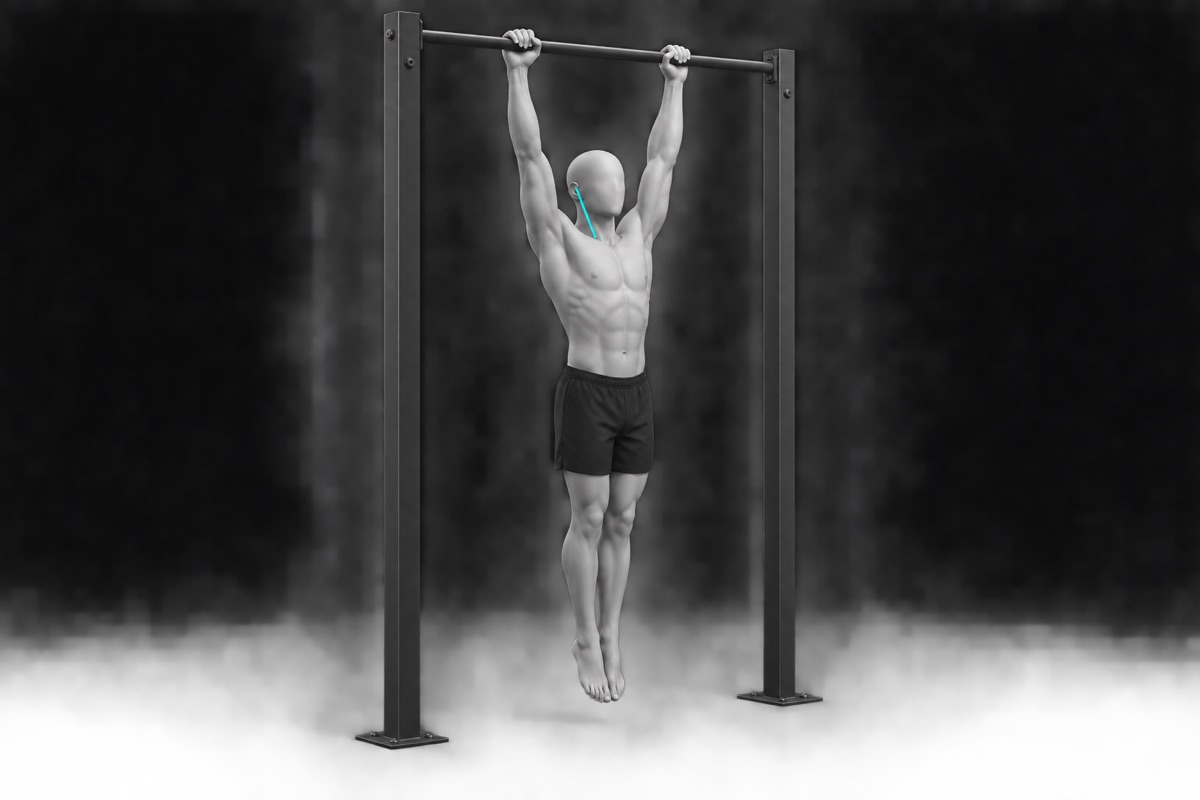
A passive dead hang lets your shoulders ride up to your ears and hangs you from your joints. An active hang pulls your shoulders down, away from your ears, while your arms stay straight, and hangs you from your back muscles. Beginners need both: passive hangs for grip and a gentle stretch, active hangs because that shoulder position is where every pull-up, muscle-up and lever starts. The scapular pull, moving from one to the other, is the drill that links them.
The question splits people on r/bodyweightfitness. In a thread on dead hang versus active hang pull-ups, the author found that relaxing fully at the bottom of each rep wore out their shoulders, while staying active did not. Some replies said the dead hang is great for shoulder health, others said it depends on how healthy your shoulders are. The top reply landed in the middle: the full dead hang may give a slightly deeper stretch, but it is not worth joint pain, and the pain itself is worth looking into.
What is the difference between an active and a passive hang?
Both hangs have straight arms. The difference is only at the shoulder blades.
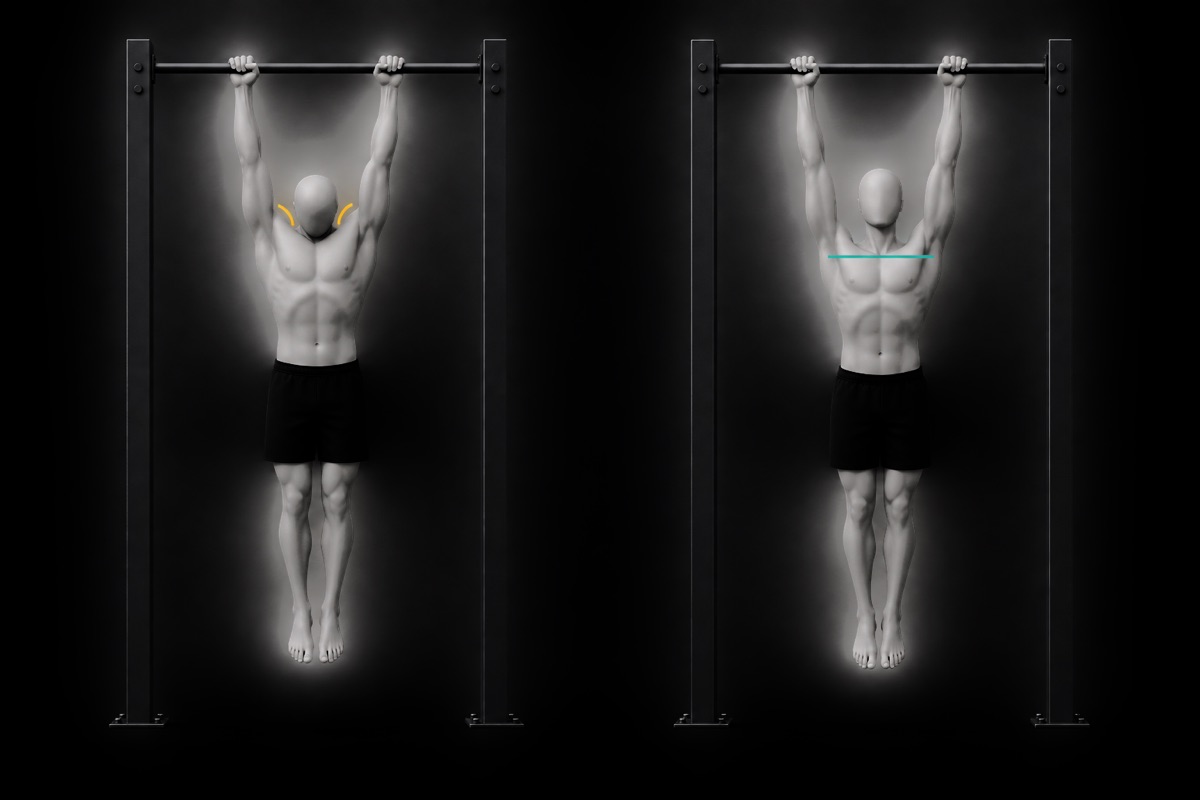
- Passive hang. You relax. Your shoulder blades slide up, your shoulders climb toward your ears, and your head sinks between your arms. Your weight rests mostly on the shoulder joint and the tissues around it.
- Active hang. You pull your shoulders down, away from your ears, without bending your elbows. Your body rises by a few centimeters (about an inch or two), your neck looks longer, and you feel it under the armpits and in the upper back.
Steven Low, in his article on relaxed shoulders at the bottom of pull-ups, calls the relaxed hang neither good nor bad in itself: it is extra range of motion. He adds that it can aggravate some shoulders, especially ones with a history of injury or instability, and that the real risk comes from being yanked into that end range with force, not from hanging there still.
Why does the active hang matter for pull-ups, muscle-ups and levers?
Because the shoulder blades move first. If they stay stuck by your ears, your arms have to start the rep alone, and the bottom of the pull feels weak.
- Pull-up. Low writes in his article on scapular positioning that pull-ups need the shoulder blades depressed and maybe slightly retracted. The active hang is that position with straight arms. If you are still working toward your first rep, see why you can't do a pull-up yet. If your reps are stuck, the bottom range is one of the things to check in why your pull-ups are not improving.
- Muscle-up. A high, fast pull starts with the shoulders already set. Starting from a loose hang wastes the first part of the pull you need to get over the bar, as explained in the muscle-up transition.
- Levers. Low describes the shoulder blades as depressed and neutral in both the front lever and the back lever. That is the active hang, turned sideways. Shrugged shoulders in a lever show up further down the body, as covered in front lever hips sagging and the back lever progression.
Full range still counts. A motion-capture and modeling study of three pull-up grips concluded that pull-ups should be done through their full range of motion, because different phases emphasize different muscles. So straighten your arms at the bottom, then set your shoulders before the next pull.
How do scapular pulls link the two hangs?
A scapular pull is one move from the passive hang to the active hang and back, arms straight the whole time. It teaches you to find the active position on demand.
- Hang with straight arms, hands about shoulder width, thumbs around the bar.
- Let your shoulders rise to your ears. This is the bottom.
- Pull your shoulders down and slightly back, without bending the elbows. Your chest lifts a little.
- Hold the top for 1 to 2 seconds, then lower slowly back to the bottom.
- Do 3 sets of 8. If you cannot move at all, do them with your feet on a box or on the floor under a low bar.
If your elbows bend, you are doing a tiny pull-up instead. Think of pushing the bar toward your feet rather than pulling your body up.
How long should you dead hang?
For a beginner, 30 seconds is a good first target and 60 seconds a solid second one. Build it with several sets that end before your grip fails, not one all-out attempt.
- Test once. Hang with a normal grip until your hands open. Note the time.
- Train at 60 to 70 percent of it. Steven Low programs isometric holds at about 60 to 70 percent of your max hold. With a 30-second max, that means 3 or 4 sets of about 20 seconds, 60 to 90 seconds of rest.
- Mix both hangs. Make one or two sets active, shoulders down the whole time. Active hangs are shorter: start with 10 to 15 seconds.
- Add time weekly. Add 5 seconds per set when every set feels controlled. Test again every 3 to 4 weeks.
- Go one-arm assisted later. Once you hold 60 seconds, hang from one hand while the other holds a towel or band looped over the bar, taking only part of your weight. Start with 5 to 10 seconds per side.
This matches the advice in a thread asking whether 70 seconds is a good dead hang time: several submaximal sets are usually better for progress, and a max hang is for testing. One reply suggested 5 sets of 60 seconds before moving to one-arm hangs, starting those at 5 to 10 seconds.
Grip is usually what ends the set. Wrap your thumb around the bar, use chalk if your hands sweat, and hang at the end of pulling sessions, three times a week, so fresh hands go to your pull-ups first.
Why do my shoulders shrug to my ears when I hang?
Because relaxing is the default. When your grip or your back tires, your shoulders drift up and the hang turns passive without you noticing.
- Cue
- Long neck. Shoulders in your back pockets.
- Why
- A shrugged hang skips the muscles that start every pull. If you meant to train an active hang, the seconds after the shrug no longer count.
- Drill
- Scapular pulls, 3 x 8 with a 2-second hold at the top, before your hangs.
What other faults ruin the hang?
Swinging. The body keeps moving after you grab the bar.
- Cue
- Legs together, still before you count.
- Why
- A swing moves your weight around and jerks the shoulders at the end of each arc. It also turns the hang into a timing game.
- Drill
- Step onto the bar from a box instead of jumping, squeeze your legs together, and start the clock once you are still.
Bent elbows. The arms soften, often when the shoulders go active.
- Cue
- Lock your elbows.
- Why
- Bent elbows turn the hang into a half-flexed-arm hold. It tires your biceps and hides whether your shoulders can do the job alone.
- Drill
- Hang at 60 percent of your max time and check your elbows on video. If they bend when your shoulders go active, go back to scapular pulls with feet support.
Flared ribs. The lower back arches and the ribs push forward.
- Cue
- Ribs down, slight hollow.
- Why
- Flared ribs and an arched lower back often come with a shrug and a swing. A slight hollow body keeps you in one piece, which is the shape levers and kip-free pull-ups need.
- Drill
- Hollow body holds on the floor, 3 x 20 seconds, then the same shape on the bar for 10 seconds.
One more confusion: the false grip is not a dead hang. It is a ring grip for the muscle-up, with the wrist over the bar and the bar low in the palm. Learn it as its own skill, with shorter holds, and keep your regular hangs in a normal grip with the thumb around the bar.
When is a passive hang fine?
A passive hang is fine when you want the stretch, not the strength. Many people like 20 to 30 seconds of relaxed hanging at the end of a session to open the shoulders and lats.
- Use it for: grip work, a cooldown stretch, getting used to hanging at all.
- Use the active hang for: the start of every pull-up and muscle-up, lever practice, and any hang meant to build pulling strength.
- Lower into it. Hang with your feet on a box, then lift them. Dropping hard into the bottom is the yank Low warns about.
Keep your expectations modest. The dead hang is a good grip and shoulder exercise, not a treatment. A study of scapula motion during pull-ups noted that high arm elevation reduces the space under the top of the shoulder, which is one reason overhead positions can bother some shoulders.
Is the dead hang safe for sore shoulders or elbows?
For healthy shoulders, a controlled hang is a normal part of training. Pain changes the picture.
- Shoulder pain, pinching or a feeling the joint might slip: stop the passive hang. Try the active hang with your feet partly on a box. If that also hurts, stop hanging and see a physiotherapist.
- Sore elbows from pulling: cut the hang volume in half, try a neutral grip or rings so your wrists can turn, and keep sets short. Pain that lasts more than a week or two after you back off is a reason to see a physiotherapist.
- Sharp pain at any point: step down, do not push through it.
How do you check your hang on video?
Film from the front, with the camera at chest height, 2 to 3 meters (7 to 10 feet) away, your hands and feet in frame. The front view shows how far your ears sit from your shoulders, which is the whole difference between the two hangs.
- Hang passive for 5 seconds, then go active for 5 seconds.
- Compare the gap between your ears and your shoulders. It should grow clearly in the active part.
- Check your elbows (straight), your legs (together, still) and your ribs (down).
- Count only the active seconds where all of this holds.
Film from the side too if you want to see the swing and the rib flare. For light and framing, see how to film yourself for a form check.
Frequently asked
Is a dead hang the same as an active hang?
Not quite. People use dead hang for any straight-arm hang, but a passive hang lets the shoulders rise toward the ears, while an active hang keeps them pulled down with the arms still straight. Both are useful; they train different things.
How long should a beginner dead hang?
Start with sets you can finish with a little grip left, often 10 to 20 seconds. Aim for 30 seconds first, then 60. Three or four sets, three times a week, build it faster than one all-out attempt a day.
Are scapular pull-ups worth doing if I can already do pull-ups?
Yes, as a warm-up or when the bottom of your pull-up feels loose. A few slow reps with a pause at the top remind your shoulder blades to start every rep, which also helps before muscle-ups and front lever work.
Should I dead hang every day?
You can, if the sets are easy and your elbows and shoulders stay quiet. For grip and hang time progress, three harder sessions a week with rest in between usually work better than daily max attempts.
Why do my hands hurt more than my arms when I hang?
Your fingers and forearms are usually the first link to give out. Wrap your thumb around the bar, use chalk if your hands sweat, and let calluses build slowly. Sharp pain in the palm or fingers is a reason to stop the set.