Blog · Hollow body · 8 min read
Hollow body hold for beginners: keep your lower back down
The hollow body hold is not about how high your legs are. It is about the gap under your lower back, and keeping it closed while your arms and legs get longer.
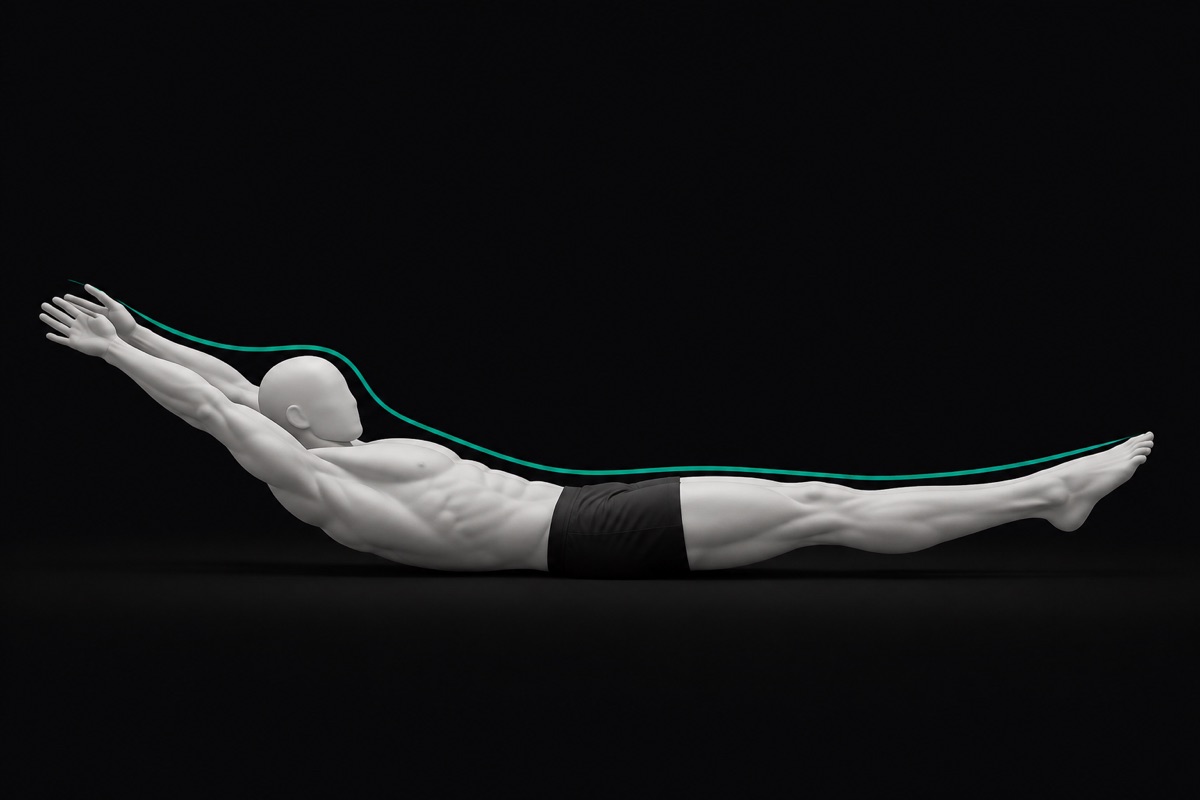
The hollow body hold is a lying hold on your back: lower back pressed into the floor, pelvis tucked under, ribs down, shoulder blades and legs lifted. It is the body line you use upside down in a handstand, face down in a planche and front lever, and it is the shape your lower back loses first. Start with bent knees, build to 60 clean seconds, then make the lever longer.
The rule that matters is simple. On r/bodyweightfitness, a month-long hollow hold challenge put it this way: lift your legs, remove the arch from your lower back, and lower the legs only as far as the lower back can stay glued to the floor. Everything below follows from that.
What is the hollow body hold, and why does it matter for calisthenics?
It is a static hold that teaches you to lock your trunk in a slight curve, like a shallow banana lying on its back. Your abs pull the front of your pelvis up toward your ribs, which flattens the lower back. That tuck of the pelvis is called a posterior pelvic tilt.
The same shape shows up in most straight-body skills:
- Handstand. Steven Low writes in The Fundamentals of Bodyweight Strength Training that a proper handstand has "no arch, and if at all maybe a slight hollow position." If your handstand curves like a banana, see why your handstand has a banana back. A tight line also makes balancing a handstand easier, because a stiff body is one piece to steer.
- Front lever. Hips that sag below the line are the lower back losing its hollow. The fixes are in front lever hips sagging.
- Planche. The planche adds rounded, pushed-forward shoulders to the same tucked pelvis. A flat, tight trunk is also what lifts the hips in a tuck planche with hips too low.
A word on names. In physiotherapy research, "abdominal hollowing" means drawing the belly button in, not this hold. Do not mix up the two when you read about it.
How do you do a hollow body hold, step by step?
- Lie on your back on a firm floor, knees bent, feet flat.
- Close the gap. Tuck your pelvis under, as if you wanted to pull your belt buckle toward your chin, until your lower back touches the floor. Pull your ribs down toward your hips.
- Squeeze your glutes. In an EMG study on correcting pelvic position, people used different muscle patterns to tuck the pelvis, but the gluteus maximus took part in every pattern and tracked the change in tilt most closely.
- Lift your head and shoulder blades just off the floor. Chin slightly tucked, eyes toward your knees or toes.
- Lift your legs in the variation you are working on, and hold. The moment your lower back starts to peel off the floor, the set is over.
A quick test: before you start, slide a hand under your lower back. In a real hollow hold, there is no room for it.
What are the hollow body progressions for beginners?
Each step makes the lever longer: arms and legs further from your hips. Stay on a step until you hold it for 60 clean seconds, the bar the hollow hold challenge used before moving on.
- Tuck hollow: knees bent and pulled over the hips, shins level with the floor, arms reaching toward your feet.
- One-leg hollow: one knee tucked, the other leg straight and low. Switch legs each set.
- Arms by the sides: both legs straight, feet about 30 to 50 cm (12 to 20 inches) off the floor, hands reaching past your hips.
- Full hollow hold: arms straight overhead, biceps by your ears, legs straight and low. Arms overhead are much harder because they add a second long lever.
- Hollow rocks: keep the full shape and rock head to heels. The challenge set a goal of 3 x 20 seconds of rocking before adding load, and warned that a bumpy rock means you are no longer hollow.
Why does my lower back lift off the floor?
Your lower back lifts because the lever is too long for your abs. The legs pull the front of your pelvis down, the pelvis tips forward, and the lower back arches off the floor. This is the most common hollow hold fault.
In a thread titled "lower back seems to fail first", replies explained that you should not feel your back in a hollow hold at all: once the back comes up, the abs are no longer in control. Another reply gave the fix: start with your legs straight above your hips and lower them only until your spine wants to peel off the floor. Hold there.
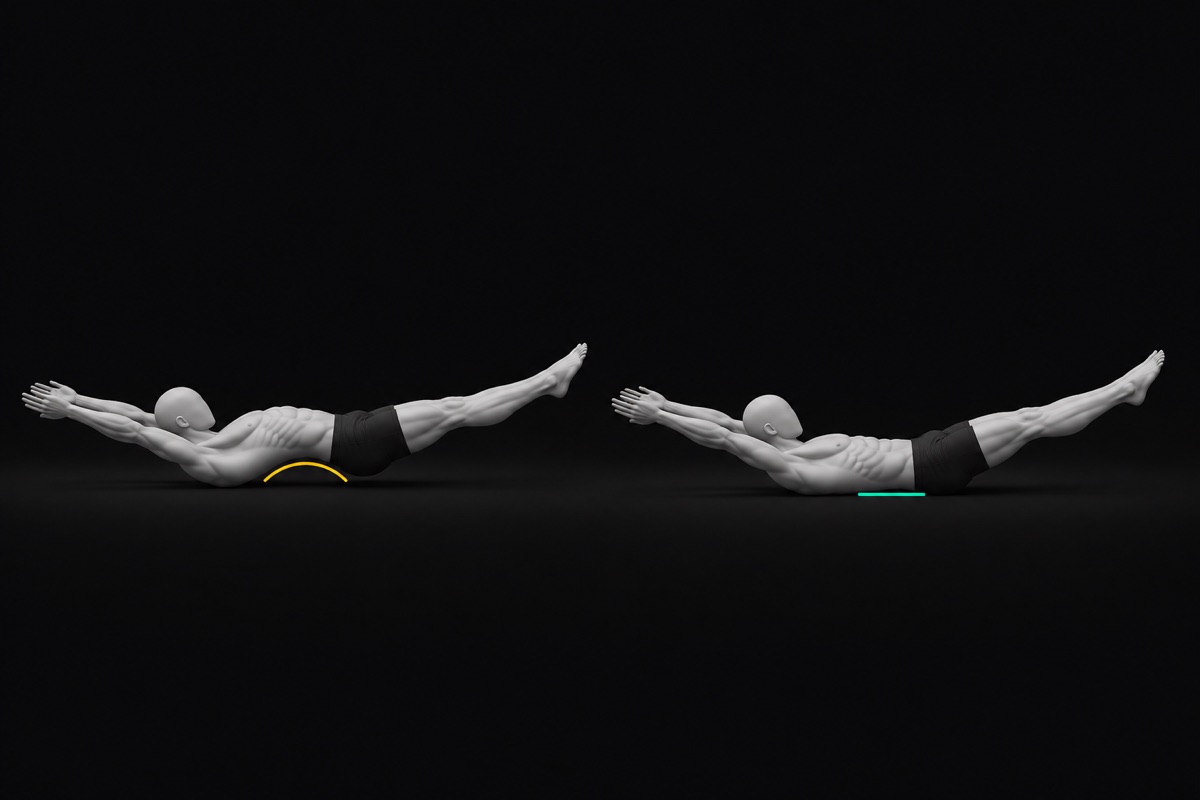
- Cue
- Glue your lower back to the floor, then lower the legs.
- Why
- The height of your legs only counts if the back stays down. An arched back moves the work from your abs to your spine.
- Drill
- Tuck hollow, 3 x 30 seconds, one hand checking the gap under your back on the first set. Straighten one leg only when the gap stays closed.
If your lower back hurts during or after the hold, stop. Pain there is a stop signal, not a sign of good work. Go back to a variation you can hold without it, and see a physiotherapist if the pain persists.
Why does my neck hurt in the hollow hold?
Your neck hurts when your head does the lifting instead of your trunk, or when it stays raised with nothing holding it.
- Cue
- Small chin tuck, shoulder blades up, not the head.
- Why
- The shoulder blades should leave the floor because your abs curl your upper trunk. A head poked forward loads the front of the neck.
- Drill
- 10 chin tucks of 5 seconds lying down before your first set. If the neck still tires first, rest your head on the floor for a few weeks and train the legs and pelvis.
In the same challenge thread, one athlete wrote that chin tucks before the hold made it feel much better, and another suggested pressing the tongue to the roof of the mouth to take strain off the neck.
Are my legs too high?
Probably, if the hold feels easy. Legs pointing up at 45 degrees or more make the lever short, so you are resting instead of training. It is a fine start, but not the goal.
- Cue
- Lower the feet until the back almost peels, then stop just above that point.
- Why
- The work is at the edge of the flat back. Too high, and you never reach it.
- Drill
- Each session, lower your heels about 5 cm (2 inches) from where you held last time, as long as the back stays down for the whole set.
If your legs stay piked no matter what and will not come down without losing the hollow, tight hip flexors can be part of it, as one r/bodyweightfitness post suggested. A kneeling lunge stretch is a simple place to start.
Should you hold your breath in a hollow hold?
No. Keep breathing, short and shallow, into your sides and back. Holding your breath gives you a few stiff seconds and then the shape collapses when you gasp.
Bracing is not the same as holding your breath. In a study on bracing and hollowing, tightening the whole trunk raised the pressure inside the abdomen far more than drawing the belly in. That tight trunk is what you want. Keep it while you breathe out slowly, then take a small breath in without letting your ribs flare up.
If you cannot breathe in the hold, the variation is too hard. Go back one step.
How long should you hold a hollow body, and how often?
- Start: 3 sets of 20 to 30 seconds at a step you hold with the back flat, 60 to 90 seconds of rest between sets.
- Build: add 5 to 10 seconds a week until you reach 60 clean seconds in one set.
- Move on: at 60 seconds, go to the next step and drop back to 20 to 30 seconds.
- Frequency: 3 to 5 sessions a week works well. It fits at the end of your warm-up, before handstands or levers.
Count only the seconds with the back down. A 40-second hold with the last 15 seconds arched is a 25-second hold. For the general rule on moving up a step, see when to progress in calisthenics.
Is the hollow body hold better than a plank?
Neither replaces the other. Both stop your lower back from arching. In a hollow body vs plank thread, one reply explained that the muscles are much the same, and that the difference is where gravity pulls against you. The hollow hold adds long levers overhead and in front of you, the way handstands and levers do. Another reply suggested simply doing both.
If you do planks, do them hollow too: pelvis tucked, glutes squeezed, ribs down. It is the same body line, turned face down.
What is the arch hold, and why train it too?
The arch hold is the hollow hold flipped over. Lie face down, squeeze your glutes, and lift your arms, chest and legs off the floor, arms overhead. It trains the back of the body: glutes, back muscles and the rear of the shoulders.
- Start with arms by your sides and only the chest and legs lifted a few centimeters.
- Progress to arms overhead, the full arch.
- Dose: the same as the hollow hold, 3 sets of 20 to 30 seconds, building to 60.
Pair them in the same session, one after the other. The arch hold works the side of the body that a back lever and a straight-arm handstand line depend on. It should feel like work in the glutes and upper back, not a pinch in the lower back. If it pinches, lift less.
How do you check your hollow hold?
Film it from the side, because from above you cannot see the gap. Put the phone on the floor, 2 to 3 meters (7 to 10 feet) away, in landscape, with your hands and feet in frame. On the video, look at three things: the space under your lower back (none), your chin (slightly tucked, not poked forward) and your legs (as low as the flat back allows). Watch the last 10 seconds of the set, that is where the back lifts. For light and framing, see how to film yourself for a form check.
Frequently asked
Is the hollow body hold better than the plank?
Neither is better, they train the same job from two directions. The plank holds your trunk against gravity face down, the hollow hold does it face up with long levers. If you train handstands or levers, keep the hollow hold in your week and do planks too if you like them.
Should I feel the hollow body hold in my lower back?
No. You should feel it in the front of your trunk. A pinch or ache in the lower back means the back has lifted and the hold has turned into something else. Make the variation easier, and stop if the pain stays once you do.
Can I do the hollow body hold every day?
Yes, if it is short and clean. A few minutes of holds in your warm-up is a common way to use it. If your abs are still sore from the last session, skip a day.
Why do I shake in a hollow body hold?
Shaking usually means you are near the end of what you can hold at that lever length. It is fine for the last seconds of a set. If you shake from the first second, pick an easier variation.
Do I need a mat?
A thin mat or a folded towel makes the hold more comfortable on a hard floor, but it is not required. Avoid a thick, soft mattress: it hides the gap under your lower back, which is the one thing you need to feel.