Blog · Elbow pain · 8 min read
Elbow pain in calisthenics: causes, fixes and red flags
Your elbows usually complain for weeks before they force a break. Read where it hurts, change the load that caused it, and know which signs need a professional.
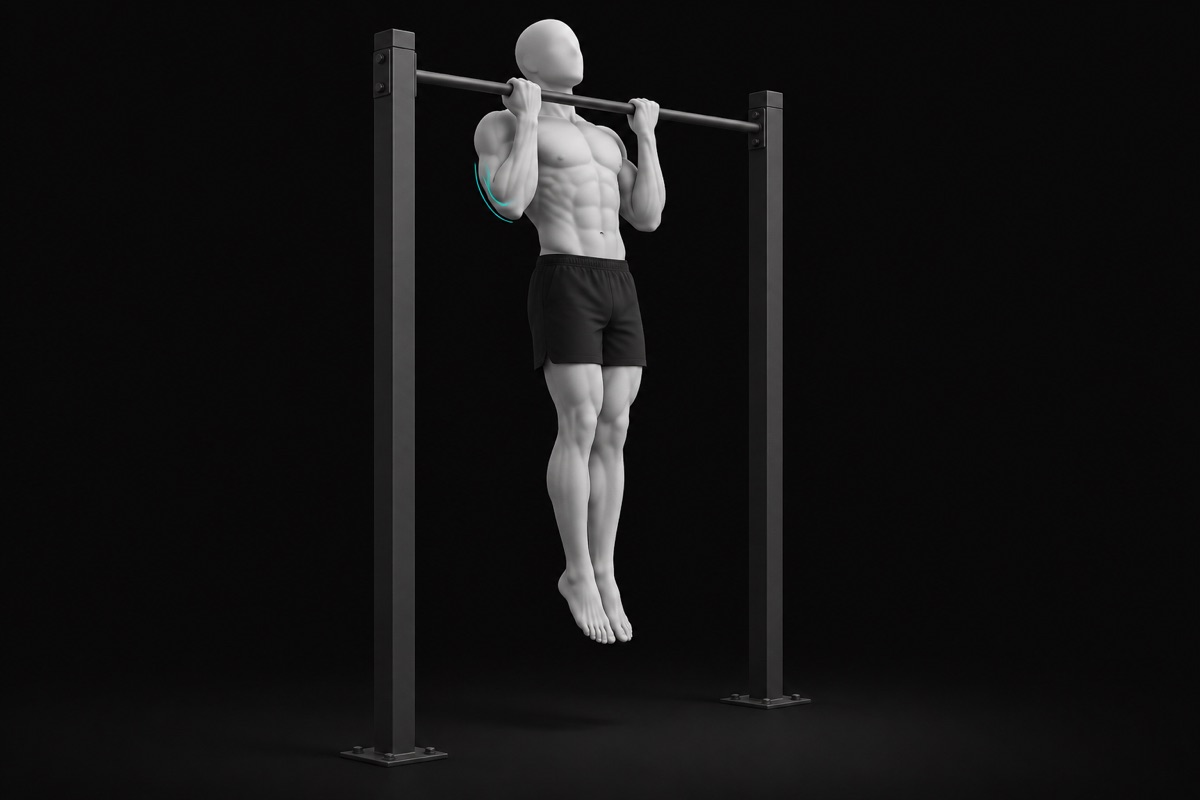
Elbow pain in calisthenics usually shows up in one of three places: the inside of the elbow after lots of pulling, the outside after hard gripping, or the front, where the biceps tendon attaches, after straight-arm holds like the back lever. The usual cause is load your tendons were not ready for. Cut what hurts, change the grip, keep training what is pain free, and see a physiotherapist if it does not settle.
This article is not a diagnosis: only an examination can tell elbow problems apart. It covers what tends to help with common overuse pain, and the signs that need an appointment.
You are not alone with it. In a r/bodyweightfitness thread on golfer's and tennis elbow, a lifter with inner forearm pain for over a year asked whether a physiotherapist was worth it. Most replies pointed to slow wrist curls and twisting exercises with a rubber bar. Another needed about two and a half months of physiotherapy, and was told to ease off without stopping completely.
Where does your elbow hurt?
Location is the first clue. Steven Low, author of Overcoming Gravity, describes three common patterns in his article on overcoming tendonitis:
- Inside of the elbow. Pain on the inner bony bump, sometimes running into the forearm: medial epicondylitis, or golfer's elbow, which climbers often call climber's elbow. Low links it to excessive pulling, which makes it the classic pull-up and chin-up complaint.
- Outside of the elbow. Lateral epicondylitis, or tennis elbow. Low links it to excessive wrist extension, for example gripping hard with the wrist bent back.
- Front of the elbow. Pain in the crease, where the biceps tendon attaches. Low links biceps tendonitis to excessive pulling too, and straight-arm holds such as the back lever and planche load that tendon while it is stretched.
Pain at the back of the elbow, sharp pain deep in the joint, or tingling in the fingers do not fit these patterns: get them checked.
Why do pull-ups and chin-ups cause elbow pain?
Because your muscles get stronger faster than your tendons do. Low explains that muscle is more metabolically active than connective tissue, so it adapts faster. Your back can be ready for more sets long before your elbow tendons are.
Tendons do adapt, just slowly. A meta-analysis of tendon loading studies in healthy adults found that tendons respond within about 2 months of heavier training, and more over 12 weeks or longer. A new routine can double your pulling in a week. Your tendons need months.
Four habits come up again and again:
- Volume jumps. A new program, a pull-up challenge, or a comeback at your old volume.
- One fixed grip. A straight bar locks your forearms in the same rotation for every rep.
- Straight-arm work too soon. Lever or planche steps added faster than the elbows adapt.
- Kipping and jumping. A swing or a jump loads the arm suddenly, at the end of its range.
What should you change in your training?
Change the load, not your whole program. Low's advice is not to stop working out: train whatever does not aggravate the sore area, because full rest leaves you deconditioned.
Volume jump. The pain started a few weeks after you added pulling.
- Cue
- Cut the pulling that hurts, keep the pulling that doesn't.
- Why
- Tendons fall behind when volume climbs faster than they adapt. Less volume lets them catch up without losing your strength.
- Drill
- Halve your weekly pulling sets for 2 weeks. Keep only sets where the pain stays at about 3 out of 10 or less and is no worse the next morning. Then add one set per week.
Straight-arm work too soon. The front of the elbow aches after back lever or planche sessions.
- Cue
- One step down, and give it weeks, not sessions.
- Why
- Straight-arm holds stretch the biceps across the elbow while it carries your weight. Your strength can pass a step before the tendon has.
- Drill
- Go back to the last pain-free step, hold it for 3 x 8 seconds, and stay there 1 to 2 weeks after it feels easy before you move up.
The back lever progression covers the biceps tendon and each step in detail. Keep pain-free bent-arm work in the week: rows, pull-ups and dips build what straight-arm holds lean on.
Kipping and jumping into holds. Reps start with a swing, or holds start with a jump.
- Cue
- Step in, lower in, then hold.
- Why
- A swing or a jump adds a sudden pull at the end of the range, on top of the hold itself. Low makes the same point for the shoulder in his article on relaxed hangs: hanging still is fine, being yanked into the end range is what puts the load on passive tissue.
- Drill
- Strict reps only while your elbows are sore. Step onto the bar from a box, and enter levers from a tuck or a slow negative instead of a swing.
If your pull-ups stalled before the pain began, both often share a cause, too many hard sets: see why your pull-ups are not improving. On muscle-ups, a lopsided turnover loads one elbow more, as in the chicken wing muscle-up.
Does your grip cause elbow pain?
It can. On a straight bar your hands cannot turn, so your forearms stay in the same rotation for every rep and the same tissue takes the load each time. Chin-ups lock your palms toward you, pull-ups lock them away.
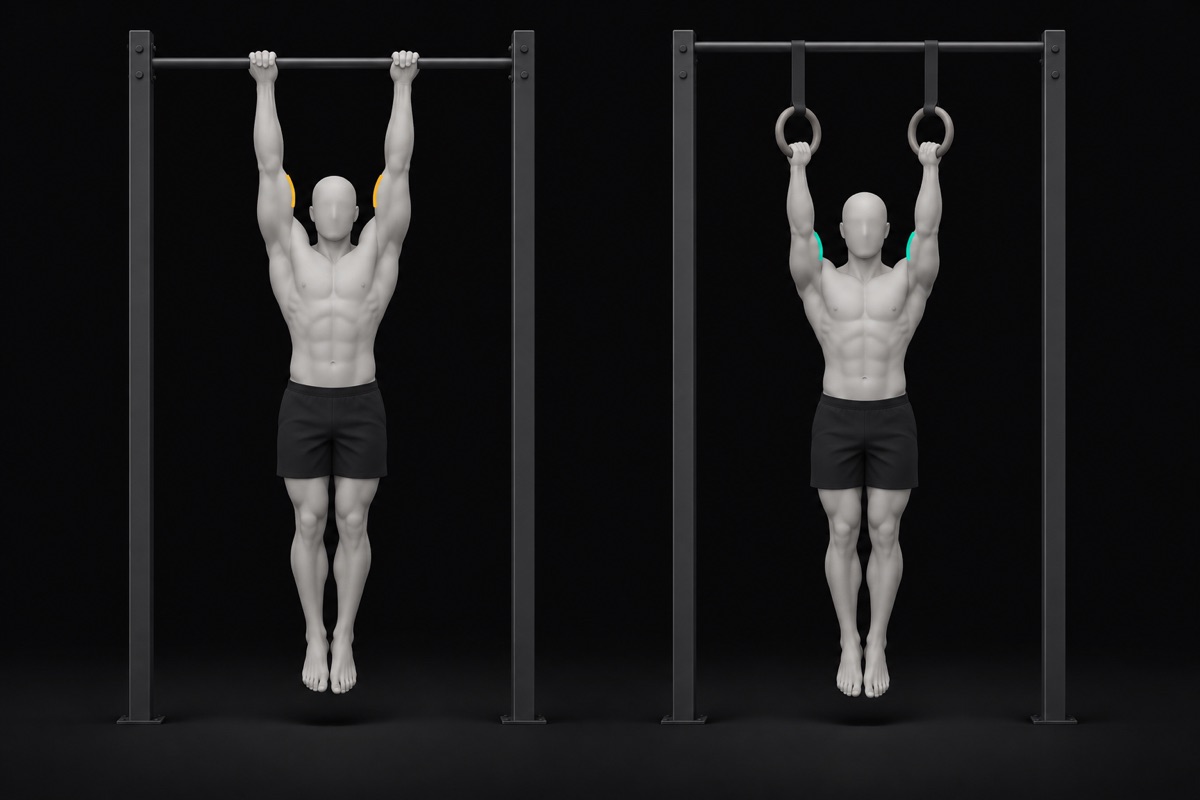
Locked grip. The pain comes on with one grip and not the other.
- Cue
- Let your forearms turn.
- Why
- Rings rotate with you, so your elbows settle at the angle they prefer through the whole rep. A neutral grip, palms facing each other, sits between the two bar grips.
- Drill
- Move your pulling to rings or neutral handles for 2 to 4 weeks, at the same reps. Start with palms facing each other at the bottom and let the rings turn freely on the way up.
Small changes help too: a slightly narrower or wider grip, or a thumb wrapped around the bar. If you train the back lever underhand, switch to overhand while the front of the elbow is sore. Hanging loads the same tissue as pulling, so cut hang volume as well: the dead hang guide covers shorter sets and grip swaps for sore elbows.
What does the research say about tendon rehab?
Progressive loading helps most tendon pain, and no single type of exercise has clearly won. The evidence is modest, so treat any protocol as a starting point.
- Load usually beats rest. Low writes that rest mainly works early, when the tendon has only just become irritated, and not once the pain has settled in. He advises against ice and says anti-inflammatory pills do not help, because tendon pain is generally not inflammatory.
- Eccentrics have support, not a monopoly. A meta-analysis of 6 trials with 429 people with outer elbow pain found that adding eccentric exercise to other treatment reduced pain and improved strength, but warned that the studies were few and varied. An editorial in the same journal argued that eccentrics alone fail many patients.
- Inner elbow evidence is thinner. In a case series of 20 people with golfer's elbow who had not improved with earlier treatment, adding a slow eccentric wrist exercise with a rubber bar (3 x 15, twice a day, for about 6 weeks) came with large gains in function. With no control group, it shows a possibility, not proof.
- Isometrics are an option, not a shortcut. A review of 10 trials found isometric holds no better than moving exercises for long-lasting tendon pain, with conflicting evidence for instant relief. Low suggests them when moving exercises hurt too much, at 70 to 80 percent effort.
- Heavier load drives tendon change. In the healthy-tendon meta-analysis above, loads above 70 percent of maximum made tendons stiffer, while light loads barely did, whatever the type of contraction.
How do you load a sore elbow back up?
Start light, move slowly, and let your symptoms set the pace. If you can, run this sequence past a physiotherapist.
- Find your baseline. Note which pulls, holds and grips hurt, and how much on a 0 to 10 scale. Drop or swap those, keep the rest.
- Pick exercises for the sore area. For the inside of the elbow, Low lists wrist curls, forearm rotation (turning the palm down and up) and finger curls. Reverse wrist curls, palm down, target the outside. For the front, slow biceps and hammer curls.
- Go slow on the way down. Low's protocol is 3 sets, lowering for 2 seconds and lifting for 1, three times a week. Start light, around 30 reps per set, and work toward heavier sets of 10 to 15.
- Keep the pain mild. Low considers pain below 2 to 3 out of 10 generally acceptable during rehab, as long as your strength improves from session to session and the symptoms trend down over the weeks.
- Add weight before you add pulling. When all sets feel easy, go heavier. Tendons respond to heavy load, not endless light sets.
- Bring the skill back in steps. Strict ring or neutral-grip pulls first, then your usual grip, then straight-arm holds. Return at about half your old volume and use the move-on rules in when to progress in calisthenics.
When should you see a physiotherapist or doctor?
Book an appointment instead of managing it alone if any of these apply:
- A pop at the front of the elbow. Sudden sharp pain in the crease, sometimes with a pop, then bruising or weakness when you turn your palm up, are described as signs of a torn biceps tendon. Timing matters: in a series of more than 200 operated tears, when a clinical test showed a full tear and surgery waited 8 weeks or more, most cases needed a more complex reconstruction with a graft. See a doctor within days.
- Numbness or tingling in the ring and little fingers. Especially when it gets worse with the elbow bent or at night. This points to the ulnar nerve, and a review of cubital tunnel syndrome notes that untreated compression can lead to wasting of hand muscles.
- Weakness or a hand that will not grip. Losing strength you had last week is not normal soreness.
- Pain after a fall, swelling, an elbow you cannot fully straighten or bend, or a joint that locks.
- No improvement after 2 weeks of reduced load, or pain that wakes you at night. Low notes that tendon pain lasting 3 months or more starts to count as chronic, so do not wait that long.
Sharp pain during a rep is a stop signal, not a hurdle. End the set.
Frequently asked
Should I stop pull-ups if my inner elbow hurts?
Stop the sets that make it worse, not all training. Many athletes keep pulling at a lower volume, on rings or a neutral grip, as long as the pain stays mild and settles by the next day. If every grip hurts, pause pulling and get it checked.
Are chin-ups or pull-ups worse for golfer's elbow?
It varies from person to person. Some athletes feel the inner elbow more with palms up, others with palms down. Test both for a few easy reps, then train on rings or neutral handles, which let your forearms find their own angle.
Does an elbow brace help with calisthenics elbow pain?
Some people find a strap below the elbow eases the pain during a session. It does not replace changing the load and rebuilding the tendon, so treat it as short-term relief and keep the rehab work going.
How long does elbow tendon pain take to heal?
Usually weeks to months, not days. Tendons adapt slowly, so judge progress over several weeks: less pain on the same exercises, and more load you can handle. If nothing has improved after a few weeks of reduced load, see a physiotherapist.
Can I keep training straight-arm skills with elbow pain?
Only the ones that do not hurt. Pain at the front of the elbow after back lever or planche work is a reason to drop to an easier step or pause those holds, while your other training continues.