Blog · Wrist pain · 8 min read
Wrist pain in push-ups and handstands: what to change
Bodyweight on a bent-back wrist is a load most beginners have never trained. Change the angle, the hands and the dose first, and learn which signs mean you should stop guessing.
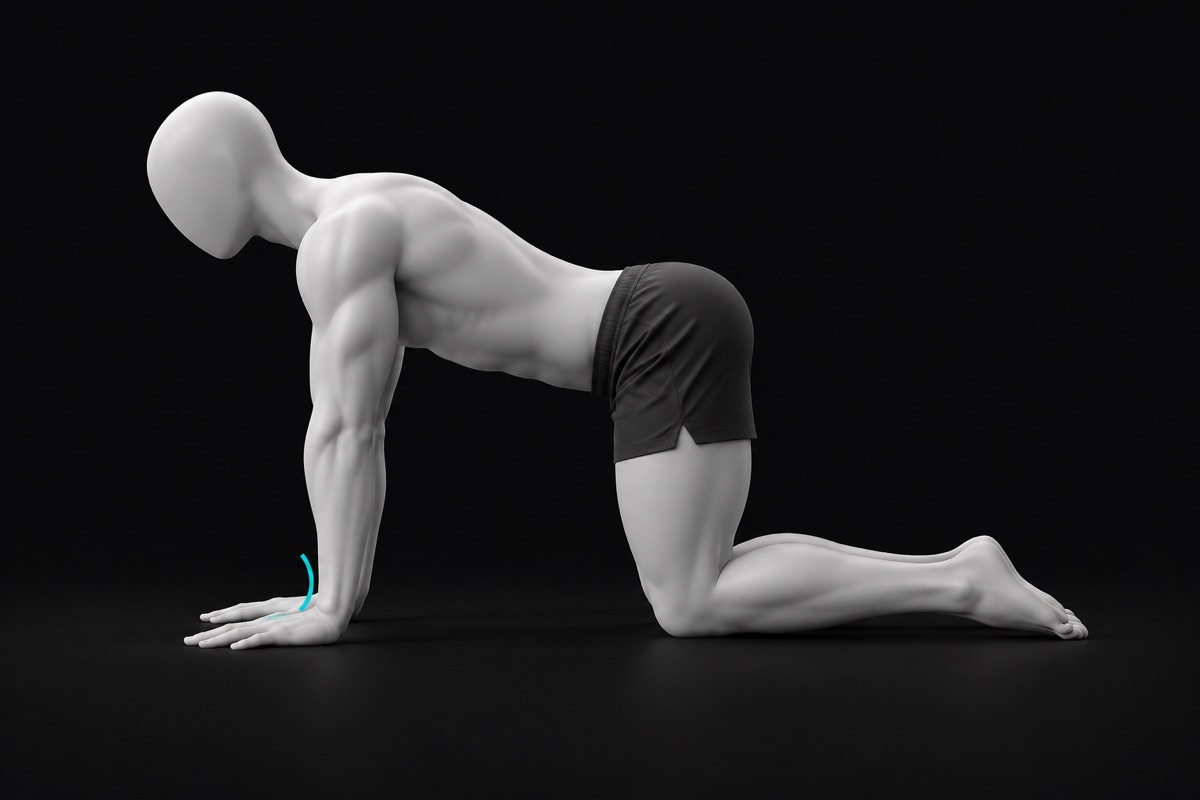
Push-ups, handstands and planche work bother beginner wrists because they load the wrist while it is bent back close to the end of its range, often with more weight than it has ever carried. Warm the wrists up for 5 minutes, press through your fingers instead of the heel of your hand, raise or straighten the wrist with parallettes or handles while it is sore, and cut the volume of whatever hurts. Pain that persists, swelling, numbness or pain at one spot after a fall needs a physiotherapist or doctor.
The complaint comes up again and again on r/bodyweightfitness. In a thread on wrist pain in push-ups and handstands, a beginner could hold a wall handstand for about 20 seconds before needing 15 minutes of rest, and stopped push-ups at 40 reps because of the pain. Replies told them to warm up, not to rush anything that loads the wrists, to train frog stands for less load, to spread the hands and press through the index finger and thumb, and to avoid any sharp pain.
You are in good company. In a survey of Dutch calisthenics athletes, the wrists were the second most injured body part, after the shoulders. In a survey of adults who practice handstands, more than half reported recurring or persistent wrist pain.
Why do push-ups and handstands hurt your wrists?
Because your wrist is bent back, close to its limit, with your bodyweight on top. Daily life almost never asks for that.
- Push-up. Hands flat under your shoulders bend the wrist back toward a right angle, on every rep.
- Handstand. The forearm stands vertical on a flat hand, so the wrist sits close to a right angle under your full weight.
- Planche. The lean pushes your shoulders past your hands, so the forearm tips past vertical and the wrist bends even further.
That end range matters. In a motion-capture study of push-ups, forces traveled differently through a bent-back wrist than through a straight one, and the authors concluded that push-ups on a neutral wrist are likely safer, because ligaments may take more of the load in hyperextension. Volume matters too: a meta-analysis of wrist pain in young gymnasts linked it with weekly training hours and years of training.
Find your current edge with one test. On hands and knees, palms flat, fingers forward, slowly move your shoulders forward past your hands. Note where a pinch on the back of the wrist starts. If it starts before your forearm is vertical, a full handstand puts you past that edge on every rep.
How do you warm up your wrists before push-ups and handstands?
Take 5 minutes, and do every step slowly. In a widely shared tips post on r/bodyweightfitness, the author described a friend whose wrists hurt despite the warm-up, until he admitted he was rushing through it. Rushed, the warm-up does little.
- Circles. Fingers interlaced, 10 slow circles each way.
- Forward rocks. On hands and knees, palms flat, fingers forward. Rock your shoulders forward over your hands and back, 10 times, a little further each rep but short of pain.
- Side and back rocks. Turn your fingers out to the sides, then back toward your knees, 10 gentle rocks each.
- Palm stretch. Fingers pointing back, palms down, sit your hips back until you feel the inside of the forearm. Hold 20 to 30 seconds.
- Back-of-hand stretch. Turn your hands over, backs of the hands on the floor, fingers toward your knees. Lean back gently, 20 to 30 seconds.
- Finger pressure. Palms flat, fingers spread. Press your fingertips down until the heels of your hands lift, then lower. 10 reps.
Then ease into the session: a few incline push-ups or a short plank before your first handstand or planche lean. Keep your expectations honest. The handstand survey found no link between warm-up routines and chronic wrist pain. A warm-up prepares the joint for the session. It does not make a bad dose safe.
How do you make your wrists stronger for handstands and planche?
Load them on purpose, in positions easier than your skill, and add a little at a time.
- Condition the wrist itself. Steven Low lists wrist push-ups and rice bucket work for wrist strength. Start wrist push-ups on your knees, 2 sets of 10, and add reps only when the next day feels normal.
- Gain extension range. Hold the end of each forward rock for 5 to 10 seconds. Push the edge from the test above a little further each week.
- Build bodyweight time. Planks, frog stands and wall handstands load the wrist less than a freestanding handstand or a tuck planche. Add about 10 seconds or one set a week.
- Earn the steep angles. In a thread on wrist pain in the tuck planche, the top replies told the beginner to step back to L-sits, handstands, frog stands and planche leans, with wrist push-ups as prehab, before returning to the tuck.
If your handstand drains your wrists, check your line too. A reply in another wrist pain thread argued that a handstand should not tire the wrists much, and that if it does, the shoulders are probably far in front of the hands. Stack them over your wrists, as explained in how to balance a handstand.
How should your hands press the floor?
Spread your fingers and press through the fingertips and the base of the fingers, so the heel of your hand is not the only thing holding you up. The heel of the hand already takes the most: in a pressure-plate study of handstands, most of the force landed on the two pads at the base of the palm. Your fingers have to claim their share.
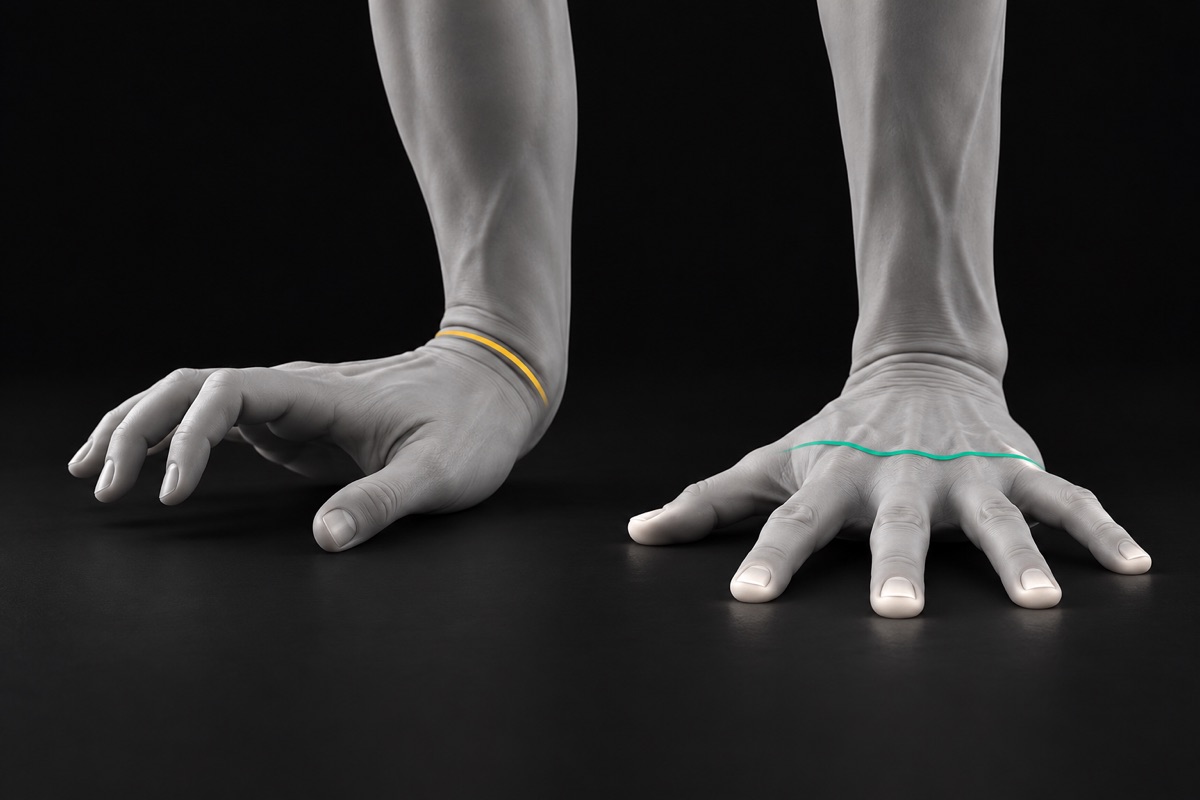
Weight in the heel. The fingers float and the heel of the palm takes everything.
- Cue
- Grab the floor. Press the knuckle of your index finger down.
- Why
- Pressing through the fingers spreads the load over the whole hand and moves part of it away from the bent-back joint. The same tips post gives this cue to avoid dumping all your weight into the heel.
- Drill
- Finger pressure lifts, 2 x 10, then a 20-second plank where you keep a little pressure under every fingertip.
Fingers turned in. The hands point toward each other.
- Cue
- Index fingers point forward.
- Why
- That turns the hands out slightly, which the tips post recommends for planks and handstands. Some people turn them out further for the planche.
- Drill
- Before each set, place your hands, check the index fingers, then start. Try small changes of angle and keep the one that feels best.
Hands too wide. The hands sit far outside the shoulders.
- Cue
- Hands under your shoulders.
- Why
- In a push-up pressure study, hands placed 30 cm (12 inches) wider than shoulder width raised the peak pressure in the middle of the heel of the hand.
- Drill
- Film one set from the front. At the top, your wrists should sit under your shoulders. For the rest of the rep, see how to know if your push-ups are clean.
What can you do instead while your wrists settle?
Keep training, but straighten the wrist or take weight off it. Each of these keeps the strength work going.
- Parallettes, push-up handles or dumbbells. A vertical grip keeps the wrist close to neutral, the position the motion-capture study favored. In a thread on wrist pain from push-ups, an athlete with a collagen condition that affects the joints said push-up handles were what finally let them do push-ups without wrecking their wrists.
- Fists. Weight on the knuckles of the index and middle fingers, back of the hand in line with the forearm. Use a mat.
- Rings. Low ring push-ups let the hands turn to a comfortable angle.
- Inclines. Hands on a bench or a table put less of your weight on them. The steeper the incline, the lighter.
- Skill swaps. Pike push-ups and planche leans work on parallettes too. See pike push-ups to handstand push-ups and tuck planche hips too low. If your wrists are touchy, the front lever spares them, as covered in front lever or planche first.
How should you adjust your training volume?
Cut the dose of what hurts, not your whole training. A guideline Steven Low gives for training around tendon pain, in Overcoming Tendonitis, works as a simple check: pain during the exercise stays at 2 to 3 out of 10 or less, does not climb during the set, is not worse after the session or the next day, and trends down over the weeks.
- Halve the painful exercise. Half the sets, or switch it to one of the alternatives above.
- One session a day at most. The Dutch survey linked several sessions per day with more injuries.
- Space hand-balancing days. Handstands and planche every other day give the wrists a full day between sessions.
- Add back slowly. When a week passes without the next-day pain, add one set back. Repeat the edge test each week to check your range.
When should you see a physiotherapist or doctor?
When the pain is no longer a training problem. In that same push-up thread, the author described a sharp pain near the pinky side of the hand that moved into the wrist, and the most upvoted reply said simply that it was a question for a doctor who can examine them in person. See one if you notice any of these:
- Pain that persists for more than a week or two after you cut the load, or keeps coming back.
- Pain at rest or at night.
- Swelling, warmth, or a wrist that looks different from the other.
- Numbness, tingling or weakness in your hand or fingers.
- Pain at one precise spot after a fall onto your hand. A review on scaphoid fractures notes that some wrist fractures can look normal on first X-rays and that missed ones can lead to complications. Get it examined, and say you fell.
- A click with pain, or a wrist that feels like it gives way.
Steven Low says the same in his tendon article: he suggests getting wrist pain checked, because several different wrist problems can feel alike and may not respond to the same exercises.
Frequently asked
Should I train through wrist pain?
Not through sharp pain, and not through pain that is worse the next morning. Mild discomfort that stays low, does not climb during the set and fades by the next day is usually a sign to hold the load steady, not to add more. Swap the painful exercise for a version that keeps the wrist straighter.
Do wrist wraps or braces help?
They can make a session feel more comfortable, but they do not build the tolerance your wrists need. In a survey of adults who practice handstands, brace use was not linked to less chronic wrist pain. Use them as a short-term aid, not as the plan.
Are fist push-ups bad for your wrists?
No, they keep the wrist straight, which is the point. Land on the knuckles of your index and middle fingers, keep the back of your hand in line with your forearm, and start on a mat or a folded towel until your knuckles get used to it.
Why does only one wrist hurt?
Your dominant side often carries more of your weight without you noticing. Studies of push-ups and handstands both found the dominant hand taking more force. Film yourself from the front to check that your hands are placed evenly and your hips are not drifting to one side.
How long do wrists take to adapt?
Think in weeks and months, not sessions. Muscles often get stronger faster than the joint is ready for, so the wrist sets the pace. Add load in small steps, about one set or a few seconds a week, and keep the steps that feel fine the next day.