Blog · Planche · 8 min read
Pseudo planche push-ups: form, hand position, wrist pain
The drill lives or dies on one distance: how far your shoulders sit in front of your hands. Keep that gap for the whole rep and a push-up turns into planche work.
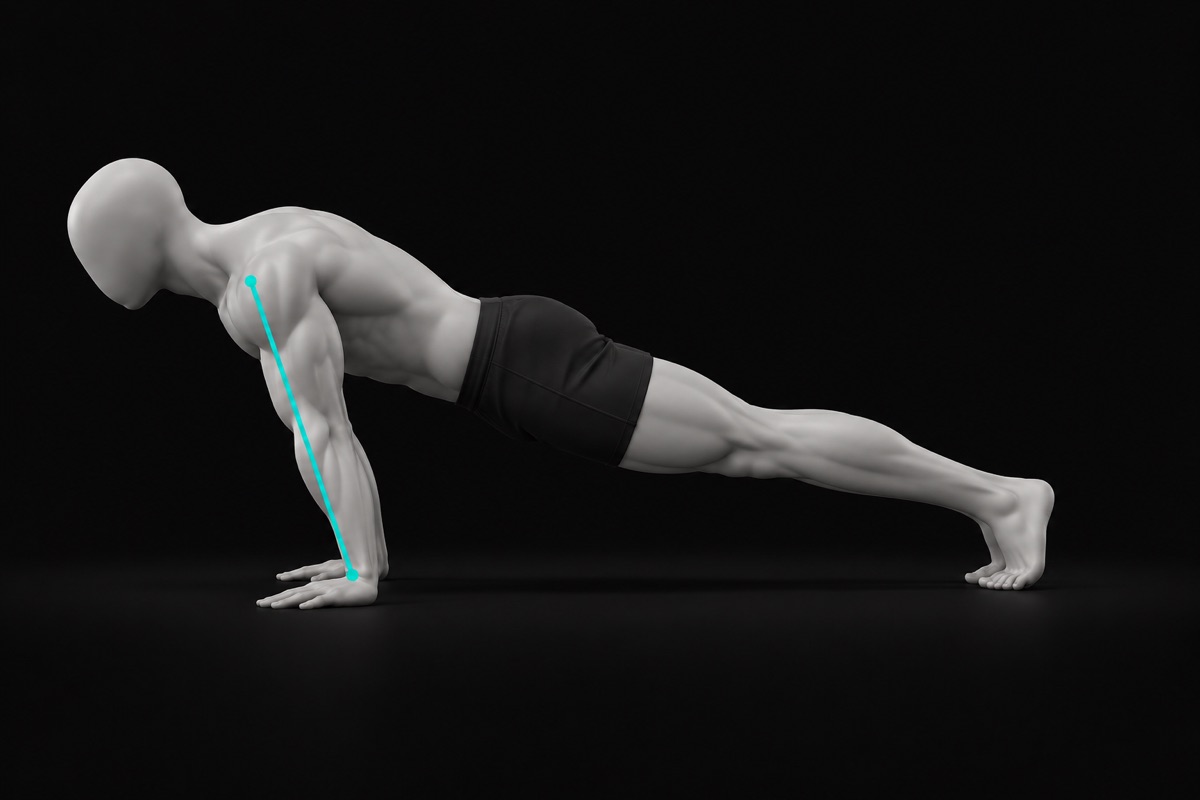
A pseudo planche push-up is a push-up with your hands set back by your waist, fingers turned out, and your shoulders leaning in front of your hands for the whole rep. That lean moves your weight toward your hands, so your shoulders and arms work much like they do in a planche, with your feet still on the floor. Start with a small lean you can keep from top to bottom, then grow it.
The drill is easy to get wrong. In a form check on r/bodyweightfitness, the top reply said the video looked like a normal push-up: not enough lean, hands too wide. Others added that the shoulder blades should keep pushing apart and the elbows should come in.
How is a pseudo planche push-up different from a regular push-up?
Three things change: where your hands sit, which way your fingers point, and where your shoulders are.
- Hands further back. In a regular push-up, your hands sit under your shoulders. Here they sit by your lower ribs or your waist.
- Fingers turned out. Fingers point to the sides, or diagonally back. Most people find the lean kinder on the wrists this way.
- Shoulders in front of the hands. At the top, your forearms slant forward and your shoulders sit ahead of your wrists. This is a planche lean, and every rep starts and ends there.
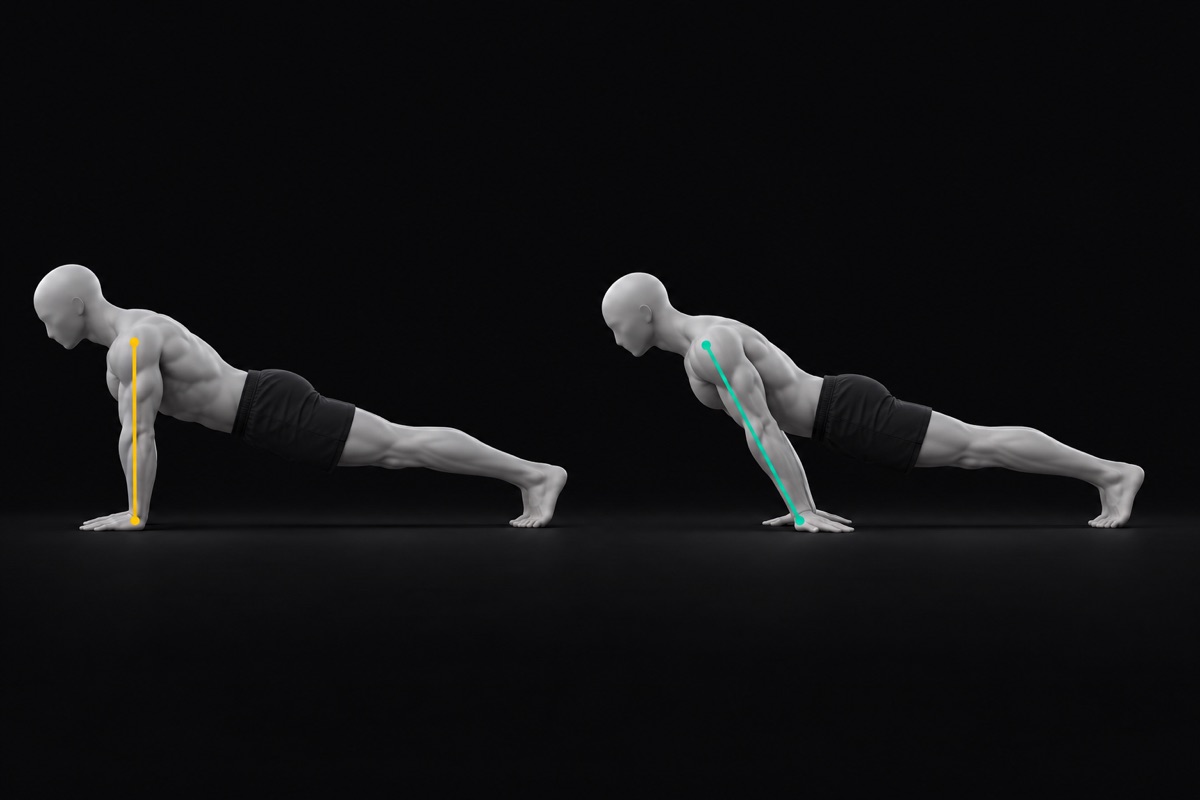
The elbows also point back toward your feet. Hands moved back with the shoulders still over the wrists is not the drill.
Why do pseudo planche push-ups build the planche?
They load the same three things the planche needs, through a full range of motion, at a weight you can control.
- Pushing in the lean. The planche asks the front of your shoulders to hold your body with your shoulders far past your hands. The top of every rep is that position, with your feet taking part of the load.
- Protraction. Pushing your shoulder blades apart at the top, the "plus" at the end of a push-up, is the shoulder position of the planche. A 2019 review of 19 push-up plus studies found that this move brings in the serratus anterior, the muscle that holds the shoulder blades against your ribs, at a high level.
- A tucked pelvis. The planche body line is a slight hollow: glutes tight, pelvis tucked under, ribs down. A long, leaning push-up trains you to keep it while your arms move.
Steven Low writes in his article on isometric plateaus that he likes pseudo planche push-ups with a 1 to 2 second hold at the top and the feet raised to shoulder height, because each rep ends with a free planche hold. Not sure which straight-arm skill to chase first? Read front lever or planche first.
How do you set your hands and the lean?
- Hands. Kneel and place your hands shoulder width apart, fingers turned out about 45 to 90 degrees.
- Plank. Step back into a straight push-up plank, arms locked, on the balls of your feet.
- Lean. Shift forward on your toes until your shoulders sit about 5 to 10 cm (2 to 4 inches) in front of your wrists. Your forearms now slant forward.
- Set the body. Push the floor away, tuck the pelvis, squeeze the glutes and the legs.
- Lower. Bend the elbows back toward your feet and bring your chest down, keeping the same lean. At the bottom, your hands should sit beside your waist.
- Press. Push back up to the lean, not back toward your feet, and push your shoulder blades apart at the top. Hold 1 second, then start the next rep.
If your shoulders sit over your hands at the bottom, move your hands 2 to 3 cm (about an inch) closer to your feet and try again.
How do you make pseudo planche push-ups easier or harder?
The lean is the main dial. More lean puts more of your weight on your hands and more work on the front of your shoulders.
- Easier: incline. Hands on a bench or a box, about 40 to 60 cm (16 to 24 inches) high. You can lean properly while the load stays light.
- Easier: knees. Do them from your knees on a mat. The lean is the same skill, with less weight.
- Easier on the wrists: parallettes. Handles or parallettes let you grip with the wrists near straight. They also give you more room to go deep.
- Harder: more lean. Grow the gap between your shoulders and your wrists by about 2 cm (an inch) at a time.
- Harder: feet raised. Feet on a box puts more of your weight on your hands. Low's version raises them to shoulder height.
Change one dial at a time, so you know which one broke your form.
What are the most common faults, and how do you fix them?
Losing the lean. The shoulders drift back over the hands at the bottom, or you push back toward your feet on the way up.
- Cue
- Same gap between shoulders and hands, top to bottom.
- Why
- Without the lean, the rep is a regular push-up with awkward hands. The lean is the whole point of the drill.
- Drill
- Heels against a wall, 3 x 5 slow reps with a 2 second pause at the bottom. The wall stops you sliding back.
This is a common one. On r/bodyweightfitness, an athlete doing 3 sets of 10 said they kept pushing back out of the lean on the way up. The top reply said the top of each rep should be the planche lean, not a regular push-up position.
Shrugged shoulders. The shoulders creep up toward your ears as you lean.
- Cue
- Long neck, push the floor away.
- Why
- A shrug takes the load off the muscles you want to train and puts the planche shoulder position out of reach.
- Drill
- Planche lean holds, 3 x 10 seconds, with a long neck and the upper back high.
You do not need to stay fully protracted all the way down. Steven Low describes the push-up as protracted at the top and retracted at the bottom, and replies in another thread agreed that losing some protraction at the bottom is fine. Win it back at the top of every rep.
Sagging or piked hips. The lower back arches and the hips drop, or the hips rise to make the lean easier.
- Cue
- Glutes tight, pelvis tucked, ribs down.
- Why
- Sagging hips hang on your lower back. Piked hips move weight onto your feet and shrink the lean.
- Drill
- Hollow body holds, 3 x 20 seconds before your sets, then the same shape in a plank for 20 seconds.
Flared elbows. The elbows point out to the sides as you lower.
- Cue
- Elbows back, arms brushing your ribs.
- Why
- Flared elbows turn the drill into a wide push-up and lose the straight-line push toward your hands that the planche needs.
- Drill
- Lower for 3 seconds with your elbows grazing your sides, 3 x 5 reps, on an incline if needed.
Why do pseudo planche push-ups hurt my wrists?
Your wrists bend back further than in a regular push-up, and the lean puts more of your weight on them. A cadaver study of push-up positions found that a push-up with the wrist bent back raised the peak pressure on one part of the wrist joint compared with a neutral, knuckle position.
- Cue
- Fingers out, then lean only as far as your wrists accept.
- Why
- Wrists need time to get used to heavy loads in this bent-back position. Pushing the lean faster than they adapt is a common way to get sore.
- Drill
- Before each session, 2 minutes of wrist circles and gentle rocks on all fours, palms flat, then palms turned back. Then use parallettes for your working sets if the floor still bothers you.
Wrist pain is common in hand-balancing practice: in a 2025 survey of 321 adults who practice handstands, 56.7% reported chronic wrist pain. Sharp pain, numbness or pain that lasts after a few days of rest is a reason to stop the drill and see a physiotherapist.
How many sets and reps should you do?
Pick a lean you can keep for every rep, then work in the 5 to 12 rep range.
- Start: 3 sets of 5 to 8 reps, 1 second hold at the top, 2 minutes of rest.
- Build: add 1 rep per set each week until you reach 3 x 12 with the same lean.
- Frequency: 2 to 3 sessions a week, with a rest day between them.
Low's sample week uses 3 to 5 sets with a 1 second pause in the lean: 15 reps one day, 10 the next session, 5 the last.
How do you combine them with planche leans and tuck planche holds?
Do the hardest work first, while you are fresh: the static holds, then the push-ups.
- Tuck planche holds, if you have one: 4 to 6 sets at about 60 to 70 percent of your best clean hold, as Steven Low programs isometrics. With a 6 second best, hold 4 seconds.
- Planche leans: 3 x 10 to 15 seconds. In the r/bodyweightfitness thread above, a reply said a lean you can hold for 60 seconds is too easy: lean further until 10 to 15 seconds is your limit.
- Pseudo planche push-ups: 3 x 5 to 12, as above.
If your tuck planche hips sit low, the leans matter most, as explained in tuck planche hips too low.
How do you check your form, and when should you move on?
Film from the side with the phone at hip height, 2 to 3 meters (7 to 10 feet) away, in landscape. Pause on the top and the bottom of a rep. Your shoulders should sit in front of your wrists in both frames, your elbows point back, and your body stay in one line from shoulders to heels. CaliLens scores regular push-ups and planche holds, not this drill, so judge these reps by eye. For the push-up basics, see are my push-ups clean.
Move on when you hit 3 x 12 clean reps, checked on video. Then either lean 2 cm (an inch) further and drop back to 3 x 6, or raise your feet. Once you hold a 10 to 15 second planche lean with your shoulders well past your fingertips, start tuck planche holds next to the push-ups. The same move-on logic applies to every skill, as explained in when to progress in calisthenics.
Frequently asked
Do pseudo planche push-ups work the chest?
Yes, but the front of the shoulders and the triceps take a bigger share than in a regular push-up, because the lean puts the load ahead of your hands. If chest size is your main goal, keep regular or weighted push-ups in your week as well.
Can I do pseudo planche push-ups without parallettes?
Yes. The floor works if your wrists tolerate the bend. Turn your fingers out and warm up first. If the floor hurts, push-up handles, parallettes or two sturdy blocks keep the wrists straighter.
Are pseudo planche push-ups better than pike push-ups?
They train different things. Pike push-ups press overhead and lead toward the handstand push-up. Pseudo planche push-ups press forward with the shoulders leaning past the hands and lead toward the planche. Pick the one that matches your goal, or alternate them.
Why do my feet slide during pseudo planche push-ups?
Your toes take more of your weight as you lean, and on a smooth floor they can slip back. Train barefoot on a mat, wear shoes with grip, or put your heels or toes against a wall so the lean cannot leak away.
Can pseudo planche push-ups replace dips?
Not fully. Dips train a deep pressing range behind the body that this drill does not reach. Many routines keep one of each: a dip or a regular push-up for general strength, and the pseudo planche push-up for planche work.