Blog · Pull-up · 8 min read
Chin-up vs pull-up: grip, muscles and which first
Turning your palms changes less than the gym arguments suggest. Both grips build the same back, one just gives your biceps better leverage. Here is how to use that.
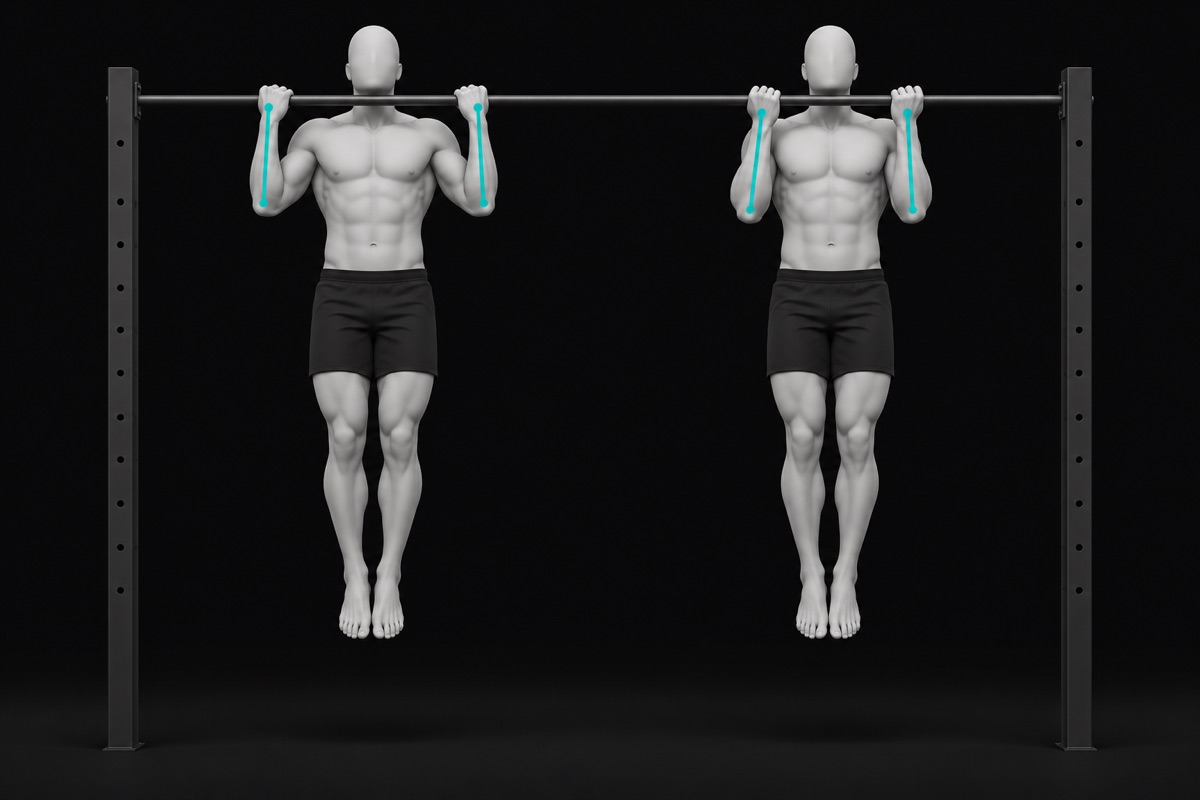
A chin-up is done with your palms facing you (underhand), a pull-up with your palms facing away (overhand). Both are mainly lat exercises. The chin-up adds a little more biceps and chest work and is easier for most people, because palms up gives the elbow flexors better leverage. Beginners can start with chin-ups, then add pull-ups as soon as they have a few clean reps. A neutral grip, palms facing each other, is the third option and often the kindest on sore elbows.
The gap between the two is usually small. In a r/bodyweightfitness thread, a beginner in his late twenties could do more than 10 chin-ups but not a single pull-up after 15 attempts. Two of the most upvoted replies said most people manage only a few more chin-ups than pull-ups, and that a gap that large points to the back not engaging, not to a missing muscle.
What is the difference between a chin-up and a pull-up?
The grip. Everything else, the dead hang start, the chin over the bar, the straight body, stays the same.
- Pull-up. Overhand grip, palms facing away. Hands about shoulder width or slightly wider, roughly 5 to 10 cm (2 to 4 inches) outside each shoulder.
- Chin-up. Underhand grip, palms facing you. Hands about shoulder width, or a little narrower.
- Neutral grip. Palms facing each other, on parallel handles or a ring set. Hands roughly shoulder width.
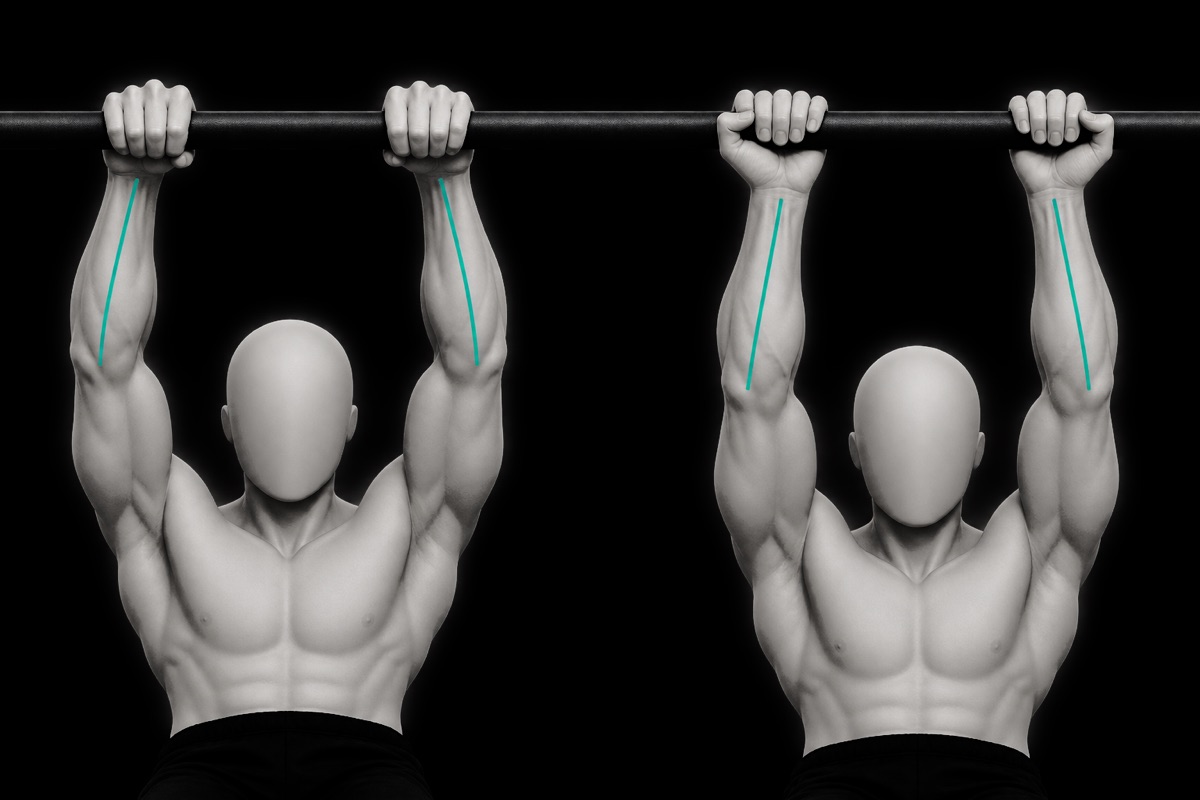
Pick a width where your forearms stay close to vertical at the bottom of the rep. Very wide grips cut the range, and very narrow chin-ups crowd the wrists.
Which muscles do chin-ups and pull-ups work?
Mostly the same ones, with small shifts. The studies agree on that more than on any detail.
- Lats lead in both. In an EMG study by Youdas and colleagues (2010) with 25 adults, the lats were the most active muscle in the pull-up, the chin-up and a rotating-handle version. The chin-up showed more biceps and chest activity, the pull-up more lower trapezius activity.
- Grip changes little overall. In a study of 19 strength-trained men by Dickie and colleagues (2017) comparing palms-up, palms-down, neutral and rope pull-ups, muscle activity over a full rep was similar across grips. The one clear difference: the middle trapezius worked harder with palms down than with a neutral grip.
- The reviews say the same. A 2026 narrative review of lat EMG studies found broadly similar lat activity across pull-up grips, and suggested choosing a grip for secondary goals rather than for the lats alone.
One study points the other way, on a machine. In a lat pulldown study of 12 men, palms down produced more lat activity than palms up, at both a wide and a narrow width. A pulldown is not a pull-up, so read it as a hint, not a rule.
The practical takeaway: EMG measures muscle activity in one session, not long-term growth. Neither grip neglects your back. If you want more biceps, lean on chin-ups. If your goal is the muscle-up or the front lever, lean on pull-ups.
Are chin-ups easier than pull-ups?
For most people, yes, by a few reps. The reason is leverage. The biceps both bends the elbow and turns the palm up, so it pulls best when the palm already faces you. With palms down, more of the work falls on the other elbow flexors.
Forearm position makes a measurable difference. In a test of peak elbow flexion force in 85 students, the neutral position was strongest, about 28 kg (62 lb) on average, and the palms-down position was weakest, about 17 kg (38 lb). A pull-up puts your arms in that weakest position for the whole rep.
Use the gap as a check. If your chin-up max is 2 or 3 reps higher than your pull-up max, that is normal. If it is 8 or 10 reps higher, your pull-ups are probably arm-led: start each one by pulling your shoulders down, as the thread replies suggested, and build the bottom of the rep with the scapular pulls in the dead hang guide.
Should beginners start with chin-ups or pull-ups?
Start with whichever grip gets you a clean rep first, usually the chin-up. Then train both. Here is a simple order:
- Zero reps with either grip. Build the base with inverted rows, then negatives and band work, as laid out in why you can't do a pull-up yet. Do the negatives with your palms facing you if they feel stronger.
- 1 to 3 chin-ups, no pull-up. Make chin-ups your main set, then finish with 2 or 3 slow overhand negatives of 3 to 5 seconds.
- 3 or more of each. Alternate the main grip by session: pull-ups on day one, chin-ups on day two, neutral or rings on day three if you have them.
- Stuck on both. The problem is the programming, not the grip. See why your pull-ups are not improving.
Whichever grip you train, put the one you want to improve first in the session, while you are fresh.
Is the neutral grip pull-up better for sore elbows?
Often, but not for everyone. A straight bar locks your forearms in one rotation for every rep. Parallel handles put them halfway between the two bar grips, and rings let them turn freely during the rep, so your elbows settle where they are comfortable.
In a thread asking why anyone would train overhand over neutral, the author, who had recovered from golfer's elbow, planned to train only with a neutral grip. The most upvoted reply pushed back gently: the activation differences are small, what is easy on the elbow depends on the person (for that athlete, chin-ups were the worst), and they rotate grips from one training block to the next. That matches the advice in elbow pain in calisthenics: test each grip with a few easy reps and keep the ones that do not hurt.
A grip swap is not a treatment. Stop and see a physiotherapist or doctor if pain persists for more than 2 weeks after you cut the load, if you feel numbness or tingling in your ring and little fingers, if your grip gets weaker, or if a pull ends with a sudden sharp pain or a pop at the front of the elbow.
What counts as a full rep?
The same standard applies to both grips:
- Start: a dead hang with your elbows fully straight and your shoulders already pulled down.
- Top: chin clearly above the bar, reached by pulling, not by lifting your chin.
- Body: legs straight and still, no kick, no swing.
- Down: a controlled return to straight arms before the next rep.
Chin-ups make a short top easier to hide, because the bar comes close to your face quickly. Hold the standard anyway.
What are the most common chin-up and pull-up mistakes?
Four faults cover most rejected reps. Each one makes the rep shorter or easier.
Half reps. The arms stay bent at the bottom, or the chin stops level with the bar.
- Cue
- Straight arms at the bottom, chin over the top, every rep.
- Why
- Skipping either end trains a shorter movement, and the missing range is usually the part you need for the next skill.
- Drill
- 3 sets of 3 paused reps: one second in a straight-arm hang, one second with the chin over the bar.
Chin poking. The head tips back and the chin reaches for the bar while the body stays below it.
- Cue
- Eyes forward, neck long, pull your chest toward the bar.
- Why
- Lifting the chin fakes the last few centimeters and loads the neck instead of the back.
- Drill
- Flexed arm hangs, 3 x 10 seconds, with the chin above the bar and the neck neutral.
Kipping. The knees drive up or the hips swing to throw the body upward.
- Cue
- Legs together, glutes squeezed, start from stillness.
- Why
- The swing moves part of the work to the hips. That is fine as a separate skill, but it hides your real strict strength.
- Drill
- Pause one second in a still dead hang before each rep. If you still swing, do sets of 2 instead of max sets.
Shrugging at the bottom. The shoulders sink to the ears between reps and the arms start the pull alone.
- Cue
- Shoulders down first, then bend the elbows.
- Why
- An active bottom puts the back in charge from the start and keeps the shoulder in a strong position.
- Drill
- 3 sets of 8 scapular pulls, then one full rep that starts with that same shoulder movement.
Which grip do you need for the muscle-up and the front lever?
Overhand, for both. Train pull-ups as soon as either skill is your goal.
- Muscle-up. On a bar, your wrists have to roll over the top into a dip support, and that only works with palms facing away. A regular overhand grip or a false grip are the two options, compared in how to get over the bar on a muscle-up. Chin-up strength helps, but the pull has to become high and fast with palms down.
- Front lever. The standard progressions are held with straight arms and an overhand grip, and the bent-arm work that supports them, such as pull-ups and rows, is usually done overhand too. Rows also build the trunk side of the lever, as covered in the inverted rows guide.
Chin-ups still earn a place in a skill program, as a heavier biceps day or a change for the elbows, but not as a replacement.
How do you check your grip and range on video?
Film from the side or a three-quarter angle, with your phone at chest height 2 to 3 meters (7 to 10 feet) away, the bar and your feet in frame. Do one set with each grip, then compare: straight arms at the bottom, chin above the bar, legs still. If one grip loses range or starts to swing, that grip is your weak link. You can also film your pull-ups for CaliLens, which scores them from a phone video. For light and framing, see how to film yourself for a form check.
Frequently asked
Do chin-ups build the back as well as pull-ups?
Yes. Your lats do most of the work with either grip. Chin-ups put a little more load on the biceps and chest, pull-ups a little more on the lower trapezius. If you only have one grip available, you can build a strong back with it.
Can I count chin-ups toward a pull-up goal?
They help, but they are not the same test. Chin-up strength carries over, yet most people still need some palms-down practice to close the gap. Keep at least one overhand set or a few overhand negatives in each pulling session.
Is a mixed grip pull-up a good idea?
It works as a variation, one palm toward you and one away. Swap which hand faces which way every set, so both sides get the same load. Treat it as an extra, not as the main lift.
Are wide grip pull-ups better for the lats?
Not clearly. Studies on grip width give mixed results, and a very wide grip shortens your range of motion. Hands slightly wider than your shoulders give you full range and a strong pull.
Should I alternate chin-ups and pull-ups in the same workout?
You can. Put the grip you most want to improve first, while you are fresh, and the other one second. Alternating across sessions works too and spreads the load on your elbows.