Blog · Pull-up · 8 min read
Inverted rows for beginners: the step before pull-ups
The row is the one pulling exercise you can scale to any level by moving a bar or your feet. Get the body line right first, then make it harder one step at a time.
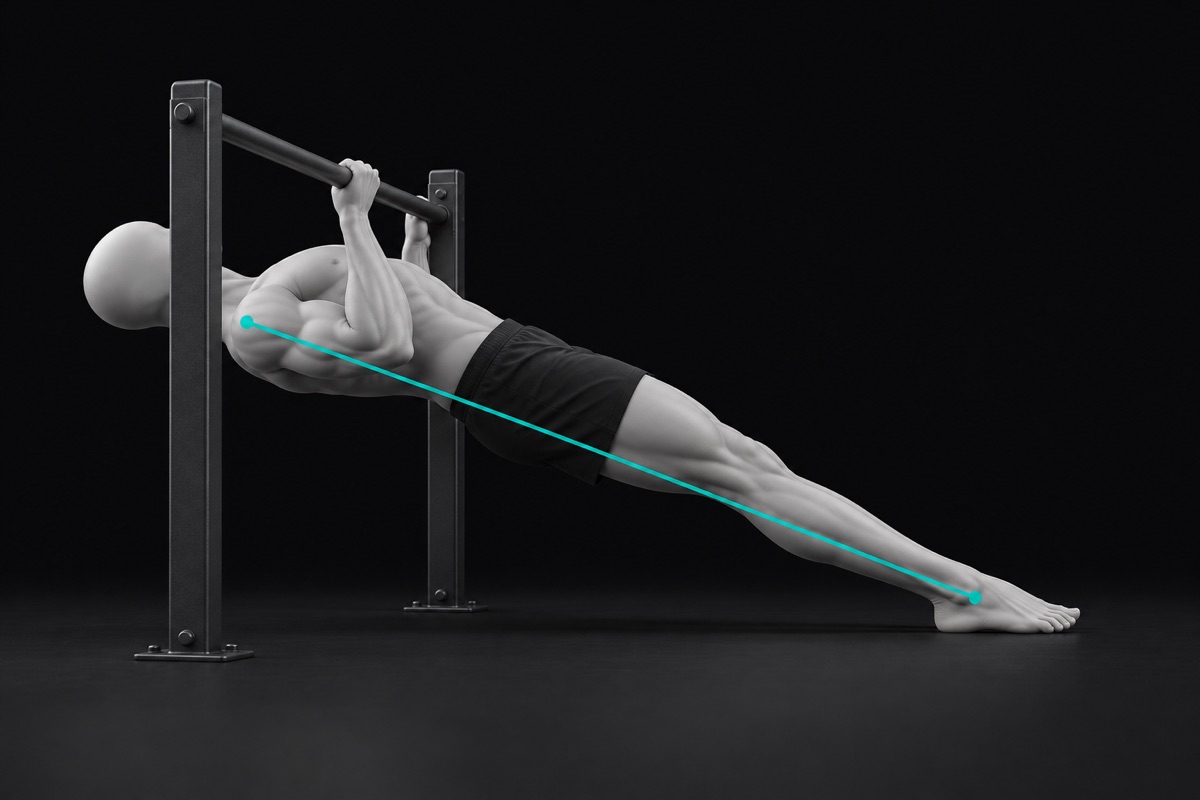
An inverted row, also called an Australian pull-up, is a pull-up turned on its side: you hang under a low bar with your heels on the floor and pull your chest up to it. Your feet carry part of your weight, so it is the easiest real pulling exercise, and you make it harder by lowering the bar or raising your feet. Train it from day one, aim for 3 clean sets of 8 with your body horizontal, and use it to build both your first pull-up and your front lever.
Beginners often find rows harder than they expected. In a r/bodyweightfitness thread asking why rows are so hard, the author could not touch the bar with straight wrists. Replies pointed to mobility and setup: check that you can bring a stick to your chest with no load, and try rings if a bar blocks your wrists.
What is an inverted row?
It is a horizontal pull. You lie under a bar set around waist height, grab it with straight arms, lift your hips until your body is one straight line, and pull your chest to the bar. Then you lower back to straight arms.
In an EMG study of 26 people doing inverted rows, the biceps, lats, lower trapezius and rear deltoid all worked hard in every version tested, so it trains your upper back, rear shoulders, lats and arms at once. Your trunk works too, because it has to stay straight between your hands and your heels.
Inverted row or pull-up: which comes first?
The row comes first, or at least at the same time. A pull-up asks you to lift all of your weight vertically. A row lets your feet take part of it, so you can do real, full reps long before your first pull-up.
- You can scale it. A pull-up has one difficulty: your body weight. A row has as many as there are bar heights.
- It trains the same muscles from another angle. The pull-up is a vertical pull, the row a horizontal one. Steven Low builds his beginner routine in The Fundamentals of Bodyweight Strength Training with a rows progression for horizontal pulling and a pull-ups progression for vertical pulling, side by side.
- It is gentle on the lower back. In a comparison of three rowing exercises, the inverted row produced the highest lat, upper back and hip extensor activation and the lowest load on the lower spine.
Rows alone are a slow road to the pull-up, though. In a thread on getting a first pull-up with rows only, the top reply said it worked for them, while others said you still need to practice the pull-up itself, and that negatives, bands or assistance get you there faster. Use rows as the base and add the vertical work from why you can't do a pull-up yet.
How do inverted rows help the front lever?
A front lever is a horizontal body held by your back and straight arms. A row trains the same two things with bent arms: pulling toward your hips and keeping your body straight while you do it.
Steven Low lists weighted inverted rows among the bent-arm options when a routine leaves out front lever holds, in the same article. If your hips drop in a lever, the trunk side of the problem is the same one you fix in a row, explained in front lever hips sagging.
How do you set the bar height and your feet?
Two rules cover every setup: the higher the bar, the easier the row; the higher your feet, the harder it gets. Your body angle is what you are really changing.
- Easiest: bar at about chest height when you stand, feet close to under the bar. Your body is steep, close to standing.
- Easy: same bar, bend your knees and keep your feet flat. Your legs can help a little.
- Medium: bar at about waist height, legs straight, heels on the floor.
- Hard: bar low enough that your body is level with the floor at the bottom, arms straight, back just off the ground.
- Harder: horizontal, with your feet on a box or bench 30 to 45 cm (12 to 18 inches) high.
Change one thing at a time, in small steps: move your feet about 10 cm (4 inches) further from the bar, or lower rings by one notch. Lifting one foot is not a shortcut: in the EMG study above, single-leg rows did not significantly change muscle activation.
How do you do an inverted row with clean form?
- Grip. Hands slightly wider than your shoulders, thumbs around the bar. Overhand is the default.
- Set the plank. Arms straight, squeeze your glutes, ribs down, and lift your hips until shoulders, hips and ankles line up. It is a hollow body turned face up.
- Set your shoulders. Before you bend your elbows, pull your shoulders away from your ears, as in an active hang.
- Pull your chest to the bar. Aim the bar at your lower chest. Keep your elbows tucked, about 45 degrees from your sides, not flared out at shoulder level.
- Finish with the shoulder blades. At the top, squeeze them together and keep them down. Pause for 1 second.
- Lower under control for about 2 seconds, all the way to straight arms.
Steven Low sums up the shoulder blades in rows in his article on scapular positioning: "protracted and depressed at bottom and retracted and depressed at the top." In plain words: spread at the bottom, squeezed at the top, down the whole time.
What are the most common inverted row mistakes?
Four faults show up again and again. Each one lets you skip part of the work.
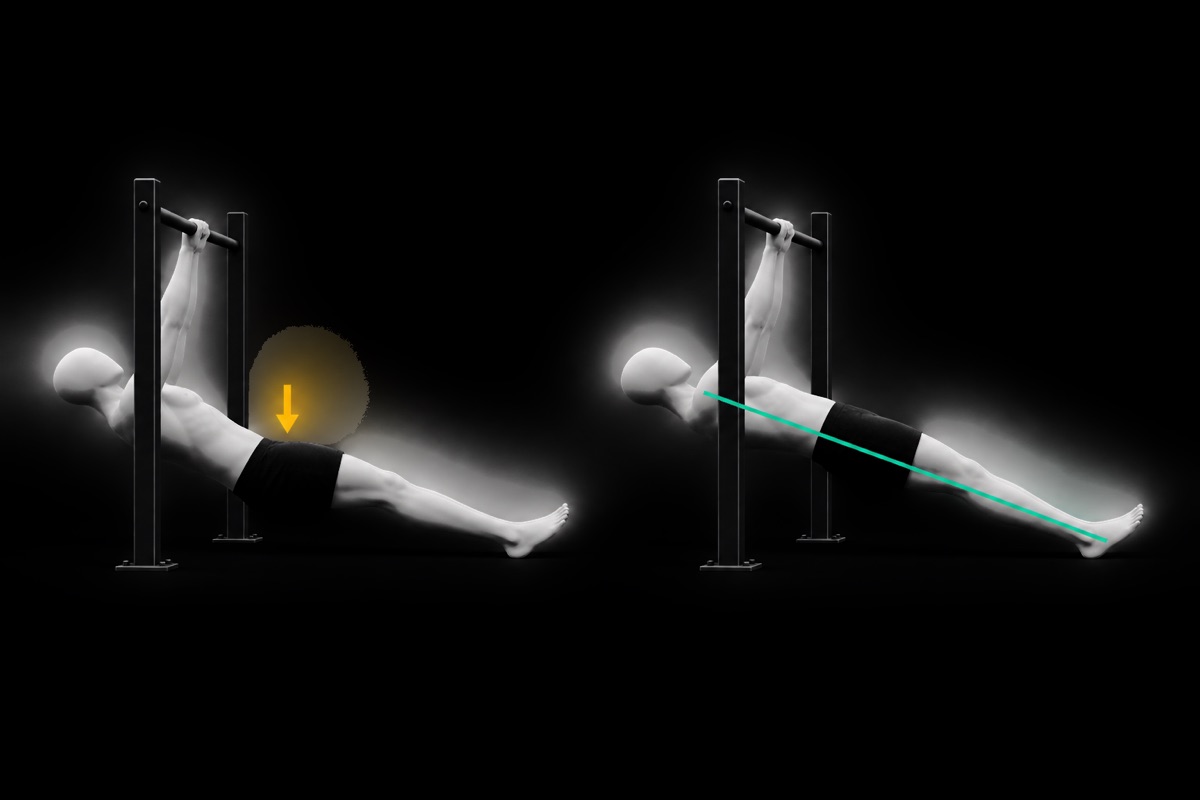
Hips sagging. The hips drop toward the floor while the chest goes up.
- Cue
- Glutes tight, body as one stiff board.
- Why
- Sagging hips shorten the distance your chest travels and turn the rep into a hip lift. The straight line is also the shape your front lever needs.
- Drill
- Hold the bottom position for 3 x 20 seconds with a straight body, then do your rows at a higher bar until the hips stay up on every rep.
Chin poking to the bar. The head reaches forward so the chin touches the bar while the chest stays low.
- Cue
- Chest to the bar, neck long, chin slightly tucked.
- Why
- A chin touch can hide the last 5 to 10 cm (2 to 4 inches) of the pull, which is the hardest part for your upper back.
- Drill
- Touch the bar with your lower chest and hold for 2 seconds at the top, 3 x 5. If you cannot reach it, raise the bar one step.
Half reps. The elbows never straighten at the bottom, or the chest stops short at the top.
- Cue
- Straight arms at the bottom, chest touch at the top, every rep.
- Why
- The top of a row is the hardest part, and the bottom stretch is where you learn to set your shoulders. In a thread about horizontal rows feeling harder than pull-ups, one reply noted that fixed feet leave no momentum to hide behind at the top, and advised a regression with full range instead.
- Drill
- Pick the bar height where you get 8 full reps, and count only those.
Shrugging. The shoulders ride up toward the ears as you pull.
- Cue
- Shoulders in your back pockets, then pull.
- Why
- A shrug lets the upper trapezius take over and the shoulder blades never squeeze down and back at the top.
- Drill
- Scapular rows, 2 x 8: arms straight under the bar, squeeze your shoulder blades together and down so your chest rises a few centimeters, hold 2 seconds, release.
How many sets and reps should you do?
- Find your setup. Choose the bar height where you get about 8 clean reps on a fresh first set.
- Train it. 3 sets of 6 to 10 reps, 90 seconds of rest, stopping 1 or 2 reps before your form breaks.
- Add a rep each week. When you hit 3 x 10 clean, make it one step harder and drop back to 3 x 6.
- Frequency. 2 or 3 sessions a week with a rest day between them.
If your elbows or shoulders hurt during rows, make the angle easier, try rings, and see a physiotherapist if the pain persists.
How many inverted rows before you try a pull-up?
A useful target is 3 sets of 8 rows with your body horizontal, the same mark used in the first pull-up plan. At that point, test a full pull-up at the start of a fresh session.
You do not have to wait for it. Once you own 3 x 8 at a medium angle, add pull-up negatives: jump or step to the top and lower in 5 seconds, 3 sets of 3. If you can already do a few pull-ups, keep rows as your second pull at 3 x 8 to 12 and see why your pull-ups are not improving for the rest.
Past horizontal, keep going: feet elevated, a weighted backpack, then archer rows.
Where can you do inverted rows without a gym?
- A low bar in a park: the low bar of a pull-up station, a parallel bar or a sturdy railing.
- Rings or straps hung from a pull-up bar, a beam or a tree branch. Lengthen or shorten them to change the angle, and your wrists can turn freely.
- A table. Lie under a heavy, solid table and pull your chest to its edge. Test it first: it must not tip or slide when you hang your full weight on one side.
These are the setups people suggest again and again in a thread on rows with household items: rings on a doorway bar, lying under a table, even a child's swing set.
How do you check your rows on video?
Film from the side, with the phone at bar height, 2 to 3 meters (7 to 10 feet) away, in landscape, bar and feet in frame. On the video, check three things: a straight line from shoulders to ankles, the chest touching the bar at the top, and straight arms at the bottom. Watch your last reps, that is where the hips drop. CaliLens does not score rows, but it does score pull-ups, so it can check your first real rep once you get there. For light and framing, see how to film yourself for a form check.
Frequently asked
Are Australian pull-ups the same as inverted rows?
Yes. Australian pull-up, inverted row, bodyweight row and ring row all name the same movement: you hang under a bar or rings with your heels on the floor and pull your chest up. Ring rows just let your wrists turn freely.
Can inverted rows alone get me my first pull-up?
They can for some people, but it is a slow road. Rows build the back and arms, yet the pull-up is a vertical pull with your full weight. Keep rows in your plan and add pull-up specific work, such as negatives and scapular pulls, so the strength turns into the skill.
Should I use an overhand or underhand grip?
Either works. Overhand is the usual default and shifts a bit more work to the upper back; underhand often feels easier on the biceps and lets the elbows stay closer to the body. Switch now and then, or use rings and let your hands turn.
Why do my wrists bend at the top of a row?
A fixed bar locks your hands, so tight wrists or a bar that is too thick can stop your chest short. Try a thinner bar, a slightly wider grip or rings. If the wrist hurts rather than just feels stiff, stop the set.
How often should I do inverted rows?
Two or three sessions a week, with a rest day between them, suits most beginners. Rows pair well with push-ups in the same session, one set of each, so you train pulling and pushing in equal amounts.