Blog · Dips · 8 min read
Dips for beginners: from zero to your first full dip
Your first dip is not built by attempting dips. It is built at the top of the bars, with straight arms and low shoulders, and then a few centimeters at a time.
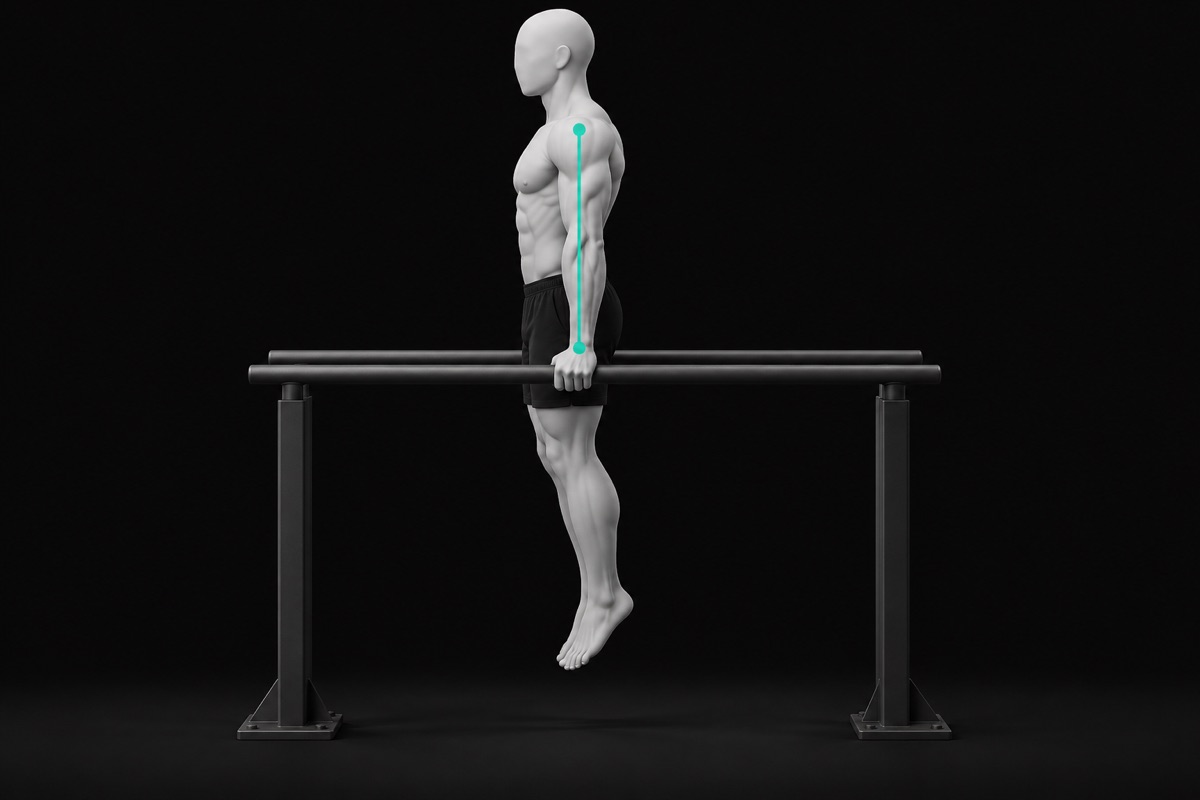
To get your first dip, start at the top. Hold yourself on parallel bars with straight arms and your shoulders pushed down, away from your ears, until you can do 3 sets of 30 seconds and work toward 60. Then lower yourself bit by bit: dips with your feet helping on a box or a band taking some weight, slow negatives, partial reps, and finally the full dip, shoulders down to elbow level and back up to straight arms. Most beginners fail dips because their shoulders give way at the top, not because their triceps are weak.
Pain is the other common wall. In a r/bodyweightfitness thread, a 120 kg (265 lb) beginner said negatives and support holds left his shoulders sore for 3 to 4 days, and that his shoulder blades kept rising during the negatives. The top replies agreed: pain that lasts days is a signal to back off, not to push through. Take some weight off with bands or your feet, and keep your shoulders down.
Why do dips feel so hard, or hurt, at first?
- Your shoulders are not used to holding you. On the bars, your full bodyweight hangs from the shoulder blades. If the muscles that pull them down give way, your shoulders slide up to your ears and the front of the joint takes the strain.
- The bottom is the hardest and most exposed position. In a 2022 motion-capture study of 13 experienced men, bar dips used about 88% of each man's own shoulder extension range. A beginner who drops straight to the bottom is loading a position they do not control yet.
So the plan is to own the top first, then go down a little more each week. Depth itself is covered in how deep you should go on dips. The short version: shoulders level with the elbows counts as a full rep.
What do you need before you try your first dip?
A solid support hold: 30 to 60 seconds at the top of the bars, arms straight, shoulders down. If you cannot hold the top, you cannot press back to it.
- Jump or step to the top of parallel bars, hands about shoulder width, arms locked.
- Push the bars down so your shoulders move away from your ears. Your neck should look long.
- Keep your body still, legs straight or knees bent, feet together, a slight hollow in the trunk.
- Hold 3 sets of 10 to 30 seconds, resting 1 to 2 minutes.
The r/bodyweightfitness Recommended Routine uses a 30 second support hold and moves people on from a hold once they reach 30 seconds on all 3 sets. Use the same test here: 3 x 30 seconds with low shoulders, then start the dip steps. Keep building toward 60 seconds as part of your warm-up.
Add scapular dips once the hold feels steady: arms straight, let your shoulders rise a little, then push them back down. 3 sets of 8 slow reps.
What is the dip progression for beginners?
Start at the first step you cannot do cleanly. Pass its move-on test before going further.
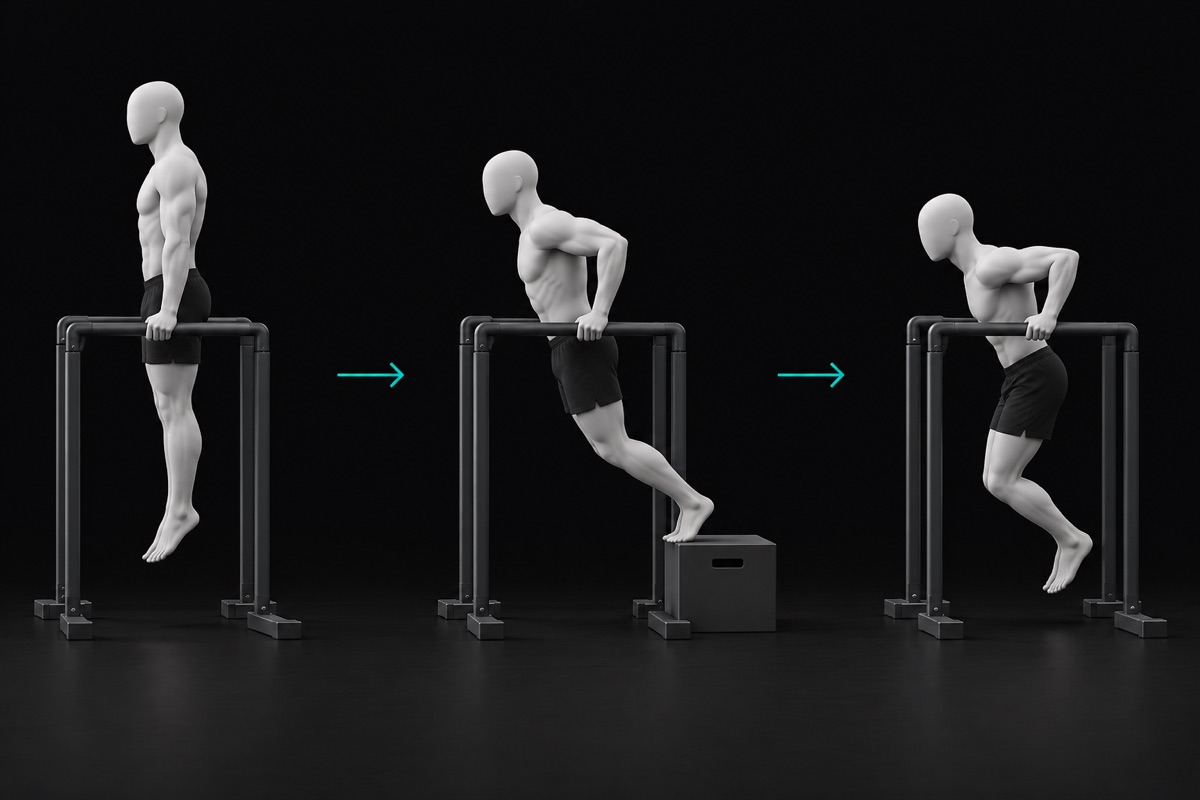
- Support hold. 3 x 10 to 30 seconds. Move on at 3 x 30 seconds with your shoulders down the whole time.
- Bench dips (optional). 3 x 8 to 12, knees bent, shallow. Many people can skip them. See the next section.
- Feet-assisted dips on a box. Put a box behind the bars so your toes touch it at the bottom. Lower to your current depth and press up, pushing with your legs only as much as you need. 3 x 8 to 12. Move on when you reach 3 x 12 with almost no push from the feet.
- Band-assisted dips. Loop a band across the bars and kneel or stand on it. A thicker band helps more. 3 x 5 to 8. Move on when you reach 3 x 8 with your lightest band. If you have no band, stay with the box and use less leg.
- Slow negatives. Start at the top, lower yourself in 3 to 5 seconds, then step back up. Steven Low lists dips among the exercises negatives help you learn and suggests 2 to 3 sets of 2 to 3 reps with 3 minutes of rest, building to 7 to 10 seconds per rep. He writes that most people get a full rep once they reach 3 sets of 3 at 7 to 10 seconds.
- Partial range dips. Lower a third of the way, press back up. 3 x 5. Each week, go a little deeper. Move on when you can press up from shoulder-to-elbow depth once.
- Full dips. 3 sets of as many clean reps as you have, then finish with 2 negatives. The Recommended Routine uses 3 sets of 5 to 8 for its strength exercises, dips included, and moves on at 3 x 8.
Steps 3 and 4 do the same job, so use either. If a step gives you only 1 or 2 reps, do those first and fill the set with the step before, as described in when to progress in calisthenics.
Should you do bench dips or parallel bar dips?
Parallel bar dips are the goal. Bench dips are lighter, but not easier on the shoulders, and they teach a different movement.
In the same motion-capture study, bench dips took the shoulder to about 101% of each lifter's own maximum extension range, more than bar dips at 88% and ring dips at 69%. The authors still list the bench dip as a starting point, because your feet take part of the load, but warn that this much extension may stress the front of the shoulder capsule.
- Their limits. Your hands are behind you, your shoulders roll forward, and you never learn to hold your weight on the bars.
- When to use them. With no bars at all, or as a light warm-up. Keep your knees bent, feet on the floor and the range short.
- When to skip them. If you can hold the support for 30 seconds, go straight to box dips. Skip them if the front of your shoulder pinches.
How often should beginners train dips?
2 or 3 times a week, with a day off between sessions. Put dips after your warm-up, while your shoulders are fresh:
- Support hold: 2 sets of 20 to 30 seconds.
- Scapular dips: 1 set of 8.
- Your current step: 3 sets, 2 to 3 minutes of rest.
Stop each set with a clean rep or two left. In the 120 kg beginner's thread, one reply suggested dropping the holds to once a week while his shoulders adapted. To fit dips into a full plan, see the beginner calisthenics routine.
What are the most common beginner dip mistakes?
Shrugged shoulders. The shoulders rise to the ears at the top or on the way down.
- Cue
- Long neck. Push the bars toward the floor.
- Why
- A shrug hands the load to the upper traps and the front of the shoulder, which is how dips start to hurt.
- Drill
- Scapular dips, 3 x 8, then a 20 second support hold with the shoulders as low as you can push them.
Elbows flaring out. The elbows point sideways and the hands drift wide.
- Cue
- Elbows point back, forearms vertical.
- Why
- Flared elbows shift the strain toward the chest and the front of the shoulder. The study authors list a wide grip among the changes that may raise the risk of a chest muscle injury on dips.
- Drill
- Use bars about shoulder width. Do 3 x 5 box dips, brushing your arms along your sides on the way down.
Going too deep too soon. The first reps drop to the bottom and bounce out of it.
- Cue
- Only as low as you can stop.
- Why
- The bottom is the least controlled position for a beginner. Depth you can pause in is depth you own.
- Drill
- Box dips with a 1 second pause at your current depth, 3 x 5. Add a few centimeters a week.
Swinging or kipping. The knees kick forward to throw you out of the bottom.
- Cue
- Legs quiet, arms do the work.
- Why
- The kick hides how strong your press is, so you move up the ladder too early.
- Drill
- Cross your feet, squeeze your glutes and do 3 x 3 dips at 3 seconds down. If you still kick, go back one step.
Half reps. The rep stops well above elbow level, or the arms never lock at the top.
- Cue
- Shoulders to elbows, then straight arms.
- Why
- Fatigue shortens the top first. In a 2022 study of 15 men doing bar dips to failure, the last reps lost about 4 cm (1.5 inches) of travel, mostly because they no longer pressed as high.
- Drill
- End the set at the first rep that does not lock out. Count only full reps.
When should a dip make you stop?
Muscle soreness for a day or two after new work is normal. Joint pain is not. Stop that step and go back one if the front of your shoulder pinches during a rep, or if your shoulders stay sore for several days, as in the thread above.
See a physiotherapist or doctor if pain lasts more than 2 weeks after you cut the load, if you feel a sudden pop or sharp pain at the chest or the front of the shoulder, if bruising or swelling appears there, or if you feel numbness or tingling down the arm. More on this in shoulder pain in calisthenics.
What comes after your first full dip?
More clean reps first. Work 3 sets of 5 to 8 until you reach 3 x 8, then keep adding reps.
- Weighted dips. Once you can do 15 to 20 clean reps, add a few kilograms with a belt or a backpack, as covered in the dip depth guide.
- Straight-bar dips. Dips on a single bar, the press that finishes a muscle-up. Start them once you have about 10 clean parallel-bar dips. See how to get over the bar on a muscle-up.
- Ring dips. The study suggests bar dips before rings for novices, because rings add instability and a risk of falling.
How do you check your dips on video?
Film from the side, phone at hip height, 2 to 3 meters (7 to 10 feet) away, your whole body and both ends of the bars in frame. Pause on the lowest and highest frame of each rep: shoulders at elbow level at the bottom, arms straight and neck long at the top, legs still. CaliLens scores full parallel-bar dips from that kind of clip. For the assisted steps, use the same angle and check the frames yourself. For light and framing, see how to film yourself for a form check.
Frequently asked
How long does it take to get your first dip?
It depends on your strength compared to your bodyweight. Some people need a few weeks of support holds and negatives. Heavier or newer trainees can need a few months. Track the move-on tests in each step, not the calendar.
Can I train dips without parallel bars?
Partly. Two sturdy chairs placed back to back, or a kitchen corner between two solid counters, work for support holds and feet-assisted dips. Test the setup with your feet still on the floor before you trust it with your full weight. For full dips, a playground or a park with bars is worth the trip.
Do push-ups help you get your first dip?
Yes. Both are presses that load the chest, the front of the shoulders and the triceps. Push-ups do not train the support position, though, so keep the support hold in every session even if your push-ups are strong.
Should I lean forward or stay upright on dips?
A slight forward lean is normal on parallel bars and helps you balance. Stay close to upright while you learn, so your shoulders do not roll forward at the bottom. A big lean with the legs behind you is a later variation.
Are ring dips easier than bar dips for beginners?
No. Rings move, so you have to stabilize them on top of pressing. Learn the support hold and your first dips on fixed bars, then move to rings once you have a few clean sets of bar dips.