Blog · Routine · 8 min read
Beginner calisthenics routine: 3 days a week, bar or none
Five exercises, three days a week, and one rule for moving up. Here is the whole plan, the version to start each slot with, and the habits that stall most beginners.
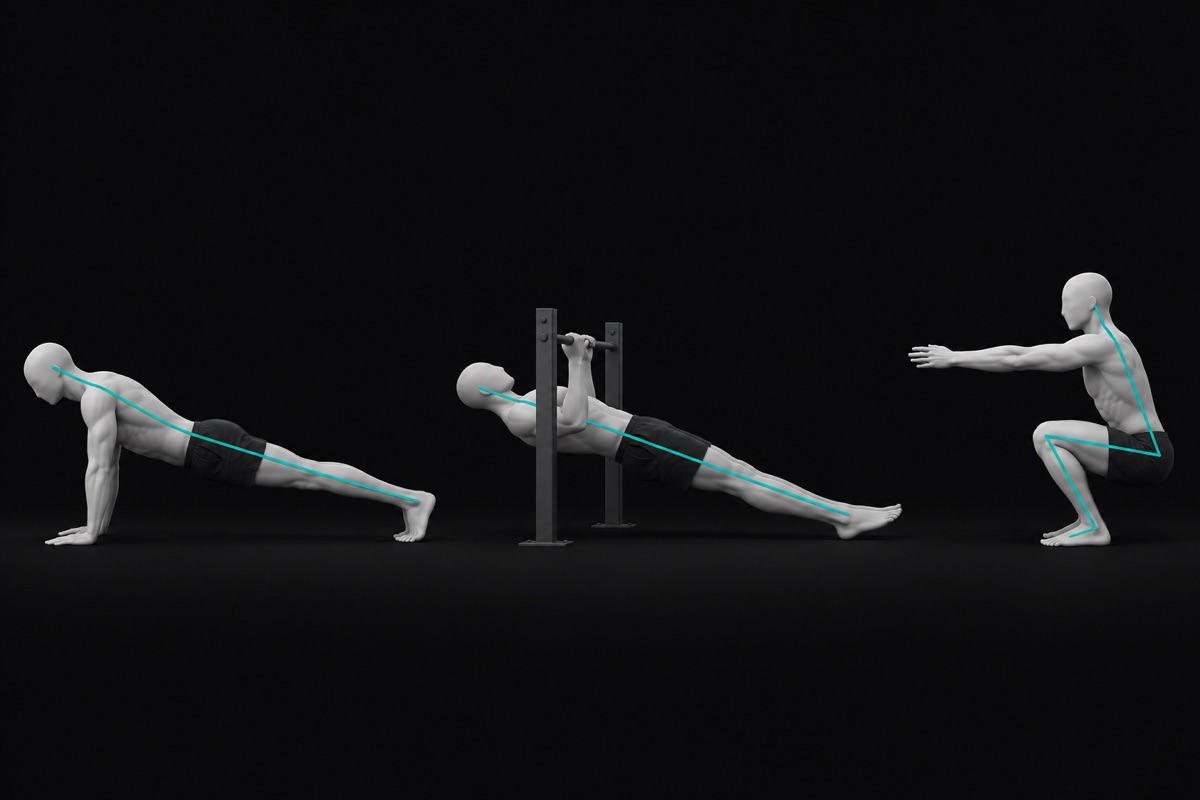
A good beginner calisthenics routine is short: a 5 to 10 minute warm-up, then one push, two pull, one leg and one core exercise, done 3 times a week with a rest day between sessions. Pick a version of each slot you can do cleanly, do 3 sets, and add reps until you top out the range. Then switch to the harder version and start low again. With a bar, you work toward the pull-up. Without one, you row under a sturdy table.
The structure is close to the r/bodyweightfitness Recommended Routine, a long-standing reference for beginners. It runs 3 times a week with at least one rest day between workouts, pairs its strength work (pull-up and squat, dip and hinge, row and push-up), adds a core triplet, and asks for 3 sets of 5 to 8 reps of the hardest version you can do. The plan below is a shorter take on the same idea.
Steven Low, author of Overcoming Gravity, builds beginner plans the same way in his fundamentals of bodyweight strength training. And it works: in a 4-week study, men training harder and harder push-up variations 3 days a week gained bench press strength, as did a bench press group.
What does a beginner calisthenics routine look like?
One session, repeated 3 times a week. Work in pairs: a set of the first exercise, rest 90 seconds, a set of the second, rest 90 seconds, until both have 3 sets.
- Warm-up, 5 to 10 minutes. Arm circles, wrist rocks, 10 slow squats, an easy set of your push and row.
- Pair 1: vertical pull and legs. Your step toward the pull-up, then your squat step.
- Pair 2: row and push. An inverted row, then your push-up step.
- Core pair. A hollow body hold and a plank, 60 seconds of rest between them.
- Optional: dips. 3 sets, only if your shoulders feel fine.
That takes about 40 minutes. Short on time? Run the five main slots as a circuit, 60 seconds between exercises, 3 rounds, in about 25 minutes.
Which push exercise should you start with?
The hardest version you can do for about 8 clean reps on a fresh first set. For most beginners, that is an incline or a knee push-up.
- Easy: incline push-ups. Hands on a wall, then a counter, a table, and a bench braced against a wall. The lower the surface, the harder.
- Also easy: knee push-ups. One straight line from knees to head. Handy as an extra set after your inclines.
- Harder: floor push-ups. Hands under your shoulders, chest to about a fist from the floor, arms straight at the top.
To choose between the two easy versions, see knee push-ups vs incline push-ups.
How do you train pulling before your first pull-up?
With two exercises every session: a row, with part of your weight on your feet, and a vertical step toward the pull-up.
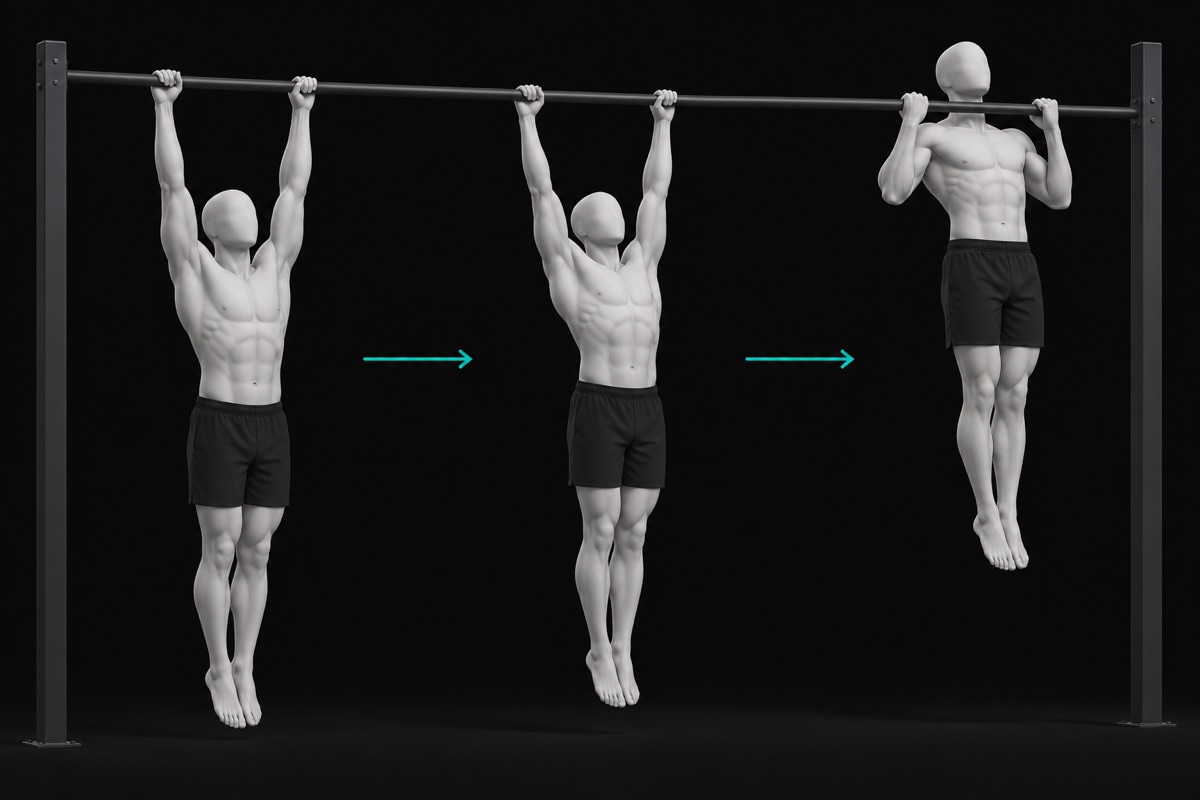
- Dead hang. 3 sets of 20 to 30 seconds, shoulders pulled down, not shrugged to your ears. See active vs passive dead hang.
- Scapular pulls. From a straight-arm hang, pull your shoulders down so your body rises a few centimeters, hold 1 to 2 seconds, lower. 3 sets of 8.
- Negatives. Step up so your chin is over the bar, then lower as slowly as you can. Low's method for eccentrics: 2 to 3 sets of 2 to 3 reps lowered in 3 to 5 seconds, 3 minutes of rest, building toward 7 to 10 seconds.
- Harder: the pull-up. From straight arms to chin over the bar, no kick.
For the row, start the inverted row on a high bar with your knees bent, then lower the bar and straighten your legs. To find your vertical step, use the tests in why can't I do a pull-up.
What about legs, core and dips?
Legs. Bodyweight squats first, to a chair if full depth is not there yet. Then split squats, one foot forward, back knee lowering toward the floor. Then lunges, stepping forward or back each rep.
Core. The hollow body hold, knees bent first, then legs straight, lower back pressed to the floor. And the plank, from your knees, then from your toes.
Dips, optional. Bench dips with your knees bent and feet on the floor, then negatives on parallel bars, then full dips. Drop them if the front of your shoulder hurts.
How many sets, reps and how much rest?
- Push, row and dips: 3 sets of 6 to 12 reps.
- Vertical pull: the doses above, then 3 sets of 3 to 8 once pull-ups arrive.
- Legs: 3 sets of 10 to 20 squats, or 6 to 12 per leg on split squats and lunges. Legs are stronger than arms, so they need more reps.
- Core: 3 holds of 20 to 30 seconds, adding 5 to 10 seconds a week up to 60.
- Rest: 90 seconds between the two exercises of a pair.
The American College of Sports Medicine gives beginners a similar 8 to 12 reps with weights.
What does the week look like?
- Monday: full session.
- Tuesday: rest. A walk is fine.
- Wednesday: full session.
- Thursday: rest.
- Friday: full session.
- Saturday: optional light day: a walk, mobility, easy hangs.
- Sunday: rest.
Any 3 days with a gap between them work.
How do you progress week to week?
Add reps inside the range, then move to the harder version. Clean reps come before more reps.
- Beat one number per session. One more rep on one set is enough, with identical form.
- Top the range, then move up. When all 3 sets reach the top of the range cleanly, switch to the harder version and restart at the bottom.
- Mix when the jump is too big. If the harder version gives only 2 or 3 reps, do those first, then finish the set with the easier one. See when to progress in calisthenics.
- Plan a lighter week. Low suggests reviewing your training every 4 to 8 weeks and taking a rest week, and notes that newer trainees can usually go longer between them. A lighter week can simply be 2 sets instead of 3.
A clean rep has the full range, a steady body line and no swing.
How long until your first pull-up or clean push-ups?
It depends on where you start, so use checkpoints, not dates. The Recommended Routine tells beginners to expect better numbers about 2 to 3 workouts in, body changes they notice after 4 to 6 weeks, and changes others notice after 12 weeks or more, if diet is in check.
The first pull-up depends heavily on strength compared to bodyweight. In a study that trained college-age women for the pull-up, those who succeeded had higher strength relative to their body mass. That can mean weeks for some, many months for others.
- Pull-up: Low writes that most people can do one full rep once they manage 3 sets of 3 negatives lowered in 7 to 10 seconds.
- Push-up: when your lowest incline gives 3 sets of 12 clean reps, test the floor. Even 2 or 3 clean reps mean it is time to switch.
What if you have no bar at all?
Every slot works without a bar except the vertical pull. Replace it with a second row.
- Table rows. Lie under a sturdy table, grip the edge and pull your chest toward it. Pull gently first to check it does not tip or slide.
- Backpack rows. Hinge forward with a flat back and row a loaded backpack to your hip.
- Chair dips. Bench dips on a chair braced against a wall.
- Outdoor bars. Playgrounds often have a bar for hangs. If you buy one thing, make it a pull-up bar.
How sore should you be, and how do you recover?
Expect soreness in the first week or two, peaking a day or two after a session. Negatives cause the most, because unfamiliar lowering work damages muscle more. A review of the repeated bout effect describes how a second bout of similar lowering work causes less damage than the first.
- Do 2 sets per exercise in your first week, then 3.
- Train through mild soreness if it eases in the warm-up.
See a physiotherapist or doctor for sharp pain during a rep, pain inside a joint, swelling, pain lasting more than a week, numbness or tingling. Severe muscle pain with swelling and very dark urine after a hard session needs a doctor the same day.
What are the most common beginner mistakes?
Too many exercises. Ten exercises a session, each done half-heartedly.
- Cue
- One exercise per slot.
- Why
- Low's beginner template is 2 push, 2 pull and 2 leg exercises. Extras steal effort from the base.
- Drill
- Write down your 5 slots. Cut everything else for 8 weeks.
Chasing reps with bad form. The count rises, the reps shrink.
- Cue
- Every rep looks like the first one.
- Why
- Half reps raise the number, not the strength, so the harder version stays out of reach.
- Drill
- Film your last set. Log only the full-range reps.
Skipping pull work. Push-ups every day, rows never.
- Cue
- At least as many pulls as pushes.
- Why
- Low points out that most routines are so push-heavy there is very little pulling, and asks for the two to stay in balance for your shoulders.
- Drill
- Row and vertical pull every session. On a short day, drop the dips, not a pull.
Training to failure every set. Every set ends with a grind and a broken rep.
- Cue
- Stop your first sets with 1 or 2 reps left.
- Why
- A meta-analysis of 15 studies found failure is not needed for gains in strength or muscle size. Low ends the first set with a rep or two to spare.
- Drill
- End each set at the first rep that slows down sharply or changes shape.
No rest days. Six sessions in the first week, then nothing.
- Cue
- A day off between sessions.
- Why
- A meta-analysis of 25 studies found weekly frequency mattered little once total volume was matched. Three full-body sessions are plenty. Extra days add fatigue, not results.
- Drill
- Put your 3 days in your calendar now. Walk on the others.
How do you check that your reps are clean?
Film one set of each main exercise from the side, phone at hip height, 2 to 3 meters (7 to 10 feet) away, whole body in the frame. Watch the last reps first, where form breaks: depth, lockout, hips in line. CaliLens scores push-ups, pull-ups and dips from that kind of clip, so you know your reps are clean before you add more. For framing and light, see how to film yourself for a form check.
Frequently asked
Can I do this calisthenics routine every day?
Not the full strength session. Your muscles need the day off to adapt, and 3 sessions a week is already enough to make steady progress. On the other days, walk, stretch or practice a short dead hang. If you want a fourth day, make it a light skill day, not a fourth hard session.
Is a beginner calisthenics routine enough to build muscle?
Yes, as long as the exercises keep getting harder. A push-up you can do 40 times no longer builds much strength. Moving to a harder version every time you top out the rep range is what keeps the routine working, along with enough food and sleep.
Should I do cardio on top of calisthenics?
You can. Walking, cycling or easy running on your rest days does not get in the way of a 3-day strength routine for most beginners. Keep hard intervals away from the day before a session, so your legs are fresh for squats and lunges.
What if I miss a session?
Do the next one as planned and move on. Do not stack two sessions on back-to-back days to catch up. One missed day changes nothing, a missed month does: if you stop for several weeks, restart one step easier than where you left off.
Do I need rings or parallettes to start?
No. A floor, a sturdy table and a bench cover every slot except the vertical pull. A pull-up bar is the one piece of equipment worth buying early, because hanging, scapular pulls and negatives all need one.