Blog · Muscle-up · 8 min read
Explosive pull-ups for the muscle-up: how high to pull
Twenty pull-ups that stop at your chin still leave you under the bar. The fix is height, built one step at a time. Here is the target, the drills and the test that says you are ready.
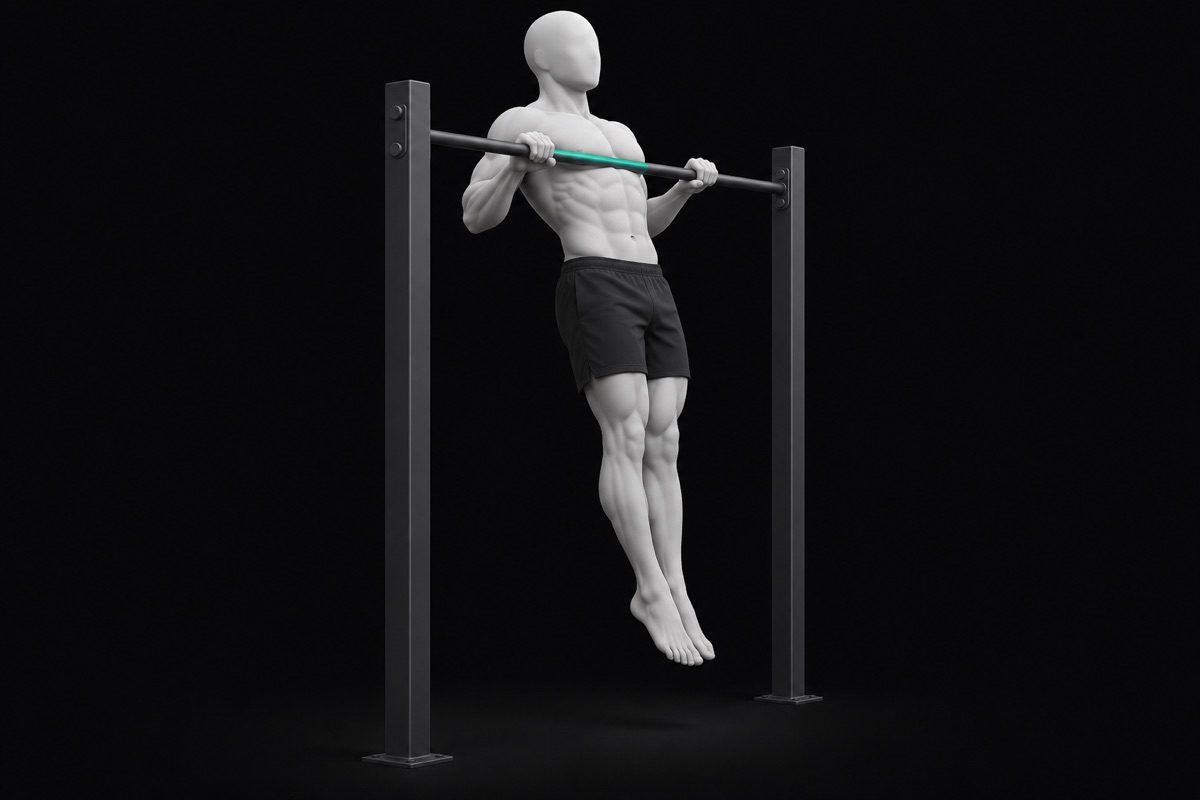
For a strict muscle-up, you need to pull the bar to roughly your lower chest, not just your chin. A regular pull-up ends too low to leave room for the turnover, so you train height on purpose: explosive pull-ups that reach a little lower on your body every few weeks. Rep counts matter less than you think. Three to five pulls to the lower chest, plus three to five deep dips, say more about readiness than any number of chin-height reps.
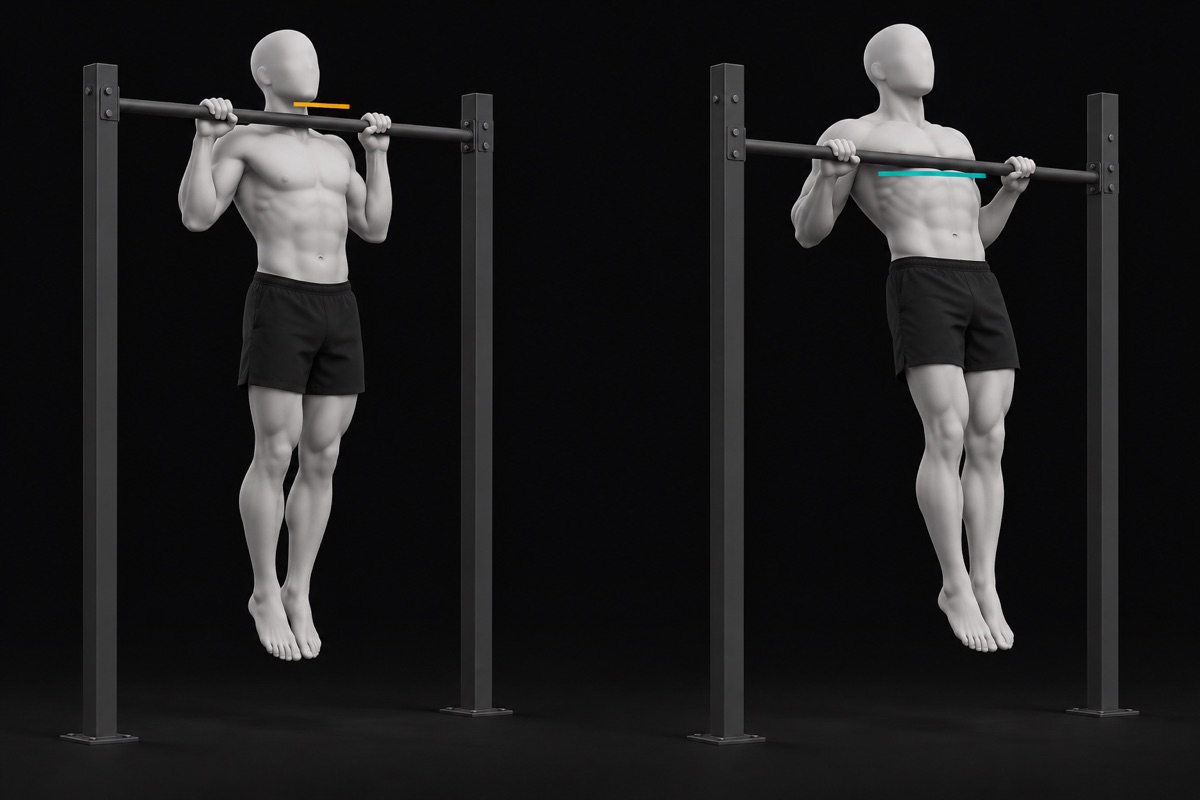
That ladder comes from Steven Low, author of Overcoming Gravity, who gives it often on r/bodyweightfitness. In one reply to a stuck lifter, he lists the steps as chin over the bar, chest to bar, nipples to bar, top of the abs to bar, then belly button to bar, and writes that most people can start to turn over the transition somewhere around the fourth step.
How high do you need to pull for a muscle-up?
Aim for the bar to reach your lower chest, just below the pecs, with the top of your stomach as the stretch goal. Here is the ladder, from easiest to hardest:
- Chin over the bar. A regular pull-up. The starting point, not the target.
- Chest to bar. The bar touches just below your collarbones.
- Lower chest to bar. The bar touches at or just below the nipple line.
- Top of the stomach to bar. Where Low says most people can start turning over.
- Belly button to bar. Extra height that makes the transition feel easy.
Why does the chin not work? In another reply, to someone whose pull always stopped at the collarbones, Low explains that past the chin the movement becomes a row: your elbows drive backward so your hands can travel down your body, past the nipples and under your armpits. A pull that ends at chin height stops before that row can even start.
How many pull-ups do you need before a muscle-up?
There is no fixed number. In a thread on the strength a strict muscle-up takes, one reply put the bar at 10 pull-ups and 10 very deep dips, and added that 20 pull-ups will not teach you the transition. The top replies told the poster, who could pull to the lower chest, that he was already strong enough. Quoted numbers run from about 10 to 15 strict reps. Treat them as rough guidelines, not a test.
Low uses height instead. When someone listed 20 clean pull-ups, a 40 second L-sit and a planche, he answered that none of those were the relevant metrics, and that once you can pull nipples or abs to the bar you usually have enough power. In another answer, he gave a concrete checkpoint:
- Pull: 3 to 5 explosive pull-ups that reach somewhere between the nipples and the top of the abs.
- Push: 3 to 5 deep dips. On a straight bar or on parallel bars, see how deep to dip for what deep means.
- Time: for someone with 8 chin-height pull-ups, he estimated about 2 to 4 months of practice.
Pull-ups in single digits and stuck? Build the base first with why your pull-ups are not improving.
How do you do a high pull-up?
A normal pull-up with more speed and a different path:
- Grip. Overhand, about shoulder width. A false grip is optional: use it only if you plan to use it on the muscle-up. The grips are compared in chin-up vs pull-up.
- Start from an active hang. Arms straight, shoulders pulled down away from your ears, body still. See active vs passive dead hang.
- Set the body. Legs together, glutes squeezed, body straight or slightly hollow, feet a little in front of you.
- Pull hard from the first centimeter. The speed has to start at the bottom, not halfway up.
- Drive the elbows down and behind you, toward your back pockets, as if you were pulling the bar toward your hips instead of your chin.
- Lean back slightly as one piece as you rise, so the bar ends lower on your chest. Do not arch your lower back to get there.
- Lower under control to straight arms, reset the active hang, then pull again.
In a thread on chest-to-bar pull-ups, the top reply recommended this hollow version, elbows toward the hips, for muscle-ups. Low agrees: legs swinging behind you arch the back.
Which drills build a higher pull?
Do these first in the session, after a warm-up. Low puts explosive pulls first, because other pulling work before them leaves you too tired to pull fast.
- Scapular pull-ups. Straight arms, pull your shoulders down so you rise a few centimeters (about an inch). 2 sets of 8 in the warm-up.
- Chest-to-bar pull-ups. The first rung past the chin. 4 to 5 sets of 2 to 3 reps that touch the bar below your collarbones.
- Explosive pull-ups to a target. Pull to the next rung as fast as you can. 4 to 6 sets of 2 to 3 reps. Add a hand release, then a clap, only once you reach the lower chest for 3 reps in a row, and always catch the bar with bent arms.
- Band-assisted high pulls. A light band lets you feel the next height. Use them sparingly: in the same reply, Low says he does not recommend bands here and prefers moving the target down a little at a time.
- Slow negatives from chest height. Jump or step up until the bar is at your lower chest, then lower as slowly as you can. Low's guideline for eccentrics: 2 to 3 sets of 2 to 3 reps lowered in 3 to 5 seconds, 3 minutes of rest, building toward 7 to 10 seconds.
Speed and lowering work both help. In a 5-week study of 30 advanced climbers training pull-ups twice a week, the eccentric and plyometric groups pulled faster and more powerfully afterward (Vigouroux and Devise, 2024).
What are the most common high pull-up mistakes?
Pulling straight up to the chin. The rep is fast, but it ends at the usual height.
- Cue
- Bar to your lower chest, elbows behind you.
- Why
- A chin-height finish leaves your elbows nowhere to go, which is exactly where most stuck muscle-ups stall.
- Drill
- Put a strip of tape on your shirt at the next rung. 4 sets of 2 pulls aiming for the tape.
Kipping to fake height. The knees drive up or the legs swing to throw the body higher.
- Cue
- Still hang, legs squeezed, then pull.
- Why
- In a study of 11 athletes, kipping pull-ups bent the hips about 49 degrees and the knees about 57 degrees more than strict ones, with more trunk and hip muscle work and less biceps work (Dinunzio and colleagues, 2019). The legs supply height your pull does not.
- Drill
- Hold a still active hang for one second before each rep. If the legs still move, cut the set to 2 reps.
Elbows flaring forward. The elbows stay in front of the body and the bar ends up at the throat.
- Cue
- Elbows to your back pockets.
- Why
- Low describes the top of the pull as a rowing motion: the elbows travel backward so the hands can move down the body.
- Drill
- Chest-to-bar pull-ups with a 2 second hold at the top, elbows behind your ribs. 3 sets of 2.
Losing tension at the bottom. You drop into a loose hang between reps and the next pull starts with a jolt.
- Cue
- Lower with control, set the shoulders, then go.
- Why
- A relaxed hang is not dangerous by itself, Low writes in his article on the bottom of the pull-up. A sudden yank at end range, with fatigue, is what he links to shoulder injuries in people new to kipping.
- Drill
- One scapular pull before every rep, then pull from that position.
Too much volume. Long sets of explosive reps, the last ones slow and low.
- Cue
- End the set when a rep is slower or lower than the first.
- Why
- In an 8-week pull-up study of 29 men, stopping sets once speed dropped by 25% gave bigger gains than pushing on to a 50% drop (Sánchez-Moreno and colleagues, 2020). In a thread from a lifter with 18 pull-ups who could not touch his chest, one reply said the same: pull fresh, 2 to 3 reps per set.
- Drill
- Film your sets. Count only reps that hit the target height.
In a survey of 93 street workout athletes, the shoulder was the most injured area and overtraining the most common perceived cause (Ngo and colleagues, 2021). Stop and see a physiotherapist or doctor if you feel a sharp pain or a pop at the front of the shoulder or elbow, painful clicking or catching in the shoulder, numbness or tingling in the hand, or pain that lasts more than 2 weeks after you cut the load.
How should you program explosive pull-ups?
Short sets, long rests, two or three times a week. With clients, Low pauses high-rep and weighted pull-ups in favor of explosive higher pulls, grip and transition practice, and deep dips. A session can look like this:
- Warm-up: arm circles, an easy set of pull-ups, 2 sets of 8 scapular pull-ups.
- Explosive pull-ups to your target: 4 to 6 sets of 2 to 3 reps, 2 to 3 minutes of rest.
- Slow negatives from chest height: 2 to 3 sets of 2 to 3 reps.
- Deep dips: 3 sets of 5 to 8 reps.
Leave a day between sessions. When the first 2 reps of every set hit your target, move it one rung lower. Expect weeks per rung.
When are you ready to try the transition?
When you can do 3 to 5 explosive pull-ups to your lower chest or the top of your stomach, from a still hang with no kick, and 3 to 5 deep dips. Then add transition practice: how to get over the bar on a muscle-up covers the grip, the path and the drills. Keep your high pulls in the same sessions. If one arm keeps getting over first, read why a muscle-up goes over one arm first.
Check your height on video, not by feel. Film from the side with your phone at bar height, 2 to 3 meters (7 to 10 feet) away, and pause at the top of each rep to see where the bar meets your body. CaliLens scores pull-ups and muscle-ups from that kind of clip, though it checks form, not pull height or speed. For light and framing, see how to film yourself for a form check.
Frequently asked
Do weighted pull-ups help you get a muscle-up?
Some, but less than most people expect. Extra weight builds strength through the usual chin-height range, not the extra height a muscle-up needs. Keep a set or two if you enjoy them, and put the explosive high pulls first in the session.
Can I train explosive pull-ups every day?
It is not a good idea. Fast pulls need fresh muscles to be worth doing, and daily sessions mostly add fatigue to your elbows and shoulders. Two or three sessions a week, with a day off between them, is plenty.
Should I use a false grip for high pull-ups?
Only if you plan to use it on the muscle-up. Train your pulls with the grip you will attempt the skill with, so the height you build carries over. A regular overhand grip is fine for a bar muscle-up if the pull is high and fast.
Why can I touch my chest on the first rep but not after?
Height is the first thing fatigue takes away. Your first rep or two are your most powerful, so they are the ones that reach. Keep sets short, rest longer, and count only the reps that hit your target height.
Are chest-to-bar pull-ups the same as high pull-ups?
Not quite. Chest to bar is the first step past the chin, with the bar touching just below the collarbones. A high pull-up keeps going, toward the lower chest and the top of the stomach, and needs speed as well as strength.