Blog · Pull-up · 8 min read
Negative pull-ups: how slow, how many, when to try a rep
You cannot lift yourself yet, but you can already lower yourself. That half of the movement is trainable today, as long as you stop treating every rep as a contest for the slowest descent.
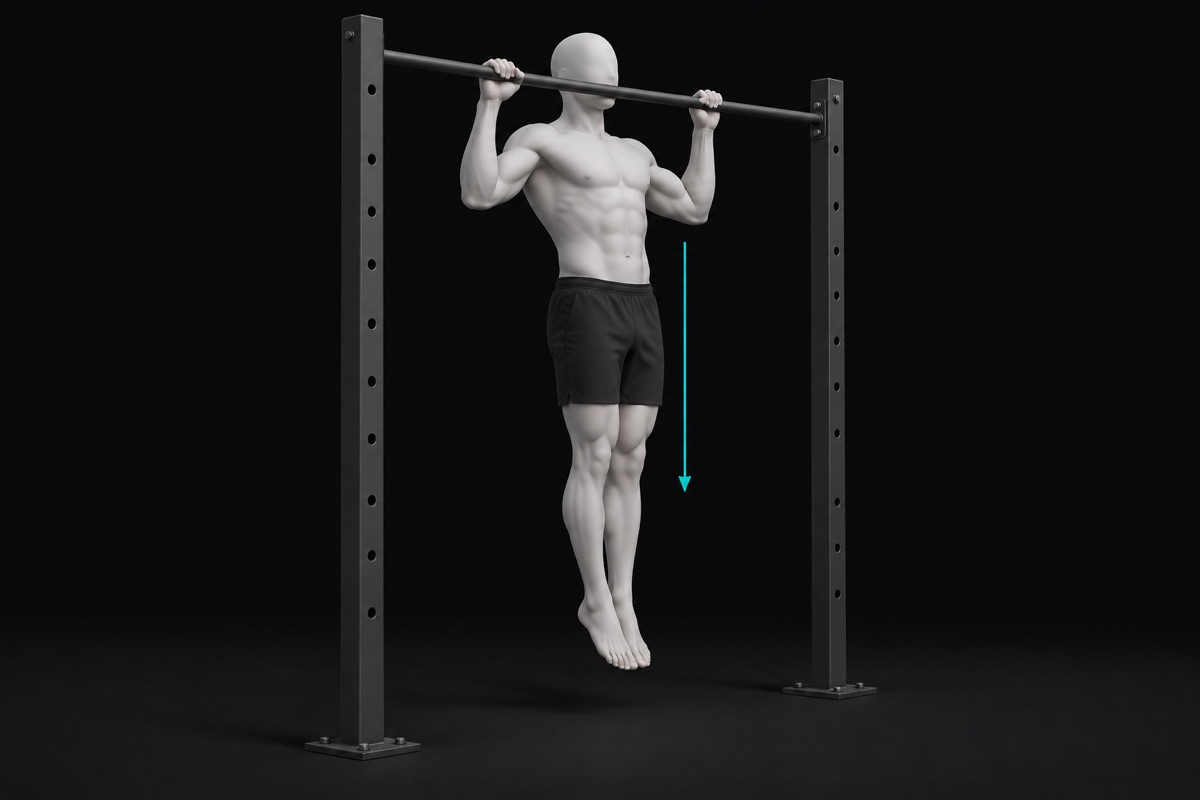
A negative pull-up, also called an eccentric pull-up, is the lowering half of a pull-up: you start with your chin over the bar and control your way down to straight arms. Yes, negatives build toward a first pull-up, because you can lower more than you can lift, so you train the whole range under your full weight before you can pull it. Start with 2 sets of 2 reps at 3 to 5 seconds each, build to 3 sets of 3 at 7 to 10 seconds, then test a full rep. Pair them with rows and active hangs, because negatives alone are a slower road.
Not sure where your pull-up breaks down? Run the four tests in why you can't do a pull-up first.
Do negative pull-ups actually help you do a pull-up?
Yes, with one limit: we found no trial on people who cannot yet do a pull-up. The case rests on three things.
- You are stronger going down. In a study of 20 regular lifters, the men could lower about 32% more than they could pull on a lat pulldown.
- It works in trained people. In a 5-week study of 30 advanced climbers, the group doing weighted 5 second negatives twice a week raised its one-rep pull-up strength by 5.0%, against a 1.5% drop in the group with no specific training. They were strong climbers, so this is support, not proof for beginners.
- Coaches report it. Steven Low, author of Overcoming Gravity, calls eccentrics the most reliable method he has found for reaching a first rep.
Expect weeks to months. In a r/bodyweightfitness thread on learning through negatives, answers ran from 2 to 3 weeks to 6 months for a formerly overweight 40-year-old. One person got nowhere for over a month, added dead hangs and inverted rows, and had a pull-up about a month later.
How do you get to the top: box or jump?
Use a box or a sturdy step until you can lower for 5 seconds.
- Box. Standing on it with your arms bent, your chin should clear the bar. At the bottom of the rep, your feet should reach it without a drop.
- Jump. Use it when the bar is low enough to reach chin height in one controlled hop. Your arms have to catch you, so it costs more effort. If you land below the bar, go back to the box.
Never stand on anything that can roll, tip or slide.
How do you do a negative pull-up, step by step?
- Grip. Overhand, about shoulder width.
- Set the top. Chin clearly over the bar, elbows fully bent, shoulders pulled down.
- Lift your feet. Legs together, no swing.
- Lower at an even speed. Count out loud. With a 6 second count, your elbows should reach about 90 degrees near the count of 3.
- Finish at straight arms, shoulders still pulled down, not hanging by your ears.
- Step back up for the next rep, or rest.
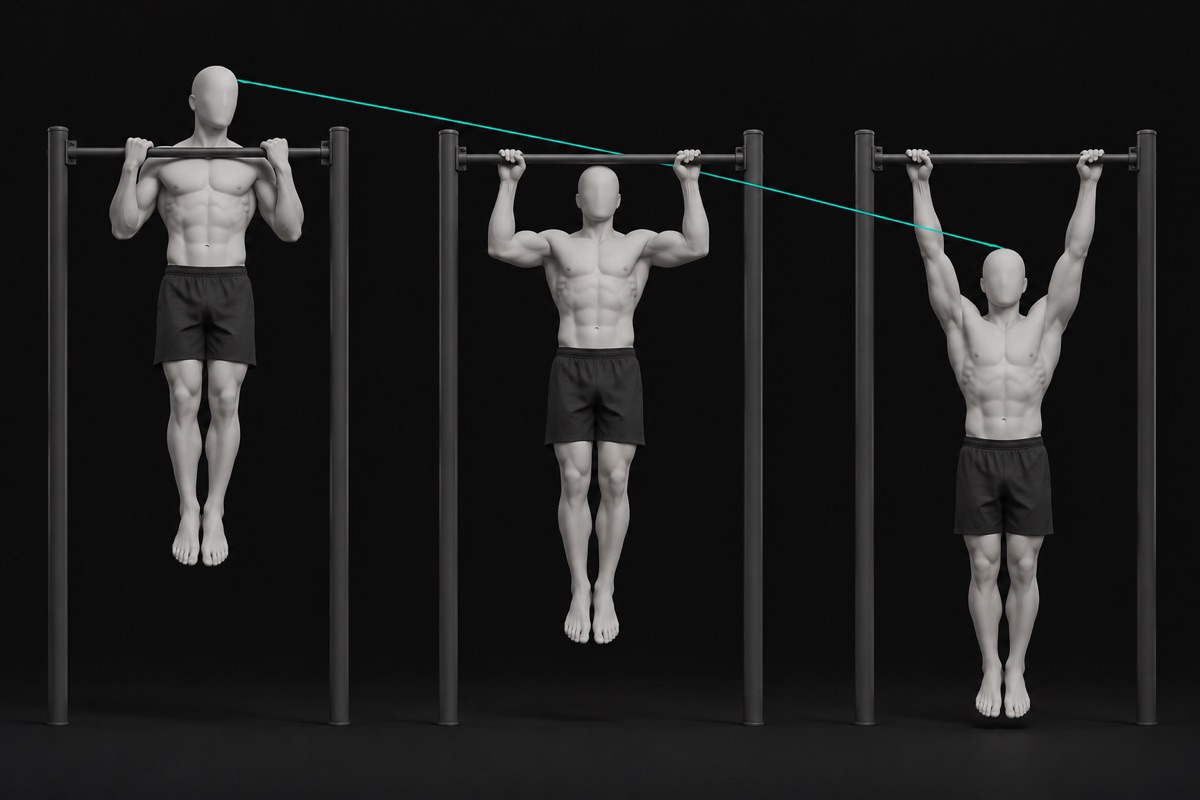
How long should a negative pull-up take?
Start at 3 to 5 seconds per rep and build to 7 to 10. That is the range in Low's guidelines. Once you own 10 seconds, stop adding time and work toward a real rep.
- Very slow reps look worse in the research. A meta-analysis of 8 training studies found similar muscle growth from 0.5 to 8 seconds per rep, while very slow reps past 10 seconds looked inferior. It covered full reps and muscle size, not negatives, and the very slow evidence is thin, so treat it as a hint.
- One long rep can end your session. In a thread from a lifter with no pull-up yet, a 10 second negative left him needing minutes of rest. One detailed reply told him to stop treating each set as a max effort and work at 70 to 80% of his slowest time.
To set your own number, time your slowest clean negative once, then train below it. Low's older chart: a best of 8 seconds means sets at about 5, and a best of 18 means sets at about 10.
How many sets and reps of negatives per week?
Two or three sessions a week, with a day off between them, and few reps. Low's guideline uses clusters: a set is 2 or 3 negatives back to back, stepping up again right after each one, then 3 minutes of rest.
- First 2 weeks: 2 sets of 2 at 3 to 5 seconds, 2 sessions a week. This low start is our suggestion.
- Next: build to 3 sets of 3 at 3 to 5 seconds, then 3 sessions a week if your arms recover.
- Then slow down: add a second per rep when every set is clean, up to 7 to 10 seconds.
- Still no pull-up? Low adds sets first, up to 3 to 5, then reps, up to 3 to 5 per cluster.
The r/bodyweightfitness Recommended Routine uses 3 sets of 5 to 8 and moves on at 3 x 8. That is more volume, so if your arms stay sore, use the numbers above.
What are the most common negative pull-up mistakes?
Dropping through the bottom third. You start slow, then fall the last part to straight arms.
- Cue
- Same speed all the way to straight arms.
- Why
- A fast finish leaves the start of your pull untrained, and your first rep begins there.
- Drill
- Film a rep and find where you speed up. Add a 2 second hold just above that height, 3 sets of 2.
Shrugged shoulders. Your shoulders ride up to your ears as your arms straighten.
- Cue
- Long neck, shoulders down, even at the bottom.
- Why
- A pull-up starts with your shoulder blades moving down. Lose that on the way down and you arrive where your first rep cannot start.
- Drill
- Finish every negative with one scapular pull before you step off. The difference is explained in active vs passive dead hang.
Kicking. Your knees drive or your legs swing to slow the fall.
- Cue
- Legs together, glutes tight, feet quiet.
- Why
- Moving legs change how much load your arms take, so your time stops telling the truth.
- Drill
- Cross your ankles and squeeze your glutes. If your legs still move, cut the set to 2 reps and shorten the count by 2 seconds.
Too many reps, until your elbows hurt. Negatives feel easier than pulling, so reps pile up.
- Cue
- End the set when a rep comes up a second short.
- Why
- Low cuts volume on eccentrics because they cause a lot of muscle damage. He also links tendon overuse to volume that outpaces recovery, and names excessive pulling as a cause of inner elbow and biceps tendon pain.
- Drill
- Add one rep or one second a week, not both. Repeat a week if your elbows complain.
Is elbow soreness from negatives normal?
Muscle soreness is, especially at the start. Joint or tendon pain is a signal to back off.
- Usually muscle soreness. A dull ache in the biceps or forearm a day or so after a session. Low writes that muscles mostly recover in 48 to 72 hours, though soreness can last up to 7 to 10 days. It should ease as you adapt: in a study of 34 male students, a first bout of just 6 hard arm eccentrics protected about as well as 24 did against a bigger bout 2 weeks later.
- More like tendon pain. A sharp or pinpoint pain at the inner elbow or the front crease, during reps or when you grip, that returns session after session. This is not a diagnosis. Cut the reps and read elbow pain in calisthenics.
See a physiotherapist or doctor if pain lasts more than 2 weeks after you cut the load, if you feel a sudden pop or sharp pain at the front of the elbow, if bruising or swelling appears, or if you feel numbness or tingling in your hand.
Get medical care the same day if you notice dark brown or tea-colored urine, or severe muscle pain, swelling or weakness well beyond normal soreness. These are described signs of rhabdomyolysis, a serious breakdown of muscle. Many people do not have all of them. It is rare at these doses: Low says 3 to 5 sets of negatives generally will not cause it, though large volumes of new eccentric work can.
How do you combine negatives with rows and active hangs?
Negatives train the descent, inverted rows train the pull with part of your weight off, and active hangs train the start. A session can look like this, with negatives early because they need fresh arms.
- Warm-up: arm circles, then 2 active hangs of 10 to 15 seconds.
- Negatives: your current sets and reps, 3 minutes of rest.
- Inverted rows: 3 sets of 5 to 8, lowering the bar as you get stronger.
- Scapular pulls: 2 sets of 8, if your grip still holds.
Stuck at a few pull-ups rather than zero? Do your clean reps first, then 2 or 3 sets of 2 negatives to finish. Why your pull-ups are not improving has the full plan.
When should you try a full pull-up?
When you pass all three on the same week:
- Negatives: 3 sets of 3 at 7 to 10 seconds, even speed, no drop at the bottom. Low writes that most people can get a full rep at about this point.
- Rows: 3 sets of 8 with your body close to horizontal.
- Active hang: 15 seconds with your shoulders down and your legs still.
Then test it right after your warm-up, in a fresh session. Allow 2 attempts, 2 minutes apart, and one test a week. The rep counts only from straight arms to chin over the bar, with no kick.
Missed it? Where you stopped tells you what to add. Stuck at the start means more scapular pulls. Stuck with your elbows near 90 degrees means holds at that height. Stuck just below the bar means flexed-arm holds. Keep your negatives going and retest next week.
How do you check your negatives on video?
Film from the side or at a three-quarter angle, phone at chest height, 2 to 3 meters (7 to 10 feet) away, with your feet in frame. Time each rep from the first frame your elbows open to the frame they straighten, and look for where you speed up. CaliLens scores full pull-ups, not negatives, so judge these clips yourself and film your first real rep the same way when you try it. For light and framing, see how to film yourself for a form check.
Frequently asked
How long does it take to get a pull-up with negatives?
There is no reliable timeline. Lighter people with some training can get there in weeks, while heavier or newer trainees often need several months. Track your lowering time and your clean sets instead of the calendar, and test a real rep only when you pass the checklist.
Can I do negative pull-ups every day?
It is not a good idea. Lowering work leaves more soreness than most beginners expect, and daily sessions leave your arms too tired to control the descent. Keep at least one rest day between sessions, and use easy hangs on the days in between if you want more bar time.
Are negatives better than band pull-ups?
Neither wins for everyone, and people reach a first pull-up with either one. Negatives load your full weight but skip the pull. Bands train the pull but help most at the bottom. If you have both, use negatives as your main work and bands as extra practice.
Should I do negatives if my arms are still sore?
Mild stiffness that eases once you warm up is usually fine, with fewer reps than planned. If your arms are too sore to straighten comfortably or the descent feels shaky, take another rest day. Your next session will be better for it.
Can I do chin-up negatives instead?
Yes. Many people find the palms-up grip a little easier, so it is a fair place to start. Keep the same sets and timing. If your goal is the pull-up, move to the overhand grip once chin-up negatives reach 7 seconds, and test which grip your elbows prefer.