Blog · Push-up · 8 min read
One-arm push-up progression: steps, setup and fixes
A one-arm push-up is a press and an anti-rotation hold at the same time. Lower the angle step by step, and keep your hips square at every height.
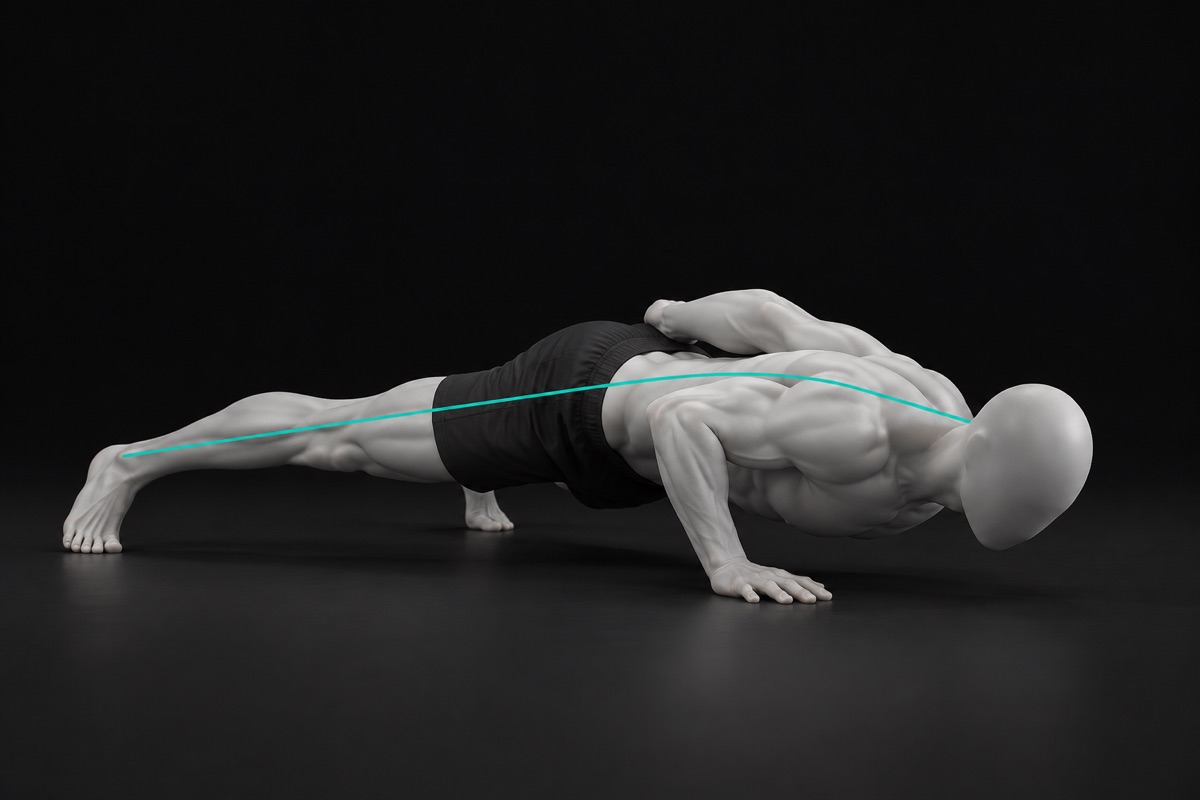
To get a one-arm push-up, first own 20 clean regular push-ups and a solid plank. Then do one-arm push-ups on an incline and lower the surface step by step, from a wall to a bench to the floor, while archer and assisted push-ups build strength on the floor. Set up with your feet wide, your hand under your chest and your hips square, and count only the reps where your hips do not twist.
The hardest part is not the press, it is the twist. With one hand on the floor, your body wants to rotate open, and the trunk has to stop it. In a lab study by Freeman, McGill and colleagues (2006) that compared 12 push-up styles, the one-arm push-up produced the highest compression on the lower spine, and staggered-hand push-ups switched which side of the oblique muscles worked hardest. Treat it as a full-body exercise, not just an arm one.
What base do you need before a one-arm push-up?
You need clean two-handed strength and a trunk that stays rigid. Check both before you start the one-arm work.
- 20 clean push-ups in a row: chest close to the floor, elbows locked at the top, no hip sag. If you are not sure your reps qualify, run them through the checks in are my push-ups clean.
- A 60-second plank with your glutes squeezed and your ribs down. The hollow body hold trains the same locked trunk.
- Diamond or close-grip push-ups, 3 sets of 8 to 10, elbows tucked. They load the triceps the way the one-arm version will.
If you are still building your first push-ups, the choice between knee push-ups and incline push-ups matters more right now than any one-arm work.
How do you set up a one-arm push-up?
The setup does half the work. Get it right at a wall before you go anywhere near the floor.
- Feet wide. Start with your feet about 1 meter (3 feet) apart. A wider base makes the twist easier to resist.
- Hand under your chest. Place the working hand below the middle of your chest, slightly toward the center line of your body, fingers pointing forward or turned out a little.
- Free hand behind your back. Rest it on your lower back. It keeps the arm out of the way and reminds you not to reach for the floor.
- Hips square. Both hips point at the floor, level with each other, on the straight line from your shoulders to your ankles.
- Elbow tucked. As you lower, your elbow travels back toward your hip, not out to the side.
- Full range. Lower until your chest is about a fist from the surface, then press back to a straight arm.
Your torso will tilt slightly toward the working arm. That small lean is normal. A hip that turns up toward the ceiling is not.
What is the best one-arm push-up progression?
The most direct path is to change the angle. In a progression thread on r/bodyweightfitness, the top reply laid it out: start against a wall with your legs straddled at shoulder width or wider, then move to a table, a park bench and lower surfaces as each one gets easy. The same reply suggested a staircase, starting high and moving down one step at a time. Run the floor steps below next to it.
- Incline one-arm push-ups. Wall first, then a kitchen counter, a table, a bench of about 45 cm (18 inches) and finally a low step. Move down when you reach 3 sets of 8 clean reps per side.
- Staggered push-ups. Two hands on the floor, one under your chest and one 20 to 30 cm (8 to 12 inches) further forward. The forward hand helps less, and your trunk learns to resist the twist.
- Uneven push-ups. One hand on the floor, the other on a ball or a block 10 to 20 cm (4 to 8 inches) high. Push mostly through the low hand.
- Archer push-ups. Hands very wide. You lower toward one hand while the other arm stays straight and helps as little as possible.
- Assisted one-arm push-ups. The helping hand rests on a ball rolled out to the side, or only on its fingertips. You can also loop a band under your chest from a bar above you. Reduce the help over time.
- Negatives. On the floor, lower on one arm in 3 to 5 seconds, then use both hands or your knees to get back up.
- Full one-arm push-up on the floor, feet wide.
How do you do archer push-ups?
Set your hands about twice shoulder width apart, fingers of the helping hand turned out. Shift your chest toward the working hand and lower until it is close to that hand. The helping arm stays straight and slides or rests on the floor. Press back up through the bent arm.
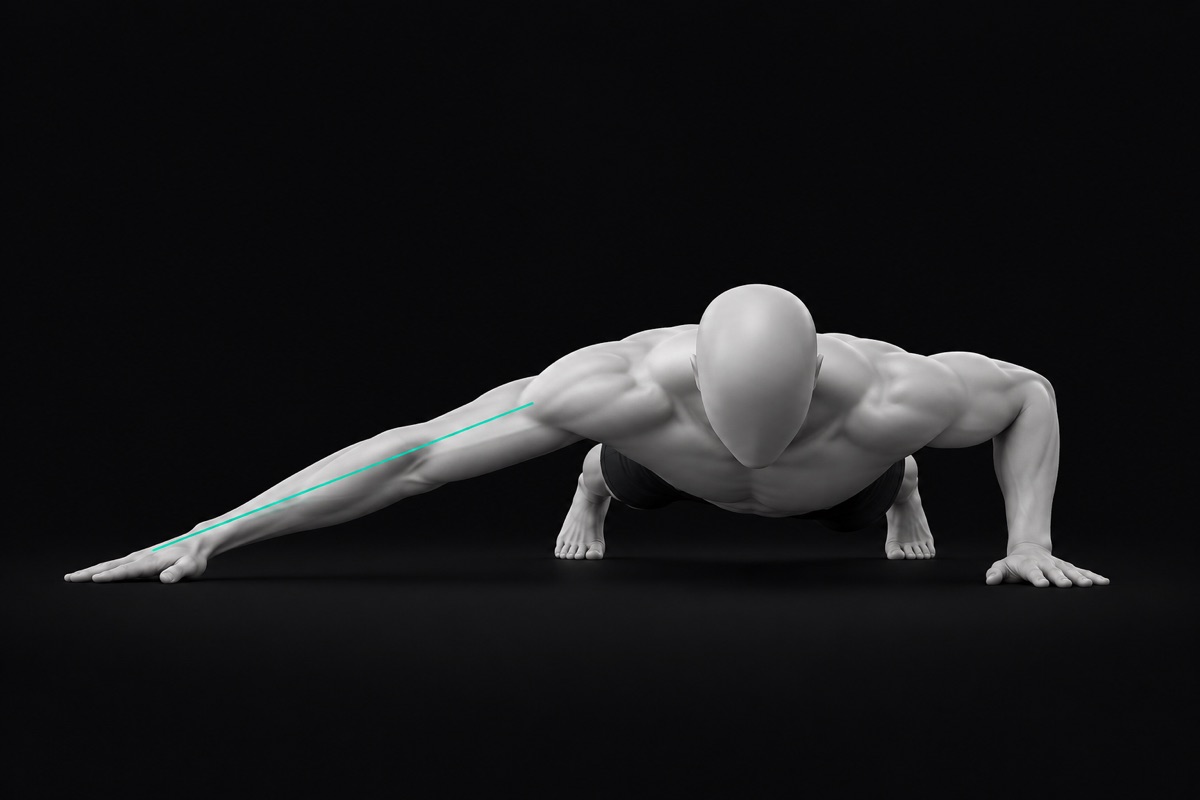
To make them harder, put the helping hand on a higher surface, as the same thread suggested, so the working arm takes more of your weight. Archer reps carry over well: in a thread comparing one-arm and pseudo planche push-ups, one athlete reported that 10 archers per side gave them 3 one-arm push-ups with the legs straddled. Treat it as one experience, not a rule. If your goal is wider pressing strength, pseudo planche push-ups are the alternative that thread kept coming back to.
What are the most common one-arm push-up form mistakes?
Five faults show up again and again. Most of them are ways to make the lever shorter or the range smaller.
Hips rotating open. The hip on the free-hand side lifts and the body turns sideways. It makes the press easier and loads the lower back with a twist.
- Cue
- Both hips point at the floor, all the way down and all the way up.
- Why
- Turning open shortens the lever and hands part of the work to a twisting spine instead of your arm and trunk.
- Drill
- Balance a light object, such as a shoe, on the small of your back for 3 sets of 5 incline reps per side. If it falls, the hips turned.
Shoulder shrugging. The working shoulder rides up toward the ear, often on high inclines where the arm pushes back and up.
- Cue
- Keep your shoulder away from your ear and push the surface away.
- Why
- A shrugged shoulder takes the load on the joint instead of the muscles around it.
- Drill
- One-arm plank on an incline, 3 x 15 seconds per side, shoulder held down and away from the ear.
Flaring elbow. The elbow drifts out to the side as you lower, and the shoulder takes over.
- Cue
- Elbow back toward your hip.
- Why
- A tucked elbow keeps the triceps and chest in the press and puts less strain on the front of the shoulder.
- Drill
- 3 x 8 close-grip push-ups, elbows brushing your ribs, then the same path on your one-arm incline.
Feet too narrow. Feet close together turn the rep into a balance fight and push the hips to rotate.
- Cue
- Feet wide, then wider.
- Why
- A wide base resists the twist, so the press becomes the limit instead of the balance.
- Drill
- Train each step with feet about 1 meter (3 feet) apart. Narrow them by about 10 cm (4 inches) only once you hold 3 x 8 clean reps.
Half reps. The chest stops halfway down, and the count goes up while the strength does not.
- Cue
- Chest to a fist from the surface, every rep.
- Why
- The bottom is the hardest part of a push-up. Skip it, and the floor version stays out of reach.
- Drill
- Put a rolled towel or a fist-sized target under your chest. Each rep touches it lightly. If you cannot reach it, go back up one incline.
If your elbow, shoulder or lower back hurts, stop the set. Go back to a variation that does not hurt, and see a physiotherapist if the pain persists.
How do you train both sides evenly?
Start every session with your weaker side, and match its reps on the strong side. If your left arm does 6 on the bench, your right arm does 6 too, even if it could do 10. Let the weaker side decide when you move down a step. Rest about 1 minute between sides, so each set starts fresh.
A small difference between sides is normal. A side that lags for weeks needs one extra set, not a different step.
How many sets and reps, and when do you move to the next step?
Train the hardest step you can do for 3 sets of 5 to 8 reps per side, 2 to 3 times a week, with at least a day of rest between sessions. When every set reaches 8 clean reps on both sides, move to the next step and restart at 5. That is the same gate as in when to progress in calisthenics.
For negatives, Steven Low's method for eccentrics starts at 2 to 3 sets of 2 to 3 reps lowered in 3 to 5 seconds, with about 3 minutes of rest, and builds toward 7 to 10 second lowerings. He notes that 3 sets of 3 slow lowerings of 7 to 10 seconds usually come before the first full rep.
More is not better. In a thread from April 2026, a lifter who practiced one-arm push-ups 10 times a day, every day, felt they were getting worse, with triceps and shoulders that needed rest. Replies told them to rest and cut back to 2 or 3 sessions a week.
How do you check your one-arm push-up form on video?
Film two angles, because no single view shows everything. From the side, with the phone at floor level 2 to 3 meters (7 to 10 feet) away, check depth, lockout and the shoulder-to-ankle line. From the front, at the same distance, check whether your hips stay level and your elbow stays tucked. Watch the last reps of the set first, that is where the hips turn.
Your regular push-ups are the base, so check them too. CaliLens scores regular push-ups for depth, lockout and body line, which tells you whether that base is ready. For light and framing, see how to film yourself for a form check.
Frequently asked
How long does it take to get a one-arm push-up?
It depends on where you start, so track the trend instead of the calendar. If your incline height drops one step every few weeks and your archer reps keep climbing, you are on the right path. If nothing has moved in a month, check your recovery and your form before adding volume.
Should my feet be together or apart in a one-arm push-up?
Apart while you learn. A wide stance gives you a stable base and lets you focus on the press. Once you own clean reps with a wide stance, bringing the feet closer is a way to make the same exercise harder.
Is the one-arm push-up better than pseudo planche push-ups?
They train different goals. The one-arm push-up is specific: if that is the skill you want, its own progressions get you there most directly. Pseudo planche push-ups build pressing strength that also carries over to planche work. Many people keep one as the main lift and the other as accessory work.
Why is my weaker side so far behind?
One-sided exercises expose gaps that two-handed push-ups hide. Start each session with the weaker side, give both sides the same number of reps, and let the weaker side set the step you train. The gap usually shrinks once it stops being trained second.
Do I need equipment for one-arm push-up progressions?
No. A wall, a kitchen counter, a sturdy table, a bench and a staircase give you every incline you need. A ball, a yoga block or a resistance band adds options for the assisted step, but a book under the helping hand works too.