Blog · Push-up · 8 min read
Wide vs diamond push-ups: what hand width changes
Moving your hands a few centimeters changes which muscle works hardest and which joint takes the load. Here is what each width is good for, and which one to build your training on.
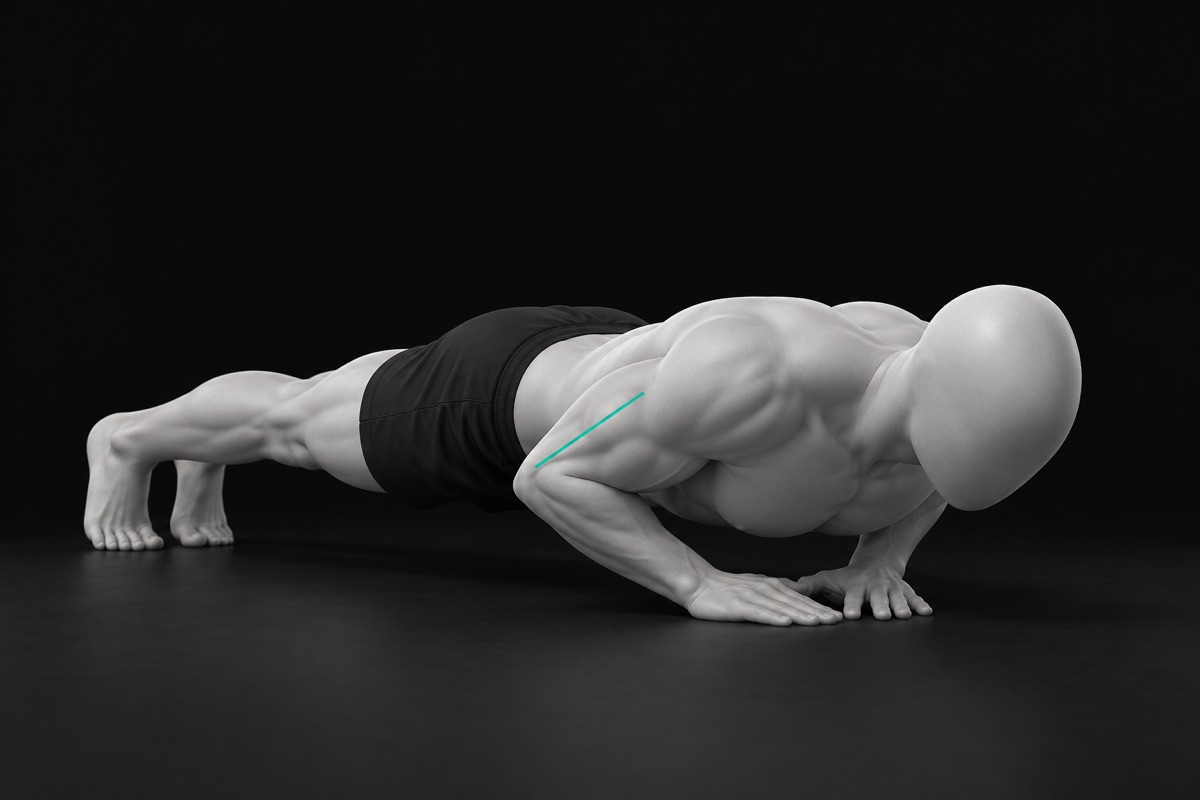
Hand width shifts the work between your chest, triceps and shoulders, and changes how much stress your elbows and wrists take. Standard width, hands just outside your shoulders, is the default and should be your main push-up. Close-grip and diamond push-ups put more load on the triceps and the elbows, and in the studies they work the chest at least as hard as standard. Wide push-ups are not a better chest exercise: the chest worked less with wide hands, not more. Train standard as your main lift and add diamonds as an accessory.
The myth is common. In an r/bodyweightfitness thread, a beginner doing wide push-ups to build his chest got sore shoulders at first and still did not feel his chest working. Replies said that where you feel an exercise is not where it works best, and that a normal grip beats a wide T shape for the chest.
What does the research say about push-up hand position?
Three EMG studies point the same way: closer hands mean more triceps and chest activity, and wider hands mean less.
- Narrow beats wide for both muscles. In a study of 40 adults by Cogley and colleagues (2005), the chest and triceps were both more active with a narrow base than with a wide base.
- Half shoulder width is the strongest triceps position. In a study of 12 men by Kim and colleagues (2016), hands at half shoulder width raised triceps activity by about 17% compared with shoulder width, while hands at one and a half times shoulder width lowered it by about 14%. Chest activity was similar at narrow and standard width, and lower at wide. The serratus anterior, the muscle that holds your shoulder blades against your ribs, was the one muscle that worked hardest with wide hands.
- Same result with 12 muscles measured. In a study of 8 volunteers by Marcolin and colleagues (2015) comparing standard, wide, narrow and other push-up variants, the triceps and chest were most active in the narrow version.
Keep two limits in mind. These are small groups and single sessions, and EMG measures muscle activity, not long-term growth. Also, "narrow" means different things across studies: half shoulder width in one, a full diamond in many gyms. The diamond is the narrowest end of that range.
What do the joints feel at each width?
The elbow does more work as the hands come together. In a force-plate study of 9 men by Donkers and colleagues (1993), the peak elbow torque reached about 56% of the triceps' maximal strength at normal width, 71% with the hands together and 29% with the hands apart. Expect fewer diamond reps than standard ones.
The wrist changes too. In a palm pressure study of 10 volunteers, hands 30 cm (12 inches) wider than the shoulders raised peak pressure in the middle of the heel of the hand. Hands 10 cm (4 inches) narrower than the shoulders raised it on the little-finger side of the heel, at the bottom of the rep.
Wide vs standard vs diamond push-ups: side by side
| Wide | Standard | Diamond | |
|---|---|---|---|
| Where the hands go | About 1.5 times shoulder width, 15 to 20 cm (6 to 8 inches) outside each shoulder | Just outside shoulder width, wrists under the shoulders at the top | Together under the lower chest, thumbs and index fingers touching |
| Elbow angle from the body | Wider, roughly 60 degrees, never a 90 degree T | About 45 degrees, an arrow shape from above | Close to the ribs, pointing back |
| Main muscles | Chest, front shoulders, serratus anterior; less triceps | Chest, triceps and front shoulders in balance | Triceps first, chest close behind |
| Joint stress | Front of the shoulder at the bottom; more pressure in the middle of the palm | Moderate everywhere | Highest elbow load; wrists bent back and turned in |
| Who it suits | Variety, people whose shoulders like it | Everyone, as the main lift | People with 15 or more clean standard reps who want harder pressing |
How do you set up each push-up width?
Every width keeps the same body: one straight line from head to heels, chest close to the floor at the bottom, arms locked at the top. The six checks in how to know if your push-ups are clean apply to all three.
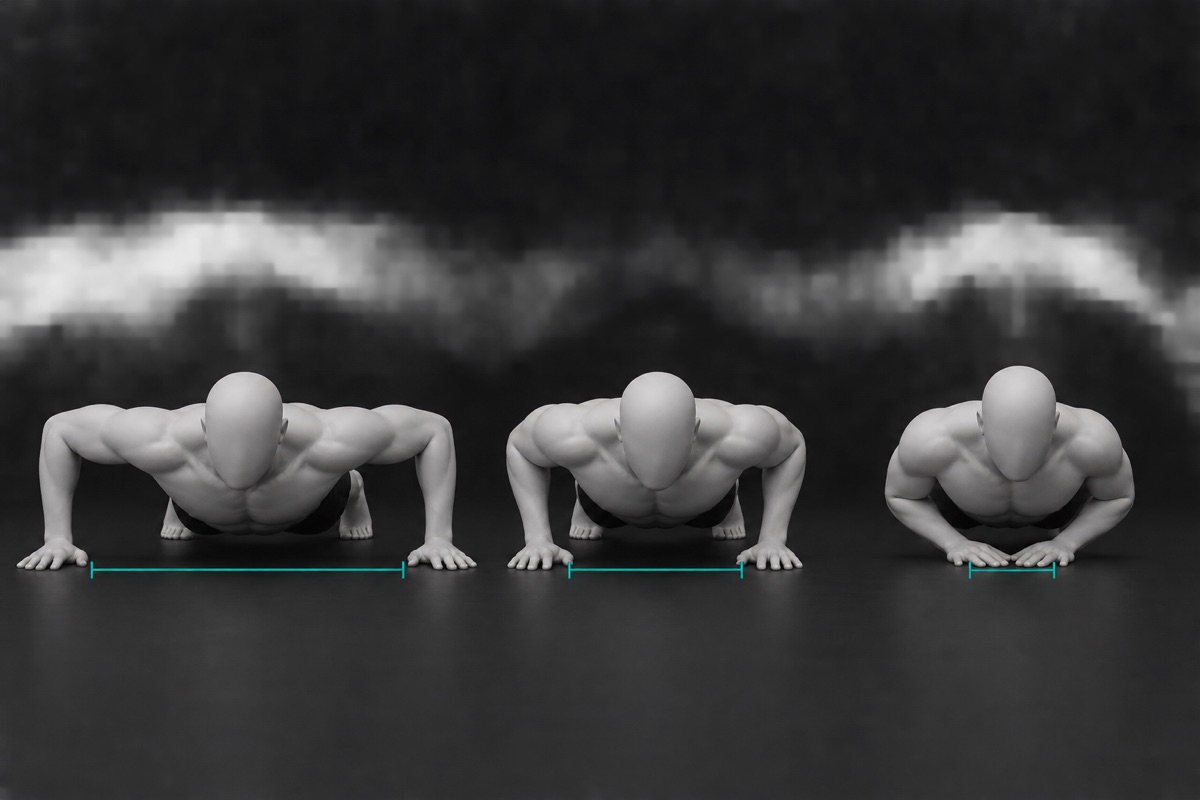
- Standard. Hands just outside your shoulders, index fingers pointing forward. At the top, your wrists sit under your shoulders. Lower with your elbows about 45 degrees from your body.
- Wide. Hands 15 to 20 cm (6 to 8 inches) further out on each side. At the bottom, your forearms should be close to vertical, with the wrists under the elbows. If they slant inward, your hands are too wide.
- Diamond. Touch your thumbs and index fingers to form a diamond, and place it under your lower chest, not under your face. Lower until your chest touches the backs of your hands, elbows sliding back along your ribs.
- Close-grip. The middle ground: hands under your shoulders or a little inside, fingers forward, elbows tucked. It trains the triceps like a diamond with less wrist bend.
What are the most common wide push-up mistakes?
Elbows flared to 90 degrees. From above, your arms and body make a T at the bottom.
- Cue
- Elbows slightly back, toward your hips.
- Why
- Flared, the upper arm sits straight out to the side under your full weight, a position many irritated shoulders dislike.
- Drill
- 3 x 8 slow wide push-ups, 3 seconds down, filmed from the front. If the T comes back, narrow your hands by a hand's width.
Shoulders shrugging. Your shoulders creep toward your ears as you lower, and your neck shortens.
- Cue
- Long neck, shoulders away from your ears.
- Why
- Shrugging lets the upper trapezius take over and crowds the front of the shoulder at the bottom.
- Drill
- Hold the top of a wide push-up for 3 x 20 seconds, pressing the floor away with your shoulders pulled down from your ears. Then do 5 slow reps keeping that same gap between shoulders and ears.
Short range. You stop halfway down because the bottom stretches the front of your shoulders.
- Cue
- Chest to a fist from the floor.
- Why
- A half rep at a wide width trains neither the chest stretch nor the strength you came for.
- Drill
- Put a rolled towel under your chest and touch it on every rep. If you cannot reach it, bring your hands in until you can.
What are the most common diamond push-up mistakes?
Hips sagging. The triceps tire, the trunk gives out, and the lower back dips.
- Cue
- Squeeze your glutes before the first rep, and keep squeezing.
- Why
- Diamonds are harder, so you tire sooner, and the trunk often goes first.
- Drill
- End the set when the line breaks, then finish with 5 incline diamonds on a bench. The author of a thread on diamond push-ups does exactly that when the core starts to give.
Elbows flaring out. The hands stay together, but the elbows swing wide to the sides.
- Cue
- Elbows brush your ribs.
- Why
- Flared elbows turn the rep into a cramped wide push-up and twist the load into the wrists and shoulders.
- Drill
- 3 x 6 close-grip push-ups with the hands under the shoulders, then move them closer once the elbows stay in.
Wrist pain from the stacked hands. The hands turn in to touch, so the wrists bend back and sideways at once.
- Cue
- Fingers spread, weight through the knuckles, not the heel of the hand.
- Why
- A bent-back, turned-in wrist under load is the position most likely to complain. In a thread from someone whose wrist hurt after diamonds, several replies switched to fists or push-up handles to keep the wrist straight.
- Drill
- Leave a small gap between the hands and point the fingers more forward, or use handles. Warm up with the routine in wrist pain in push-ups and handstands.
Chest not reaching the hands. The rep turns around with the chest high above the diamond.
- Cue
- Touch your chest to your hands.
- Why
- The bottom is where the triceps work hardest. Skip it and you skip most of the benefit.
- Drill
- Incline diamonds on a bench or a step, 3 x 8, chest to the hands every rep. Lower the surface as you get stronger.
Pain is a signal to change the setup, not to push through. See a physiotherapist or doctor if pain lasts more than 2 weeks after you cut the load, if you feel numbness or tingling in your fingers, if a joint swells, or if a rep ends with a sharp pain. For the shoulder side, see shoulder pain in calisthenics.
How should you program wide, standard and diamond push-ups?
One main width, one accessory width, and the rest only for variety.
- Main lift: standard push-ups. 3 sets of 8 to 15 clean reps, 2 or 3 times a week, with 1 to 2 minutes of rest. Fewer than 5 clean reps? Start with knee or incline push-ups instead.
- Accessory: close-grip or diamond. 2 or 3 sets of 6 to 12 after your main sets, once you have 15 clean standard reps. Start with close-grip, move to diamonds when close-grip reaches 3 x 12.
- Optional: wide. 2 sets of 10 to 15 for variety, if your shoulders are happy with it. It does not replace standard push-ups for the chest.
Progress the same way at every width: add a rep per session, and when every set hits the top of the range with clean form, move to a harder version.
Where do diamond push-ups lead?
They are a step toward harder pressing. The one-arm push-up progression lists 3 sets of 8 to 10 diamond or close-grip push-ups as part of the base, because they load the triceps the way a one-arm push-up will. Archer push-ups come next. If your goal is the planche instead, pseudo planche push-ups are the next step for the front of the shoulders.
How do you check your hand width and form on video?
Use two angles. Film one set from the front, phone on the floor about 2 meters (7 feet) away, to check your hand width and whether your elbows flare. Film another from the side, phone at floor level with your whole body in frame, to check your hips, depth and lockout. You can also film that side-view set for CaliLens, which scores the push-up and counts your reps, but does not grade the hand width, so judge that one from your front view. For light and framing, see how to film a calisthenics form check.
Frequently asked
Do diamond push-ups work the chest?
Yes. They are known as a triceps exercise, but in the studies that compared hand widths, the chest worked at least as hard with the hands close together as at shoulder width. You get both, with the triceps doing a bigger share.
How many diamond push-ups should I be able to do?
Expect fewer than your standard push-ups, because your elbows do more of the work. Once you reach 3 sets of 8 to 10 clean diamond reps, you have a solid base for archer and one-arm work. Below 5 clean reps, train them on an incline first.
Are wide push-ups bad for your shoulders?
Not by themselves. Problems come from elbows flared straight out to the sides at the bottom, or from adding a lot of wide volume at once. If the front of your shoulder hurts, bring your hands back to standard width and tuck your elbows a little.
Is a close-grip push-up the same as a diamond push-up?
Close. A close-grip push-up keeps the hands under the shoulders or a little inside them, with the fingers pointing forward. A diamond push-up brings the hands all the way together. Close-grip is easier on the wrists and a good step before diamonds.
Can I mix all three widths in one workout?
You can, but you do not need to. One main width plus one accessory width per session is enough. Doing three widths every day adds volume fast, and that volume, more than the width, is what tends to make wrists and elbows complain.